


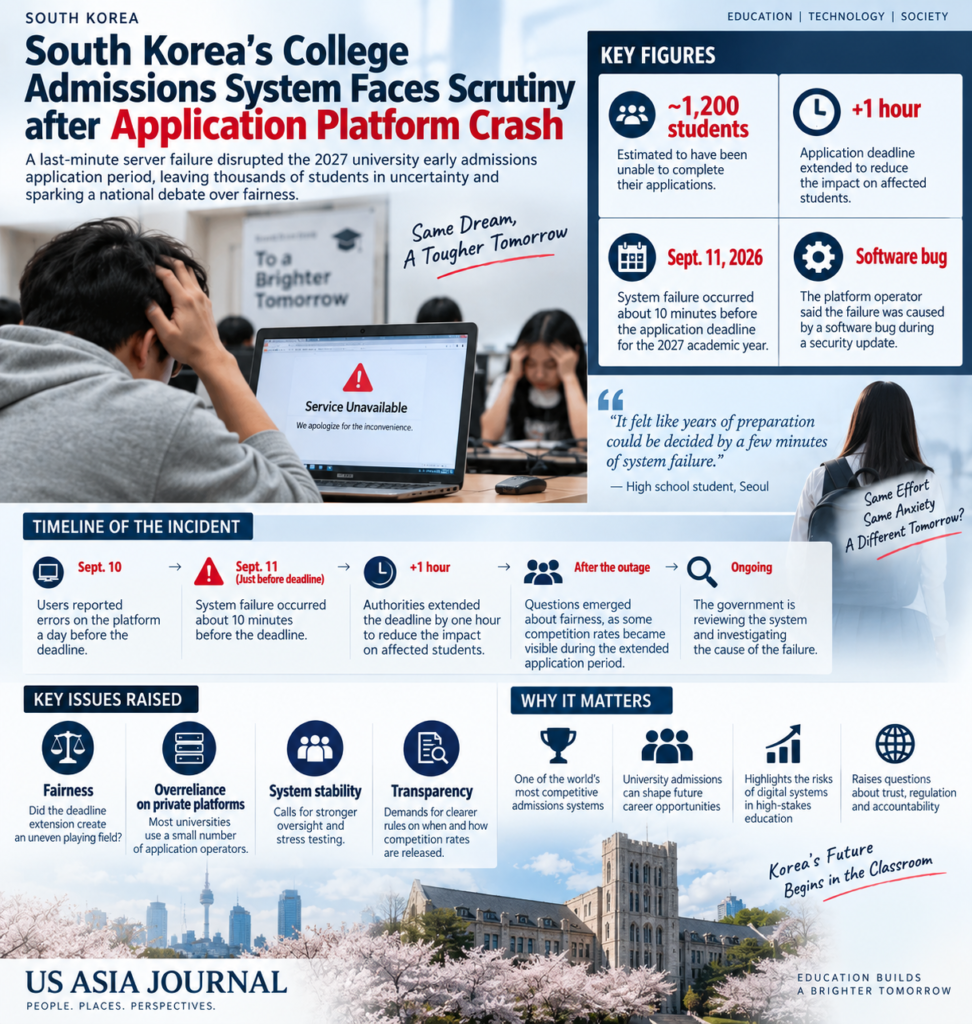
South Korea’s highly competitive college admissions system is facing renewed scrutiny after a major online application platform suffered a server failure just minutes before a key admissions deadline, leaving thousands of students uncertain about their applications and triggering a national debate over fairness.
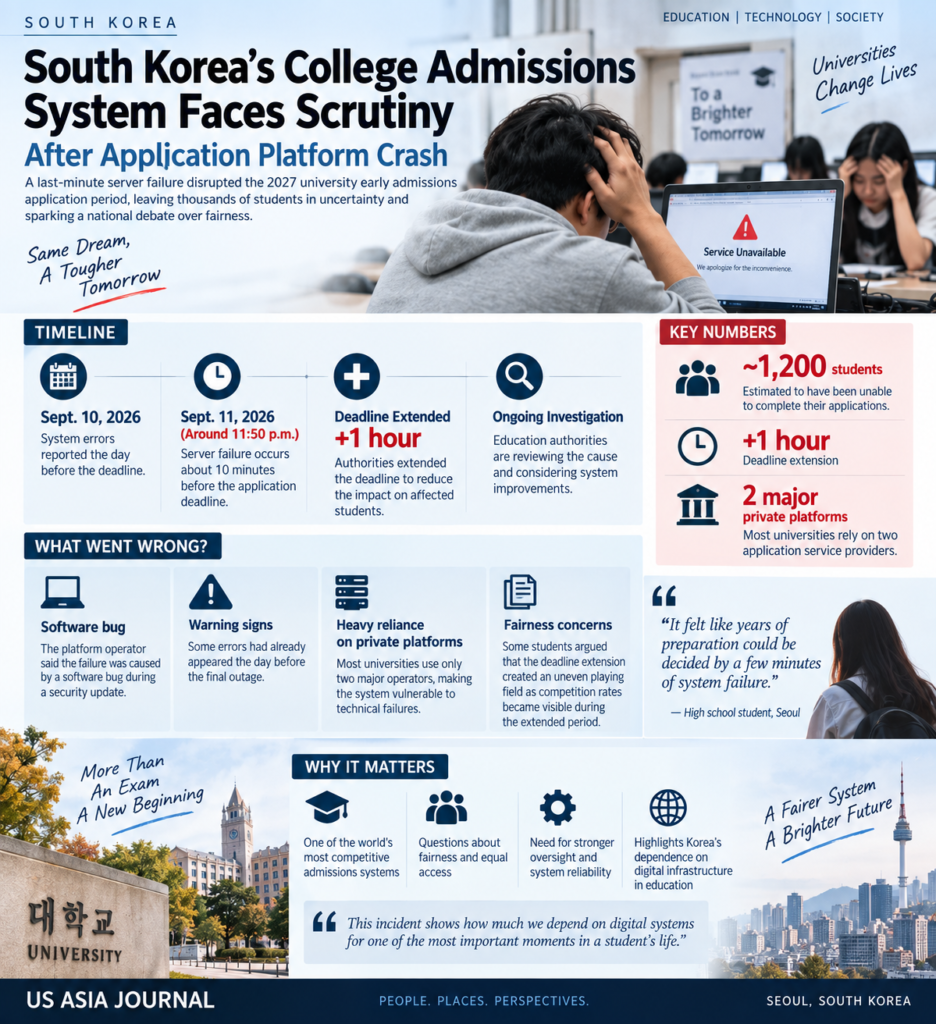
The disruption occurred on Sept. 11 during the early admissions application period for the 2027 academic year. One of the country’s two major admissions platforms experienced a system failure approximately 10 minutes before the deadline, preventing some applicants from submitting forms or completing payments. Authorities later extended the deadline by one hour in an effort to reduce the impact on affected students.
What might have appeared to be a temporary technical problem quickly developed into a broader controversy.
South Korea’s university admissions process is among the most competitive in the world, with students spending years preparing for a limited number of places at top universities. Because admission decisions can influence future educational and career opportunities, even small disruptions can become highly sensitive issues.
Following the outage, questions emerged about whether all applicants had been treated equally. Some students argued that the deadline extension created an uneven playing field because competition rates at certain universities became visible during the additional application period. Critics claimed that students submitting applications during the extended window may have had access to information unavailable to those who completed their applications before the original deadline.
The controversy has highlighted how heavily South Korea’s admissions system depends on a small number of private application platforms.
Most universities rely on two major operators to process applications. As a result, a technical problem affecting one platform can impact large numbers of applicants across multiple institutions at the same time.
Education authorities estimate that as many as 1,200 students may have been unable to complete their applications because of the disruption. The Ministry of Education and the Korean Council for University Education established a special relief process allowing affected applicants to seek review based on electronic records showing login attempts, application drafts, saved forms or payment attempts.
The government has also launched a broader review of the admissions system.
Officials announced plans to examine both major application service providers and evaluate whether current procedures are sufficient to prevent future disruptions. Authorities are also considering changes to how application competition rates are released during the admissions process, an issue that became central to the fairness debate following the outage.
The platform operator later apologized and said the failure was linked to a software bug that occurred during a security update. Company officials acknowledged that warning signs had appeared before the final outage and promised measures to prevent similar incidents in the future.
For many observers, however, the issue extends beyond a single technical failure.
The incident has exposed the risks of relying on digital systems for one of the most important moments in a student’s academic life. As university admissions become increasingly dependent on online platforms, concerns are growing about whether the infrastructure supporting those systems is receiving sufficient oversight and stress testing.
The debate also reflects a larger reality of South Korean society.
Education remains one of the country’s most important pathways to social mobility. Families often invest significant time and resources into preparing students for university admissions, making any disruption especially emotional and controversial.
For international observers, the incident offers a glimpse into the intensity of South Korea’s education culture. In a system where admissions outcomes can influence future opportunities, a server outage lasting only a few minutes was enough to spark nationwide discussion about fairness, transparency and accountability.
The Ministry of Education says it will continue investigating the cause of the disruption and reviewing possible reforms.
Whether the incident leads to significant structural changes remains unclear.
But the controversy has already raised an important question: in an era where admissions are increasingly managed online, how much trust should students be required to place in private digital platforms when their academic futures are at stake?
The server failure may have lasted less than an hour, but the debate it triggered is likely to continue long after this year’s admissions cycle ends.
SOPHIA KIM
US ASIA JOURNAL

