


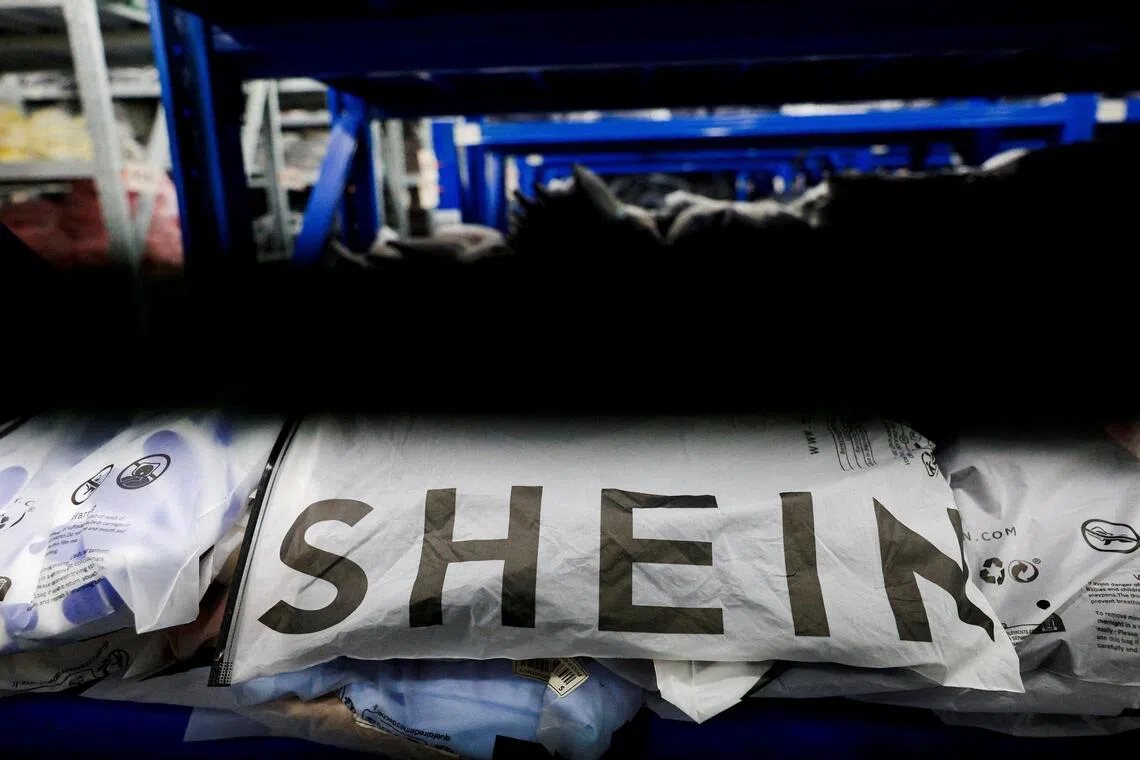
The US authorities are conducting a national security review of Shein Global Holdings’s purchase of American clothing retailer Everlane after Shein sought approval for the deal, sources familiar with the matter said, adding to a growing list of regulatory hurdles for the China-founded fast-fashion giant in one of its most important markets.
The review by the Committee on Foreign Investment in the US (Cfius), an interagency panel led by the Treasury Department, began after the US$80 million (S$102 million) transaction was completed in May, according to the sources, who asked not to be identified discussing private deliberations.
Shein voluntarily initiated the review at that time, which is unusual as companies typically seek Cfius approval before a transaction closes, the sources said.
Clearance by Cfius usually prevents future challenges but the body also has the power to block, unwind or impose conditions on transactions it determines threaten US national security.
A Shein spokesperson said the company is “committed to complying with all applicable laws and regulations in the markets where we operate”. The Treasury did not respond to a request for comment. Cfius reviews are confidential.
Shein maintains substantial operations in China even after it moved its headquarters from there to Singapore several years ago.
The company remains subject to Chinese regulators, whose blessing it needed to pursue its long-sought initial public offering – launched on Aug 24 – in Hong Kong. At the same time, the US remains among Shein’s top markets for sales.
The Cfius review is focused on potential national-security issues linked to Shein’s acquisition of a company that handles Americans’ personal data, and it’s unclear what the conclusion will be, according to one of the sources familiar with the situation.
Such data has become an increasingly sensitive national security issue worldwide, especially in the context of the US-China rivalry with both countries looking to limit the other’s access to citizens’ information.
After announcing the Everlane deal closed, Shein engaged a new lawyer from King & Spalding to handle the filing to Cfius, according to the sources.
That lawyer, Phil Ludvigson, is a former senior Treasury official who built the office that pursues deals that Cfius may want to review but which the parties have not proactively flagged to the committee. A spokesperson for King & Spalding referred questions about the Cfius review to Shein.
The company filed for the Cfius review after the deal had closed because Everlane’s financial circumstances required the parties to move quickly on the transaction, according to a person close to the deal, noting that the request wasn’t in response to any government intervention or inquiry. Ludvigson was engaged because of his extensive Cfius expertise and Shein’s longstanding relationship with his firm, the person said.
“In the case of Chinese acquirers, Cfius often closely scrutinises the acquisition of any large data sets, particularly those that include geolocational and financial information,” said Rick Sofield, co-chair of Debevoise & Plimpton’s national security practice.
National security concerns involving consumer company deals typically revolve around activities such as the collection of customer names and addresses, the use of tracking cookies to build customer profiles, and the implementation of military discount programmes that could identify service members, according to lawyers who represent companies in Cfius reviews. The details of the specific issues raised in the Shein probe were not immediately clear.
Shein’s IPO prospectus includes a section on US regulatory risks as a potential risk factor but doesn’t mention Cfius specifically.
Though the Everlane deal is tiny compared with the valuation of up to US$27 billion that Shein is seeking in its IPO, the acquisition has already drawn public criticism in the US. Media commentators, influencers and Everlane’s founder Michael Preysman, who left the company several years ago, have lamented the acquisition as a betrayal of company values rooted in sustainability and supply chain transparency.
Shein has faced a range of legal and regulatory hurdles in the US. Texas Attorney General Ken Paxton sued the company in February, alleging it unlawfully sold toxic products to consumers and exposed Americans’ personal data to China’s government. Shein said at the time it “strongly” disagreed with the allegations and is contesting the case.
The Federal Trade Commission is also investigating Shein’s US business operations for potential violations of consumer protection laws, Bloomberg has reported. Shein has said it’s cooperating with the probe.
Shein abandoned earlier plans to list in New York after facing criticism from lawmakers over its ties to China. Opponents included then-Senator Marco Rubio, who is now US President Donald Trump’s secretary of state and acting national security adviser.
In 2023, a bipartisan group of lawmakers questioned Shein in a letter about its alleged reliance on forced labour after laboratory testing conducted for Bloomberg found that garments shipped to the US by the company were made with cotton from China’s Xinjiang region. Shein at the time said it has “zero tolerance against forced labour”.
The US and other Western countries have accused Chinese officials of engaging in serious human rights abuses in Xinjiang, which Beijing denies. BLOOMBERG