


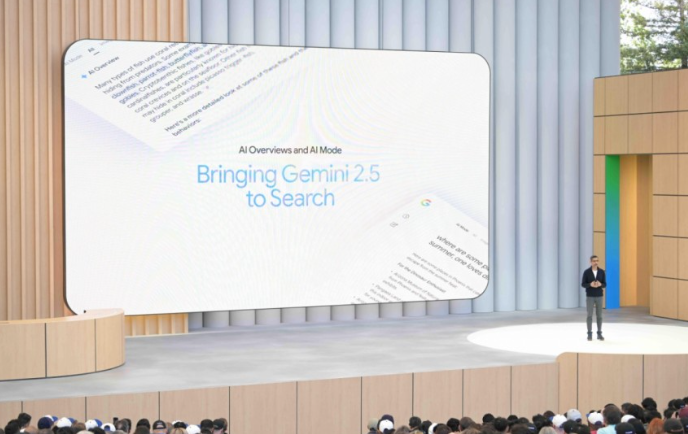
At the annual developer conference held in Mountain View, California on the 20th, Google announced that it will develop smart glasses with Samsung Electronics.

Smart glasses are attracting attention as the next generation of devices to succeed smartphones. Most of the functions of smartphones are performed in glasses without the need to carry a mobile phone in hand.
Google introduced smart glasses and demonstrated a prototype during the keynote speech. It also provided media with an opportunity to experience smart glasses.
The prototype device was thick horn-rimmed glasses in black. The rim looked thicker than regular glasses. A micro camera was mounted on the upper right frame.
The lens was equipped with an inconspicuous transparent screen measuring 1 cm in width and length. It seemed to function as a head-up display that displays speed and navigation information on the front window of the car.
The lens is attached to suit the user’s eyesight. A lens with no frequency has been attached to users who do not wear glasses.
Contrary to the expectation that wearing glasses would be heavy, the short fit was not bad. Until now, smart glasses have been considered a technical limitation as they are equipped with various devices, but prototypes are not heavy enough to feel heavy.
The glasses are equipped with Google’s AI model Gemini. When I touched the right frame once, a blue light appeared. It means that the Gemini works. When I touched it again, the light went out. The Gemini is not working.
Wearing smart glasses, the Gemini was restarted. Then, he picked up a thick bookshelf, turned it over randomly, and asked, “What is this page explaining about?” It was the page that explained winter in Helsinki, Finland. A second or two later, the Gemini said in a voiceover, “It is explaining Helsinki in Finland.” The voiceover was also made with subtitles for a speech bubble in the right field of view.
When asked, “What is Helsinki?” the answer came back, and when asked to explain the picture on the page, a voice answer came out with the caption, “People are enjoying skating on a snowy day in winter.”
It is equipped with a function that allows you to interact with your voice naturally like talking with a person called “Gemini Live.”
This time, a card was randomly selected from among several tarot cards. The card meaning “The High Priestess” was chosen.
When asked, “What does this card mean?” Gemini replied, “It symbolizes intuition, subconscious, mystery, and inner wisdom,” and “It contains a message to pay attention to the truth or something you feel intuitively.”
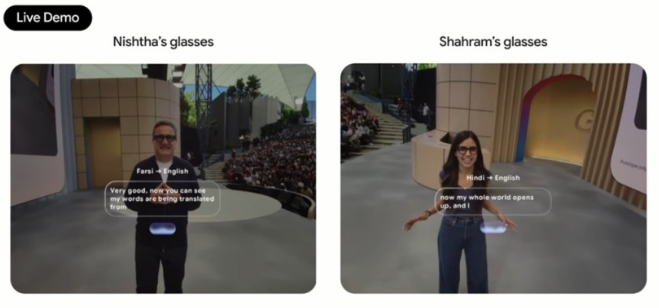
Smart glasses have many other functions. They can talk to friends without taking out a phone from your pocket, and are equipped with real-time translation function to enable conversation without fear of foreigners.
As you walk on the street, you can ask the Gemini about your surroundings, and this AI understands your surroundings through the camera and remembers excessive objects during recording and informs users.
However, the experience was only given a short time of three minutes, so people could not experience other things such as real-time translation. Google did not reveal specifications such as the weight of its smart glasses or cameras.
Google will support developers to develop apps for smart glasses based on this hardware platform in the second half of the year.
EJ SONG
US ASIA JOURNAL

