


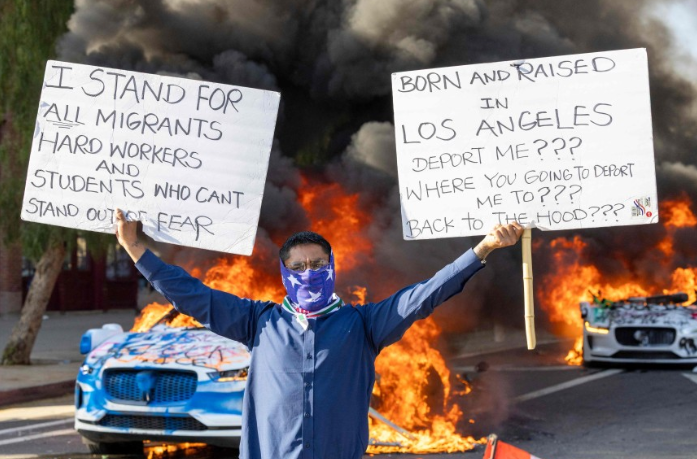
Protesters protesting the Immigration and Customs Enforcement (ICE) raid in downtown Los Angeles (LA), and the National Guard, who blocked them, were entangled and plunged into huge chaos.
Concerns are growing that a sharp drop in migrants due to hard-line suppression could result in a “labor supply shock” that shakes the foundation of the U.S. economy.
Fortune, an economic media outlet, quoted the Deutsche Bank report as saying, “The issue of cracking down on immigrants will have a more lasting negative impact on the U.S. economy than the issue of tariffs.”
“Everyone is paying attention to the impact of tariffs, but the real problem with the U.S. economy is reduced immigration,” said George Sarabelos, head of Deutsche Bank’s foreign exchange research, in a report. “The number of immigrants to the U.S. has decreased by more than 90% this year from last year, which will have the effect of slowing labor growth by more than 2 million people.”
Sarabellos stressed that “the decline in immigration is expected to have a much more lasting negative impact on the U.S. economy than the tariff issue.” In May this year, which was released on the 6th, the number of foreign-born workers fell by the largest monthly rate in five years since 2020. According to this tally, there are currently 32.3 million foreign-born workers in the United States. It is 19.2% of the U.S. labor force.
According to a study by the Hamilton Project, they have increased sharply since 2022, when Biden was in power. In 2022, the number of foreign-born workers in the United States increased by 70,000 per month. In 2023 and 2024, an acceleration put as many as 100,000 foreign-born workers into the U.S. economy per month.
Last year, the U.S. Congressional Budget Office (CBO) predicted that by 2033, the number of foreign-born workers in the U.S. will increase by 5.2 million compared to 2023. They estimated that the U.S. gross domestic product (GDP) they generate over 10 years is $8.9 trillion and the federal tax revenue is $1.2 trillion.
“Over the past two years, the influx of immigrants has served as a strong catalyst for stabilizing the overheated U.S. labor market and easing pressure on wage growth,” the Kansas City Fed said in its economic report. “Without immigrants, the soft landing of the U.S. economy, which was called a boom alone, would not have been possible.” However, existing U.S. workers lost their jobs or saw their wages fall as low-skilled immigrants flooded in.
As inflation and housing shortages intensified after the pandemic in 2020, there was a widespread perception that immigrants “who came in to roll” lowered the wages of existing workers who were “locked in” and increased social costs.
In particular, there was strong opposition in the Rust Belt region, where Trump’s supporters were strong. Areas in the decline of manufacturing, such as Ohio, Indiana, Michigan, and Pennsylvania, have seen their population decline by 45% since 1970. White workers in the economically collapsed region blamed immigrants for the Trump administration’s anti-immigration policies.
The trigger of the protest was ICE’s massive crackdown in fashion districts and Home Depot stores. With supporters on their backs, the Trump administration conducted crackdowns in downtown L.A. without asking the California governor for opinions.
On the 8th, Trump issued a hard-line policy to send 2,000 National Guard troops to the protest, calling it a “restoration of law and order.”
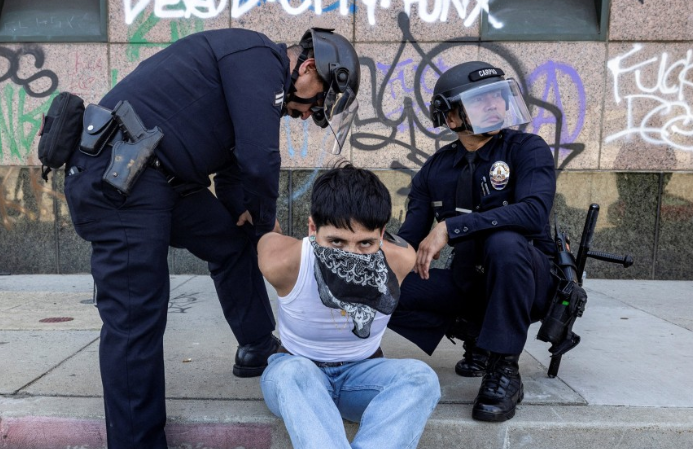
According to ICE, a total of 118 people were arrested for three days in Los Angeles. Protesters gathered in front of City Hall, where the arrests were held, and shouted, “All of them free.” Police and National Guard troops fired tear gas and flash bullets at them to put out a crackdown.
California Governor Gavin Newsom criticized the federal government, saying, “The federal government is trying to escalate the situation by encouraging confusion.”
This incident is a symbolic event that shows that the United States is in a dilemma between economic growth and immigration control. It reveals how vulnerable the United States is to discrimination and prejudice as a multiethnic multiethnic society symbolized by the American Dream.
Experts warned that the anti-immigration policy strengthened by the Trump administration could have the effect of rallying supporters in the short term, but in the long run, it is likely to be a “self-inflicted water” that eats away at economic growth potential.
In particular, executives in industries with a large proportion of Hispanic workers, such as agriculture, construction, manufacturing and service industries, expressed considerable concern.
According to an analysis by the U.S. Agricultural Commission, 25.3% of U.S. agricultural workers are immigrants. More than half of the agricultural product selection and packaging jobs are immigrants. Farms in the U.S. are already short of 1.5 million to 2 million workers every year.
The construction industry is also short of 500,000 jobs next year alone. “More than 40 percent of construction workers in California and Texas are immigrants, so a massive crackdown will inevitably hurt the overall economy,” the LA Times said.
Researchers at George Mason University analyzed that the shortage of immigrants leads to a shortage of labor supply, causing wage increases and inflation. Wall Street financial experts predict that the employment growth baseline will be lowered by half from 170,000 to 90,000 per month.
70% of executives at major U.S. corporations also predicted in a survey by Littler’s employment law firm that “the strengthening of the ICE crackdown will have a significant impact on workplaces within the next 12 months.”
JENNIFER KIM
US ASIA JOURNAL

