


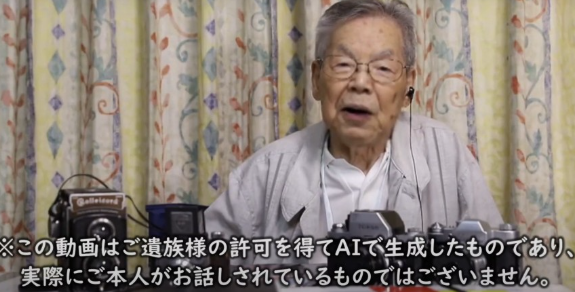
In December 2024, a special funeral was held in Shizuoka Prefecture, Japan. Shigeo Murakawa, who died at 98, appeared on a TV screen installed at the ceremony and said, “I’m very grateful to all of you who gathered for me today. I just want to say thank you for thinking of me like this and sending me a smile and tears. This is my last message.”
Was it a video letter that Murakawa filmed himself during his lifetime? No, it was not. It was an artificial intelligence (AI) video that was made after Murakawa’s death. It was so natural and smooth that it was hard to think that it was not real. The deceased blinked his eyes and moved his body, and at the end of his speech, he gently raised the corner of his mouth. “The longing has greatly eased.” In Japan, AI-generated video services are spreading as if the deceased were filmed during his lifetime. It is the so-called “AI deceased.”
Alpha Club Musashino, an official marriage product company, launched a related service in December last year. Based on photos and videos taken during the lifetime, AI reproduces the lively face, voice and speech of the deceased, creating sophisticated images that cannot be distinguished from the real ones in the shortest three days. Production cost starts at 98,000 yen. Dozens of requests have been received as of last month.
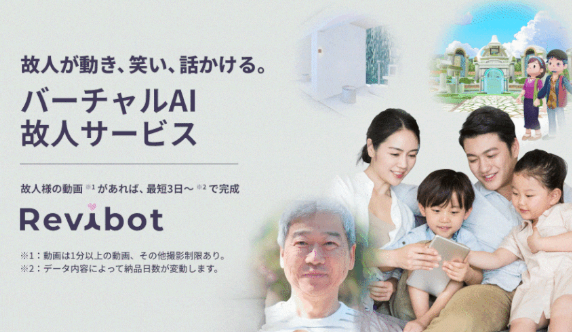
It is said that the AI deceased usually appear in funerals, and in some cases, the late founder is requested to appear like an event at the OO anniversary event of the foundation of a large company.
A Japanese man who met his recently deceased father as AI deceased told the Yomiuri Shimbun on the 1st, “I wanted my late father to greet me in his own voice. It was also fun to think about what (my father) would say.”
You can also talk to the deceased. It is said that if you write a diary or post on social media that you wrote while you were alive, you can recreate the personality of the deceased. Unlike video letters, you can communicate with each other.
New Jia, a Japanese AI company, recently launched the so-called interactive AI Goin service. “I heard an employee muttering, ‘I miss my deceased mother,’ which triggered the development,” said Yukihiro Kashiwaguchi. Just as photography technology and portraits were created, now is the time for a new way of mourning to emerge as AI technology has been developed.” In some cases, they are trying to “rejuvenate” deceased celebrities with AI. In 2019, legendary singer Misora Hibari (1937-1989) was on the stage of NHK’s year-end music program “Red and White Singers.” It was through the AI Goin.
Akiko Orita, a professor of information and sociology at Kantogakuin University in Japan, recently asked more than 1,000 people if they would like to see Shikibu Murasaki (written by Kenji Monogatari) and Ieyasu Tokugawa (first shogunate from the Edo shogunate), and 30 percent of the respondents said yes. “In previous surveys, very few people had positive opinions on AI, but with the proliferation of AI technology, intimacy grew,” Orita told the Mainichi Shimbun. “The dead do not speak. That may be why it is a naive comment to raise the issue of ethics over the AI deceased. However, the pros and cons are more divided than expected. Yomiuri Television reported that there are growing antipathy against the AI deceased, saying, “(The deceased) is enough to be in our hearts,” and “It is an insult that does not take into account the dignity of the dead.” According to a recent local perception survey, 77 percent of the respondents said they were against reviving the deceased with AI or CG. The reason was that “the intention of the deceased could not be confirmed.”
Some criticize that they use other people’s sadness as a means of making money. “We do not use sadness, but rely on sadness,” New Zealand said. “Our mission is to heal the hearts of the bereaved families and help them take new steps.”
Professor Keisuke Sato of Japan’s Jochi University, who studies lion ethics, said, “There are concerns that if the bereaved family (the deeper the sadness), the sadness of ‘I want to meet’ may become stronger if the quality of the representation is low,” but added, “However, it is true that being able to connect with the deceased means a lot to the bereaved family.”
The death toll continues to rise. Japan’s death toll is expected to peak at 1.65 million in 2040. “The challenge of how to protect the dignity of the deceased will remain,” Mainichi said. The Toyogeizai Shimbun said, “The awe given by the AI deceased may be more like an act of digging into the taboo of human dignity beyond the ‘unpleasant valley’.”
JULIE KIM
US ASIA JOURNAL

