


Voters took to polling stations on Wednesday in the largest-ever parliamentary by-elections, critical for political parties to gain the upper hand for the rest of the 19th National Assembly.
The by-elections, which will see 15 new National Assembly members, are also seen as a mid-term referendum on the Park Geun-hye administration that hit a long string of obstacles from early on.
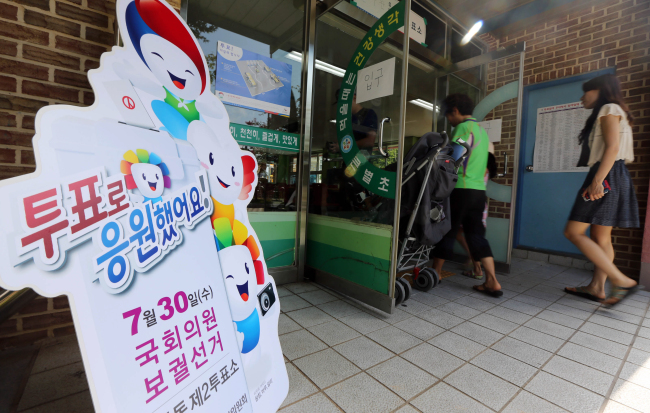 |
| (Yonhap) |
The government has been blamed for mishandling the April 16 sinking of the ferry Sewol, which resulted in the deaths of more than 300 people.
The discovery of the body of the ferry’s owner Yoo Byung-eun has also added to the public’s distrust of the government.
On July 25, the police announced that a body found on June 12 was that of Yoo, and admitted to shortcomings in its actions regarding the body. Yoo had been “on the run” since early May and the government had operated a massive manhunt for more than two months.
President Park Geun-hye’s approval ratings have also suffered significantly brought down by the string of unsuccessful nominations for high level government posts.
Due to the large number of seats being contested, and due to the implications the results will have for the two main political parties and the government, Wednesday’s by-elections have been dubbed the “miniature general elections.”
With much riding on the results, the ruling Saenuri Party tried to garner support by putting economic issues at the top of its agenda.
Throughout the 13-day campaign period ending Tuesday, Saenuri Party chairman Rep. Kim Moo-sung and others have emphasized the economy, arguing that the government’s plans can only be successful if their party gains a “stable majority” in the assembly. The ruling party currently holds 147 of the 300 seats, while the main opposition New Politics Alliance for Democracy lays claim to 126.
“Political stability is essential for solving livelihood-related problems of the people. For this securing majority in the assembly is crucial,” Kim said Wednesday.
With the Saenuri Party already holding 49 percent of the seats in the National Assembly, the ruling party only needs to win in four voting districts to clinch a majority.
However, despite the Saenuri leadership’s claims, a parliamentary majority may largely be symbolic.
According to the amendments, a political party must occupy at least 60 percent or 180 of the parliamentary seats in order to pass contentious bills.
As such, the Saenuri Party can push its share at most to 162, which is well short of the 180-seat cutline that would give the conservatives the ability to push through bills resisted by the opposition parties.
The NPAD, for its part, promoted the elections as an opportunity for the public to pass “judgment” on the government for its mishandling of the April 16 Sewol ferry disaster.
“Today’s by-elections are for making the government answer for its incompetence seen in the Sewol tragedy, disastrous personnel management and the investigation into Yoo Byung-eun,” NPAD co-chairman Rep. Ahn Cheol-soo said Wedensday.
“Whether our society collapses again or moves forward through self-reflection and (taking) responsibility hangs on each and every vote.”
Similar sentiments were echoed by NPAD co-chairman Rep. Kim Han-gil who asked the voters to “raise the cane on those in power.”
In an attempt to encroach on Saenuri Party territory, and the ruling party on NPAD territory, both sides called on heavyweights.
The largest-ever by-elections also saw mudslinging and vehement attacks between the rival parties, as well as the employment of tried and tested strategies such as inter-party alliances, accusations of illegal campaigning and even criminal complaints.
The NPAD formed de facto alliance with the minor opposition Justice Party in key districts, prompting vehement accusations of collusion from the ruling party.
By Choi He-suk and Jeong Hunny
(cheesuk@heraldcorp.com) (hj257@ heraldcorp.com)

