


SINGAPORE – For the third year running, fraud and scam victims made up the largest group of consumers turning to the Financial Industry Disputes Resolution Centre (FIDReC) for help with disputes involving financial institutions, with claims averaging $24,531.
The centre received a record 5,344 claims against 103 financial organisations – including banks, insurers, investment firms and payment providers – in its financial year 2025/26 ended June 30. That is up 23% from 4,355 the previous year, it said in its annual report released on Nov 26.
Of these, 3,356 proceeded to dispute resolution proceedings, while 891 were resolved early by encouraging direct conversations between consumers and financial institutions.
The median claim amount rose to $5,655, up 16% from $4,859 the previous year, while the average claim amount rose 2% to $47,572.
FIDReC is an independent, non-profit centre that helps consumers resolve disputes with financial organisations through mediation and adjudication when they cannot settle the issues directly.
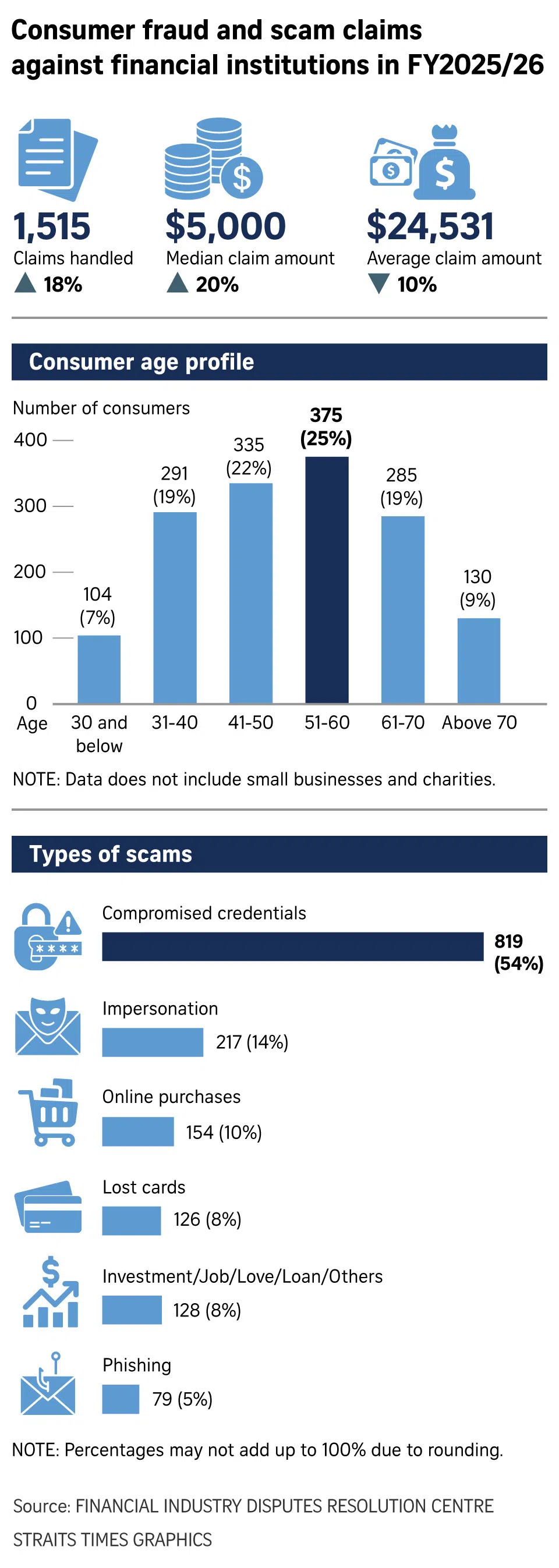
Fraud and scam claims made up 45% of the cases that proceeded to dispute resolution. FIDReC handled 1,515 such claims in FY2025/26 – an 18% rise from the 1,285 recorded in the previous year.
The centre also completed 1,523 fraud and scam-related claims during the year, up 64% from the year before. Of these, 63% of the consumers accepted settlement offers at mediation, while 27% chose not to continue after mediation.
Of the fresh fraud and scam claims in FY2025/26, 1,460 were against banks and finance companies, and 53 against payment service providers such as stored-value e-wallet providers.
The remaining two claims involved capital markets service licensees, which include brokerages and fund managers.
FIDReC said 54% of the fraud and scam claims handled involved compromised user credentials.
In these instances, consumers discovered unauthorised transactions on their bank accounts, debit or credit cards or digital wallets, but could not identify how these transactions occurred.
Impersonation (14%) and online purchase (10%) scams rounded out the top three scam types.
Larger losses to scams, more older victims
Across all fraud and scam cases, the median claim amount jumped from $4,175 to $5,000, an increase of 20% from FY2024/25. The average claim amount, however, fell 10% to $24,531.
This divergence between the average and median claim amounts suggests that while the typical consumer sought redress for larger losses than in the previous year, fewer outsized claims skewed the overall average upwards.
Looking closer at the profile of the claimants, consumers aged 51 and above were the most affected, accounting for 53% of all scam-related claims, while cases involving claimants above 70 more than doubled from 59 to 130 cases.
In one case, a 74-year-old woman transferred about $1.2 million over two weeks to a purported safe-keeping account after scammers posing as bank and government officials told her that she was being probed for money laundering.
She was told not to tell anyone about the confidential investigation, so when the bank queried the unusually large transfers, she repeated the scammers’ cover story, that she was buying another property.
The lady realised it was a scam only after the callers became uncontactable, and turned to FIDReC when the bank could not recover the funds.
At mediation, the bank maintained that she had authorised the transfers but offered a 10% goodwill settlement without admitting liability, which she accepted.
FIDRec highlighted the case to show how the circumstances of a scam can affect consumers’ claims for redress.
Eunice Chua, the centre’s chief executive, said that scammers are becoming more sophisticated, making it harder for consumers to realise they have been scammed.
She added that rising scam-related disputes underscore the importance of prevention and access to a fair way to resolve them.
Chua suggested that consumers take proactive steps to protect themselves, such as using Money Lock, setting lower card limits and lowering thresholds for notification alerts.
She also urged them to remain vigilant and act immediately to prevent further losses if they suspect they are victims of a scam.
Claims up across the board
FIDReC said consumer claims rose across all categories in FY2025/2026.
The second-largest number of claims after fraud and scams related to the practices and policies of financial institutions, at 889, representing 26% of FIDReC’s caseload.
These claims generally centre on contractual disputes, including disagreements over insurance policy terms such as exclusions, surrender values and payout conditions.
In one case, a consumer lost $5,000 after entering her card details and a one-time password on a phishing website while trying to make a purchase through TikTok.
When she was unable to recover the money through her bank, she tried to make a claim under her scam cover insurance policy but was rejected by her insurer.
Her claim with FIDReC was dismissed at adjudication, as phishing websites were not covered by the policy, which covered only scams through specified channels, such as phone calls, e-mails or WhatsApp.
FIDReC advised that consumers consider the risks they want protection against and ask the insurer whether those scenarios are included before buying insurance.
“A cyber insurance policy may not cover every type of scam. Read your policy carefully to understand what type of risks are covered.”
It further emphasised: “Insurance is not a substitute for staying alert to scams.”
FIDReC also handled 432 market conduct claims in FY2025/26. Such disputes typically involve giving inappropriate financial advice, making false and misleading statements about financial products, or inadequately disclosing information needed for customers to make decisions.
In one case, a woman in her early 40s invested most of her $200,000 savings in a fund that her financial adviser assured her over message was “principal guaranteed”.
When the fund failed and she could not recover her money, she filed a claim at FIDReC.
After mediation failed, the case proceeded to adjudication, which involves an independent, qualified professional appointed to hear the dispute and make a decision.
The financial institution argued that the policy documents the woman signed did not state that the principal was guaranteed.
The adjudicator, however, ruled in the woman’s favour – up to the $150,000 adjudication limit – finding that the company, through the financial adviser, had misrepresented the terms of the fund.
FIDReC said that the case underscores why consumers should scrutinise investment terms and risks, and they should also keep records – messages, e-mails and other communications – of what their financial adviser tells them.
Helping small businesses and charities
In FY2026, FIDReC extended its dispute resolution services to small businesses registered here with annual turnover of $1 million or under in each of the two preceding financial years, and registered charities with gross annual receipts below $10 million over the same period.
The take-up rate among small businesses was modest, with 17 claims handled.
Of these, seven related to fraud and scams, six involved the practices and policies of financial institutions and four were over service standards, such as delays or errors in processing transactions or account updates.
FIDReC said it will continue to raise awareness so small businesses and charities have an accessible way to resolve financial disputes.