

SINGAPORE – Kelvin Hong spent seven years in the civil service before giving up the security of public service to pursue his entrepreneurial dream – establishing a vocational school and a chain of spa and wellness outlets.
As a civil servant, he worked on economic policy, including writing the first policy paper setting out the Government’s approach to fighting SARS, or severe acute respiratory syndrome.
Having previously enjoyed the security of an “iron rice bowl” career, he now had to make difficult financial decisions to fund his business.
He sold his condominium unit and moved his family of five to a rental property, and later downsized to an HDB resale flat, all while dealing with the uncertainty of running a business and providing for his family.
He sold his chain of wellness outlets in 2010.
“Education has always been a passion of mine. I’ve been tutoring since my university days and have accumulated about 28 years of experience teaching economics,” said Hong, 52, who founded The Economics Tutor in 1998 while running other businesses.
Throughout his entrepreneurial journey, he continued to tutor in economics, a passion he had developed at university.
After selling his other businesses, he decided to focus fully on tuition.
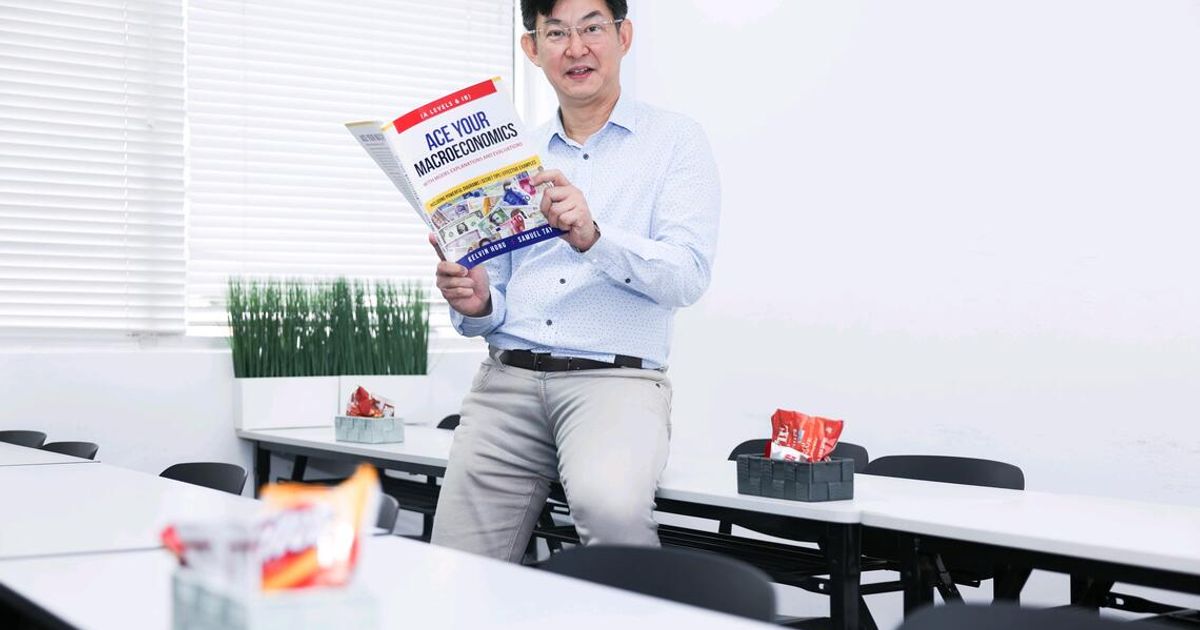
Today, Hong is the founder and principal tutor of The Economics Tutor and Ace GP Tuition, where he helps pre-university students build a strong foundation in economics and General Paper.
He graduated from the National University of Singapore with a Bachelor of Social Sciences, with first-class honours in economics.
His wife, 50, is also his partner in the tuition business, and they have three children aged 22, 20 and 11.
Do you invest in anything? If yes, what do you invest in and why?
The Economics Tutor and Ace GP Tuition are my current ventures. I have run and sold off other businesses over the last two decades.
I prefer investing in my businesses because making money on its own has never given me much joy. What I enjoy is creating something and developing it until it succeeds, because by then, it adds real value to society. I am also considering other business ventures in the tech and education space.
I don’t own any individual stocks at the moment. My savings sit in safe assets. They won’t make anyone rich, but they’re secure. I’ve been tempted to buy a few individual stocks over the past year, but prices have looked too high to me, so I’m keeping dry powder and waiting for a correction rather than chasing the market. Knowing when not to invest is part of investing too.
My children’s education isn’t a financial asset in the usual sense, but it’s the investment I’m most certain of. Besides carefully choosing tuition that deepens their understanding and mastery beyond exams, I invest heavily in building their competencies: carpentry, baking, art and craft, music, robotics, various sports and communication skills, as well as their own little start-ups.
What’s your biggest or most valuable asset right now?
On paper, probably my home. But the asset that actually pays the bills is my tuition business. Unlike most assets, it doesn’t depreciate as long as I keep using it.
What’s your approach when it comes to growing your money?
Spend less than you earn, don’t borrow what you can’t comfortably repay, don’t buy what you don’t understand, work really hard, and be patient.
None of it is original, but after working on economic policy and then running businesses through good years and bad, I’ve found that most financial disasters come from impatience: wanting the return without putting in the time or effort.
A lot of what passes for investment advice online today is really marketing. If someone is promising high returns with no risk, the question I’d ask is – who is actually making money from the arrangement?
Do you invest in any tangible assets?
No. As an economist, I find it hard to love an asset that pays no income and whose value depends entirely on another person fancying it. The closest I came to tangible assets was a small property portfolio, which I have since sold.
What was your first exposure to investing, and what was your first investment?
My first real investment, in the sense of putting serious money at risk, was buying some stocks on the Singapore Exchange and some unit trusts. I don’t think they fared well. I was a greenhorn who had just started earning serious money and was happily experimenting. In hindsight, there are cheaper ways to learn.
What has been your biggest financial mistake?
In a previous business, an overseas outlet ended in a six-figure loss. Looking back, I had made the classic mistake of planning around the demand I hoped for rather than the demand I could actually see. I now use that outlet as a case study when I teach company strategies. Students remember a real six-figure mistake far better than a textbook example.
What has been your best financial decision?
My best financial decision was to sell off, in 2010, my chain of wellness outlets. It was a multimillion-dollar business, but my greatest returns came in the form of a sabbatical to reset my spiritual condition, including my lifestyle and life goals.
I traded in my business world back then for my soul, and it has been my best investment to date. During those sabbatical years, I was still providing tuition, albeit on a very small scale, and I have built it up since then into my current ventures.
Money-wise, what were your growing-up years like?
My mum was a homemaker and my dad was a senior executive in a multinational corporation. It was a comfortable childhood, and maybe that is why I was rather spendthrift as a young adult.
I did start working early, selling Newsweek subscriptions and tutoring during my varsity days, so I was earning my own money from about 18. That taught me what an hour of my time was worth, and that the most reliable way to earn more was to become better at something people needed.
What was your first job?
Selling Newsweek subscriptions in schools during the holidays was my first lesson in selling – a few minutes in front of strangers to make my case and far more noes than yeses.
I learnt that selling is mostly about informing people in a persuasive way, which turns out not to be so different from teaching. I don’t remember exactly what it paid, but it was decent money for someone my age.
As a child, what did you save up for?
I don’t recall actually saving up for anything. I was more of a spender as a child. I learnt to save only as I became wiser and more mature.
My students sometimes assume I live a lavish, branded lifestyle, and I tell them it’s quite the opposite: When I need to shop, I mostly do it online or in Johor Bahru.
When did you first realise money is important?
Honestly, not until I was near 30, when two big responsibilities arrived almost at once. I had left the civil service to start my business, and suddenly, I had staff whose salaries had to be paid every month. Around the same time, my wife and I started our family.
Before that, money was something I earned and spent on myself. After that, other people’s livelihoods were in my hands, and so was my own young family’s. Money stopped being about what I could buy, and became about the people I was responsible for.
Where is home for you?
I live in a semi-detached house in the east.
What car do you drive?
I don’t own a car and I don’t drive. I take public transport, which, in Singapore, is excellent.
What would your perfect day look like?
A swim or pickleball game followed by brunch with my wife and, ideally, at least one of my children. Then class prep and lessons from early afternoon all the way till 10pm, ending with a late dinner while my children have some desserts.
What would you do if you suddenly had a windfall of $1 million?
Very little would change as it won’t be enough to buy me a school. But I’d set aside more for my children’s university costs, keep the rest in safe assets like T-bills, and wait patiently for the right opportunity.
If you suddenly had only $100 to your name, what would you do?
I’d boost my social media accounts to market my businesses. If I lost everything else, I’d still have the ability to teach, and that has never needed much capital to get going.
I would also write a book titled Riches To Rags to share valuable lessons and hopefully turn it into a bestseller and a popular podcast.