


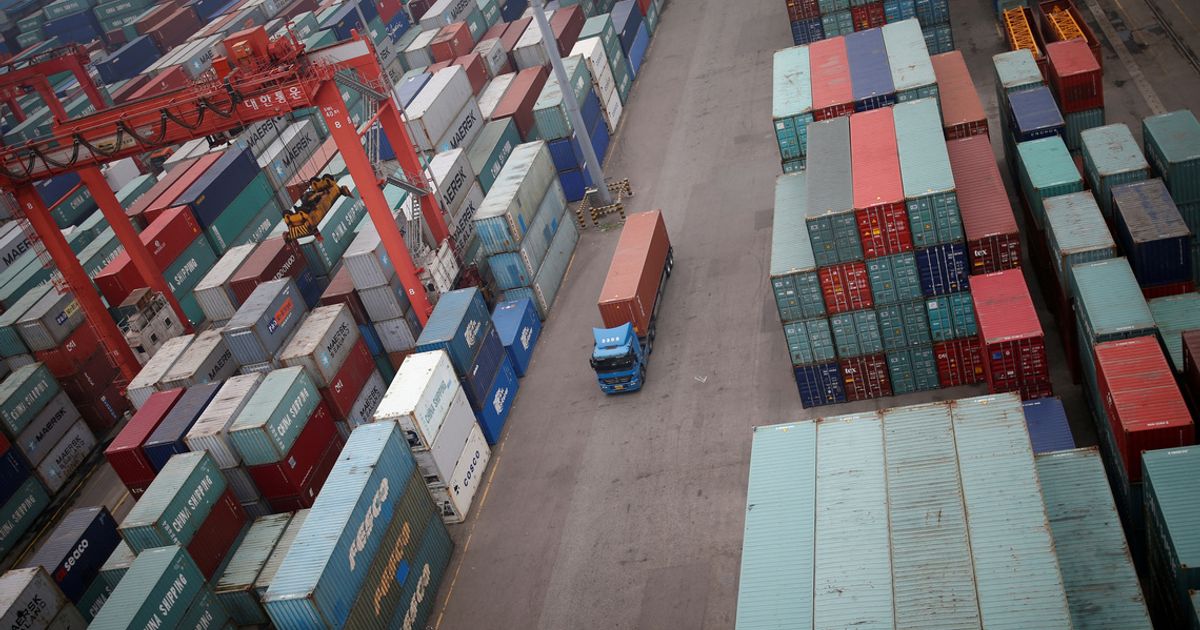
SEOUL – South Korea’s annual exports surpassed US$1 trillion (S$1.29 trillion) for the first time, making it the fourth country to reach the milestone after Germany, the US and China, and the first new entrant to the club in 19 years, as global spending on artificial intelligence sent semiconductor prices and shipments soaring.
Cumulative exports crossed the mark at 2.09pm on Nov 19 (1.09pm Singapore time), a year after first topping US$700 billion and 62 years after reaching US$100 million.
President Lee Jae Myung hailed the achievement as the culmination of generations of effort, paying tribute to workers who spent their youth in garment factories, shoe plants and shipyards.
“The gains from exports must, above all, improve people’s lives,” Lee said in a message on X, pledging to ensure that growth benefits large and small companies and communities across the country.
“We must now turn this achievement into sustained growth. We will strengthen the competitiveness of our key industries and nurture future growth engines such as AI and biotechnology.
“We will also actively support Korean consumer products, including beauty products and food, as they expand into global markets.”
Germany and the US crossed the US$1 trillion mark in 2006, followed by China in 2007, riding a trade boom after China joined the World Trade Organization.
South Korea did so amid rising tariffs and the US-China rivalry, with a population of 51.6 million and an economy of just US$1.88 trillion, smaller than any of its predecessors at the time.
The Ministry of Trade, Industry and Resources projects full-year exports of US$1.17 trillion, up about 65% from a record US$709.3 billion in 2025.
“Given our smaller population and economy, this is a remarkable achievement,” Kang Kam-chan, the ministry’s deputy minister for trade and investment, told reporters.
Chips lead, but not alone
Exports totalled US$930.2 billion in the first 10 months, including US$396.8 billion in semiconductors, accounting for about 43% of the total and nearly triple the previous record for the period.
AI data centre demand drove up DRAM and NAND prices, while the build-out lifted shipments of solid-state drives, transformers, cables and copper, according to the ministry.
Exports excluding chips rose 20%, with 16 of 20 major categories gaining. Cosmetics exports reached US$12.4 billion, topping the 2025 full-year record in 10 months. Shipments rose in seven of nine major markets, led by China, up 88%, and the US, up 77%. Small and midsize companies also posted record exports.
Imports rose 21% to US$635.1 billion, leaving a surplus of about US$295 billion through October, against US$77.4 billion for all of 2025.
“Part of the US$1 trillion belongs to imports,” Kang said, citing steady supplies of crude oil, naphtha and chipmaking equipment.
Bigger numbers, thinner spread
Much of the record reflects higher prices, not higher output. Kang said rising prices drove much of the growth, as AI demand sent memory chip prices soaring and petroleum product export prices jumped 62% to US$1,105 a ton.
Kang acknowledged the gains have gone mostly to large companies, citing structural limits in chips and petrochemicals, which have short supply chains and employ relatively few workers, unlike automobiles or ships.
“It is regrettable that the profits have not flowed through to suppliers,” he said, adding that new chip plants and joint research with equipment-makers could spread the benefits.
Normally, a large trade surplus lifts the won, because exporters convert their dollar earnings into local currency. But many keep those dollars abroad or spend them on imported parts and overseas factories, meaning less of the surplus reaches the currency market.
Kang said exports could exceed US$1 trillion again in 2027, though easing chip and oil prices could pull them below the 2026 level.
He expects AI infrastructure demand to hold through the third quarter of 2027. Delays in US data centre projects, Chinese competition and protectionism remain risks.
From selling goods to investing abroad
Kang said Korea’s major industries appear to be undergoing a structural shift. When exports first passed US$10 billion in 1977, they were led by ships, frozen fish, plywood and clothing. The AI build-out now creates markets for Korean power equipment, copper and aluminium alongside chips.
That shift, he said, calls for rethinking how Korea manages its surpluses. Japan, Germany and China channelled theirs into overseas investment that now returns income home.
“As an economy matures and costs rise, it cannot keep expanding production at home indefinitely,” Kang said. “The export structure has to gradually shift toward investment.”
He sees overseas investment as a way to build strategic ties, particularly with partners sensitive to trade deficits, such as the US, where the administration of Donald Trump has made shrinking them a priority.
Korean factories abroad can create local jobs, buy from local suppliers and export to third markets, giving partners a stake in the relationship.
“Korea should not be a country that simply sells goods,” he said.
Asked whether Korea would follow Japan, which came to rely on income from overseas investment after the 1985 Plaza Accord, Kang said Korea is likely to take a similar path.
But he noted that Japanese companies prospered while ordinary Japanese saw fewer gains.
Korea should instead keep research and “mother factories”, the advanced plants that develop new processes, at home while expanding overseas, he said. THE KOREA HERALD/ASIA NEWS NETWORK

