


SINGAPORE – The scandal surrounding former Nvidia CEO Jensen Huang now risks escalating into the start of a war between the world’s two largest economies for a strategic resource: computing power.
The United States’ move to curb both indirect AI chip shipments to China and its access to overseas data centres – ahead of a summit between the presidents of the two nations – could be the first shot in the much-dreaded fragmentation of the global tech ecosystem.
Analysts said if mounting US-China friction on tech dominance raises the cost of or limits access to AI models and computational capacity, it can slow down worldwide AI adoption needed for extracting broader economic value from the technology.
The new measures, which come into effect 90 days after it is gazetted in the Federal Register, expand US chip export controls to cover Indonesia, Malaysia, Singapore, Thailand and Brazil, to close routes through which smuggled chips have been reaching China. Licences are now required to export advanced chips to any non-US headquartered firms in these countries.
The measures also ban Chinese chip designers from using foreign chip foundries such as Taiwan-based TSMC or South Korea’s Samsung to manufacture chips.
Data centres in third countries are now required to obtain a US licence before supplying significant amounts of AI computing power to Chinese-owned or headquartered firms.
The US goal is to crack down on companies, like Singapore-based Megaspeed International, which have bought billions of dollars’ worth of Nvidia chips and built data centres throughout South-east Asia.
Megaspeed came into the public eye on Nov 8 after the disclosure of an extramarital affair between Jensen Huang, founder of America’s most advanced chipmaker Nvidia, and Megaspeed’s former top executive Alice Huang, a Chinese businesswoman who is suspected by the US of being a Chinese spy.
He stepped down as Nvidia CEO on Nov 12, while she has been banned from re-entering Singapore and is believed to be in China.
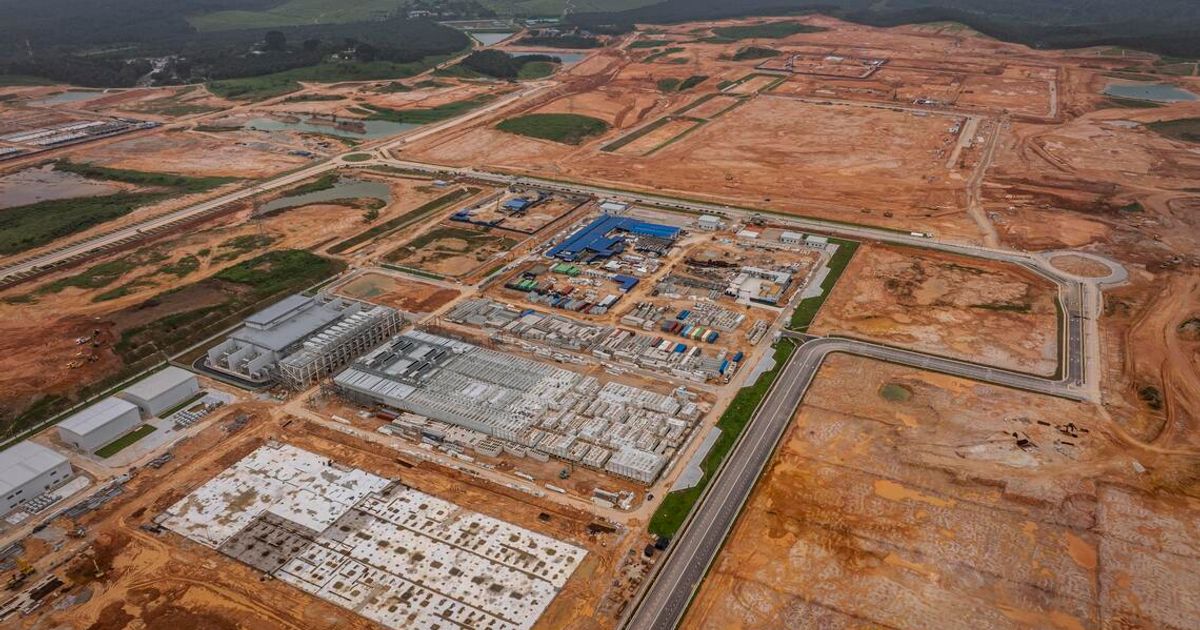
Beyond the impact on China, the US restrictions on access to computing power may affect data centre investment across South-east Asia, including Singapore, which wields an estimated 1.6 gigawatts of capacity spread across more than 70 facilities.
Most analysts believe Malaysia stands to lose the most, given it has been the biggest beneficiary of the region’s data centre build-out.
However, the whole region will still suffer because restrictions on access to overseas cloud facilities would undermine the commercial case for expanding capacity to serve Chinese customers.
This could weigh on investment in data centres by both Chinese and US companies. Any resulting slowdown in investment would add to the drag from an anticipated cooling in the global AI export cycle in 2027.
Lim Siew Khee, an analyst at brokerage firm CGS International, expects the near-term impact on ASEAN markets to be felt mainly through slower AI-related capital expenditure and investment into 2027, particularly in Malaysia and Thailand, as investors await licensing clarity.
However, enterprise cloud, sovereign AI and domestic digitalisation should sustain broader data centre investment.
Analysts said these new regulations were clearly rushed through, given there are several drafting errors in the official document, and loopholes remain.
For example, Chinese companies can still lease data centres in the US. However, American hyperscalers are unlikely to take any risks by providing access to Chinese companies, especially those that are direct competitors.
Swiss private bank Julius Baer analyst Enrico Chinello said compute – hardware, and the supporting infrastructure used to train AI models and run them – is increasingly being treated as a strategic resource, and access to it is becoming a point of mounting geopolitical friction.
“The AI market could be fragmenting into a US-aligned ecosystem and a Chinese one, each building its own chips, models and infrastructure,” he said.
London-based research and consultancy firm Capital Economics expects US chip restrictions to tighten further. Its senior China economist Leah Fahy said the US Congress looks set to include a series of even harsher chip restrictions in the National Defence Act, due to be passed in December.
“They include legislation that would strengthen congressional oversight of advanced chip exports, mandate chip-tracking, further restrict China’s remote access to US tech, and tighten controls on third-country exports of chip-making equipment to China,” she said in a research report.
Come January, the Democratic Party, with majority in both chambers of the Congress, may choose to further intensify the push for a tougher approach on China and its access – both direct and indirect – to US tech.
Charu Chanana, chief investment strategist at Danish investment bank Saxo, said AI model developers in China are increasingly concerned that Washington could restrict their open-source and open-weight AI models on national security grounds.
“This matters because lower-cost Chinese models have gained international users, including American businesses,” she said.
Hence, if such restrictions materialise, they could limit global adoption of Chinese AI models, which are seen as quite capable and yet less expensive than US frontier models.
Chanana added: “This could raise AI adoption costs for businesses globally, including American companies increasingly using cheaper Chinese models for coding, automation and routine tasks.”
This could result in a slowdown of the next phase of AI’s economic value creation.
“As the AI investment cycle shifts from building infrastructure towards adoption, affordable models are crucial for businesses to scale AI applications and generate measurable productivity gains,” Chanana said.
Accelerated fragmentation, with separate US and Chinese technology ecosystems, could potentially reduce competition, efficiency and innovation.
Still, Chanana believes a broader crackdown is not inevitable as Washington may choose to balance national security concerns against the costs to American tech firms and innovation.
However, Fahy of Capital Economics said the new measures underscore how hawkish the mood in Washington has become.
“Congress has long favoured a tougher approach to China, but US President Donald Trump has so far appeared more willing to compromise. The fact that these new restrictions have been introduced by the administration, rather than imposed by Congress, suggest this distinction is narrowing.”
This situation leaves the already-fragile US-China relationship on even more difficult footing, with a senior White House official reportedly claiming that US export controls would not be up for negotiation at the Asia-Pacific Economic Cooperation meetings in China from Nov 17 to 19.
Beijing has already condemned the restrictions and said it will “take the necessary steps to safeguard its legitimate interests”.
Fahy said: “The first of those steps may be to appeal directly to Trump in Shenzhen. The second could be retaliation – for example, a tightening of critical mineral export controls. If that happens, the existing trade truce will have all but broken down.”
Hours after the US Commerce Department announced the new rule on Nov 16, Singapore said it is assessing the impact of a new US rule targeting China’s remote access to AI chips through data centres in South-east Asia.
In a joint media statement, the Ministry of Digital Development and Information and the Ministry of Energy, Trade and Industry said: “We are studying the details of this new measure carefully. We are engaging affected companies to understand the potential impact on their businesses.”

