


SINGAPORE – When it comes to furniture shopping, online e-commerce platforms such as Taobao are hugely popular for their easy access to a wide range of mass-market products at affordable prices.
But increasingly, homeowners who have more particular tastes are on the hunt for premium quality furniture that can also be customised to their needs, and local company HomesToLife is bullish this demand will continue to grow as it secured its secondary listing on the Singapore Exchange.
The Nasdaq-listed company completed a placement of 7.5 million shares on the SGX Mainboard on Nov 17 at $1.15 per share, raising some $8.6 million in gross proceeds. The placement attracted more than 50 accredited and institutional investors, including funds under the Equity Market Development Programme.
Institutional investors, including Amova Asset Management Asia and Lion Global Investors, collectively subscribed for about 4.6 million shares worth around $5.3 million.
UOB Kay Hian acted as the placement agent, while Maybank Securities was the sub-placement agent.
This is the second company to achieve a dual listing on both the SGX and Nasdaq, with the first being cybersecurity firm Avepoint in September 2025.
The counter closed flat at $1.15.
About 80% of the $7 million in net proceeds will be used for business expansion, and 20% will be reserved for general working capital.
Chief executive Phua Mei Ming told The Straits Times that the company is seeking to expand its presence in the Asia Pacific, where it already has a sizeable presence but still has room to grow its distribution.
A burgeoning middle class in markets such as South Korea, Taiwan and Thailand presents good opportunities for HomesToLife’s business, she said.
“We see huge potential in growing not just our premium offering but also a mid-price range of products, as the emerging middle-class appreciates well-made products.”
HomesToLife was started by Phua’s father and his two brothers in 1976 as Hwa Tat Lee, one of Singapore’s first sofa makers, with local retailer Courts as one of its major clients. By 1994, it had started its own leather tannery operations here.
In 2014, the current iteration of the brand was launched as a retail business, with six stores in Singapore at its peak. Today, it operates four stores here, with three more in South Korea.
In addition to HomesToLife’s range, the company also owns German luxury brand Domicil, which it acquired in 2005.
Phua said retail comprises only a small percentage of HomesToLife’s business, as 95% of its revenue comes from its export business.
Its furniture is sold by major leading retailers around the world, including DFS in the UK and Cuir Center in France.
For its 2025 financial year ended Dec 31, Europe accounted for almost 60% of its revenue at $377.9 million, while 26.9% stemmed from Asia-Pacific, and the rest from North America.
HomesToLife reported $19.4 million in operating profit for FY2025, a 103.7% increase from the previous year. But it also faced cost pressures due to disruptions in the Suez Canal, which raised freight rates by 22%.
Most of the company’s products are made to order, allowing both retail customers and retailers to customise their furniture before they are shipped from factories in China, Vietnam and India.
A number of retailers also carry the brand’s white-labelled products, which are developed and designed exclusively for the retailers’ territories.
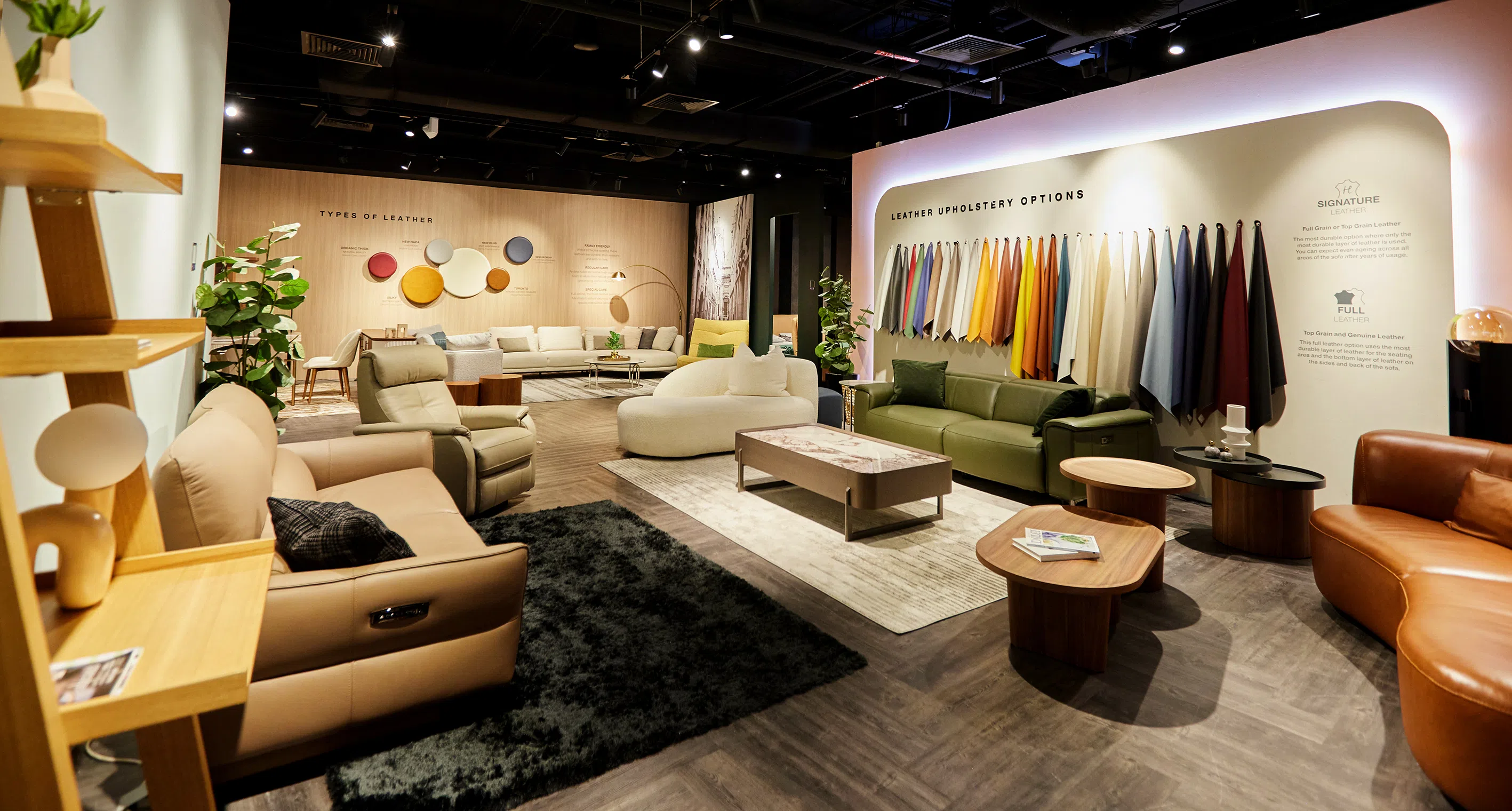
HomesToLife’s outlet at Marina Square.
PHOTO: HOMESTOLIFE
Phua said the company is one of the few furniture brands that controls its own supply chain end to end, from design all the way to distribution, where the company would deliver its products to retailers’ warehouses while other customers may pick up directly from the port.
The advantage of HomesToLife’s made-to-order model is lower inventory risk for its distributors – if demand for a particular product has waned, for instance, they can flexibly move on to selling new products.
“This is what we call our ‘easy buy, easy sell’ approach to business. We just make it easy for our partners to do their business, which is selling furniture,” she said.
Long-term relationships with most of its retailers, some as long as over 30 years, have also ensured stability in the business. The company has already rented showrooms in a few markets such as Australia and the UK, not for its retail business, but to showcase its products to their local partners.
“These are steps we are taking to ensure that we are the first port of call when customers want to get new ideas on products,” Phua said.
She has observed higher demand for mid-tier and luxury furniture in countries such as South Korea and Japan, in spite of weakening economic conditions. For instance, customers in Japan are more likely to pay a higher price for the company’s products because domestic production is unavailable and furniture delivery from Europe takes far too long.
Shrinking domestic furniture production globally due to higher wages and costs of raw materials from China, especially in markets reliant on imports, presents HomesToLife with new opportunities for growth.
Amid competition from online retailers such as Taobao that sell furniture at a fraction of HomesToLife’s prices as they sell direct from the factories, the company does not target the mass market. Rather, Phua said, its own retail outlets’ unique proposition is the ability to guarantee customers that they are getting the most value through its quality assurance.
“Our strengths lie in customisation and comfort, and at the retail level we are targeting the consumer who wants the full suite of service – from helping them to take measurements to confirming their purchase is the right size and comfort level, and then organising their delivery.”
She added that there are few competitors that have the same scale as HomesToLife when it comes to its “unrivalled” range of offerings. For instance, the company has 20 different types of fabric and 10 leather options. It is also one of the leading companies in embedding technology such as dual-motor reclining systems, speakers and even Bluetooth-synced vibration in its sofas to deliver a 4D home cinema experience.
“There is very low customer churn because of the way we service and support our customers,” Phua said, referring to its retail partners. “You might need a few different players to replace us.”
Its parent company HTL International was delisted from the SGX in 2016 and acquired by Chinese furniture company Yihua Lifestyle Technology. It was placed under judicial management in 2020 as the Covid-19 pandemic crippled its manufacturing business.
In 2021, an entity beneficially owned by the founding Phua brothers acquired the company out of judicial management, and HomesToLife listed on Wall Street in 2024 to access the capital markets there for expanding its business.
The company’s share price has fallen over 250% from its initial public offering price of US$4 to US$1.13 on Nov 16.
Phua acknowledged the challenge of attracting investors on a bourse dominated by tech companies, which is one of the reasons why it has chosen to list on the SGX as well.
She also cited recent initiatives to rejuvenate the local stock market as well as to support the growth of Singapore companies as a major consideration for HomesToLife’s dual listing.
“A homecoming to SGX makes sense for us as a homegrown company to increase awareness among the investing public. Listing here would also give us the credibility to expand in the region.”