


SHANGHAI – For more than 15 hours a day over four days, Ray Ng and a five-member team from Heritage Tanglin Puff kneaded dough, peeled and cut potatoes, and hand-crimped thousands of puffs, among them the Singapore brand’s signature curry puff.
The work began on Oct 30, ahead of the company’s debut at the annual China International Import Expo (CIIE) in Shanghai, which ran from Nov 5 to 10. Besides introducing its products to Chinese consumers and potential business partners, it was also there to gauge feedback on taste and pricing.
The food business had tried to showcase its products in China before, but faced difficulties with permit applications and shipping supplies from Singapore. This time, it cleared those hurdles.
By Nov 9, a day before the expo closed, Heritage Tanglin Puff sold out all 4,000 puffs.
Growing up, Ng watched his father sell curry puffs from the back of a tricycle before the business moved into a hawker stall at Old Airport Road.
Driven by his father’s ambition to expand the business, which was founded in 1952, Ng has since grown it to 12 outlets across Singapore and automated about half of its production.
“I’m just trying my best to fulfil (my father’s) wishes to expand the business. He just wanted to be proud of it after working on it for so many years,” he said.
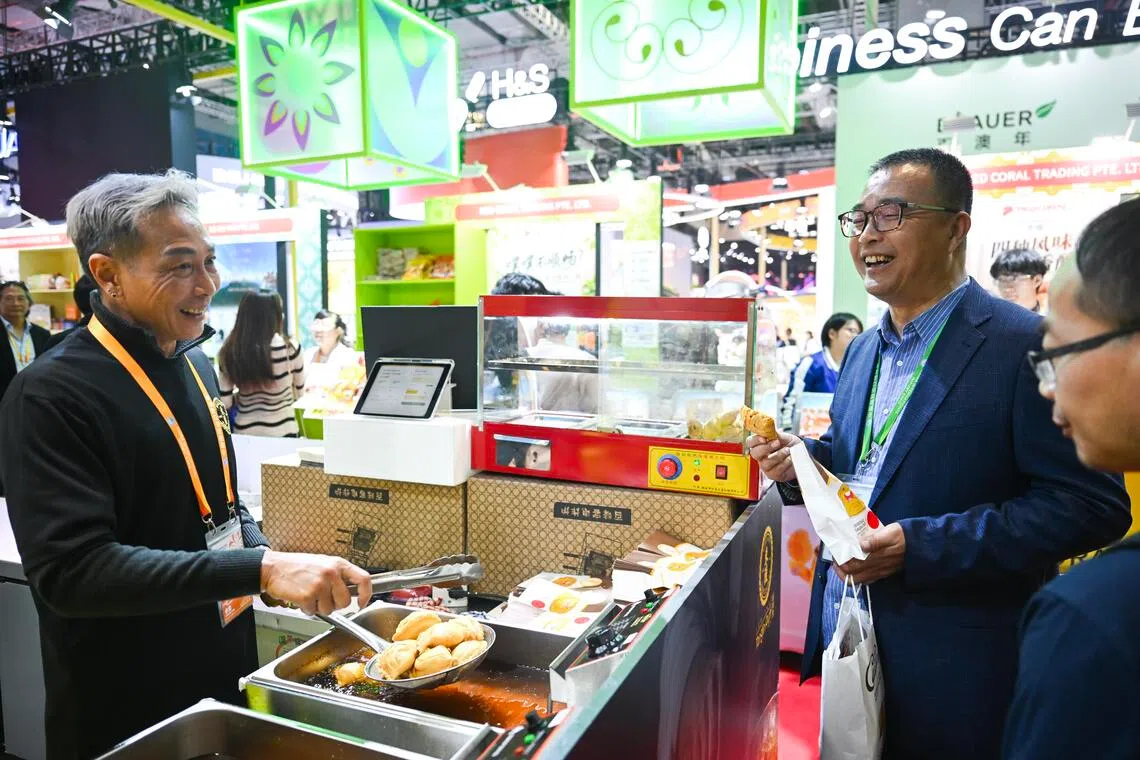
Heritage Tanglin Puff’s second-generation business owner Ray Ng (left) speaking with attendee Lin Qingming at the China International Import Expo.
ST PHOTO: SHINTARO TAY
Now, the 54-year-old is setting his sights on China. His was one of 54 Singapore businesses at 2026’s expo, taking part with support from the Singapore Business Federation (SBF).
Ng said he was surprised by how much interest Chinese visitors showed. Many asked whether the brand had a restaurant in China or sold its puffs online, and several chefs who tried them praised the taste.
“It is very crispy and has a very nice aroma. If it is served with some Chinese-style tea like Pu’er, it will pair very well,” said Lin Qingming, a visitor from Guangdong.
At 12 yuan (S$2.30) a curry puff, the price is on the high side, but Lin said consumers would pay it if they liked the product.
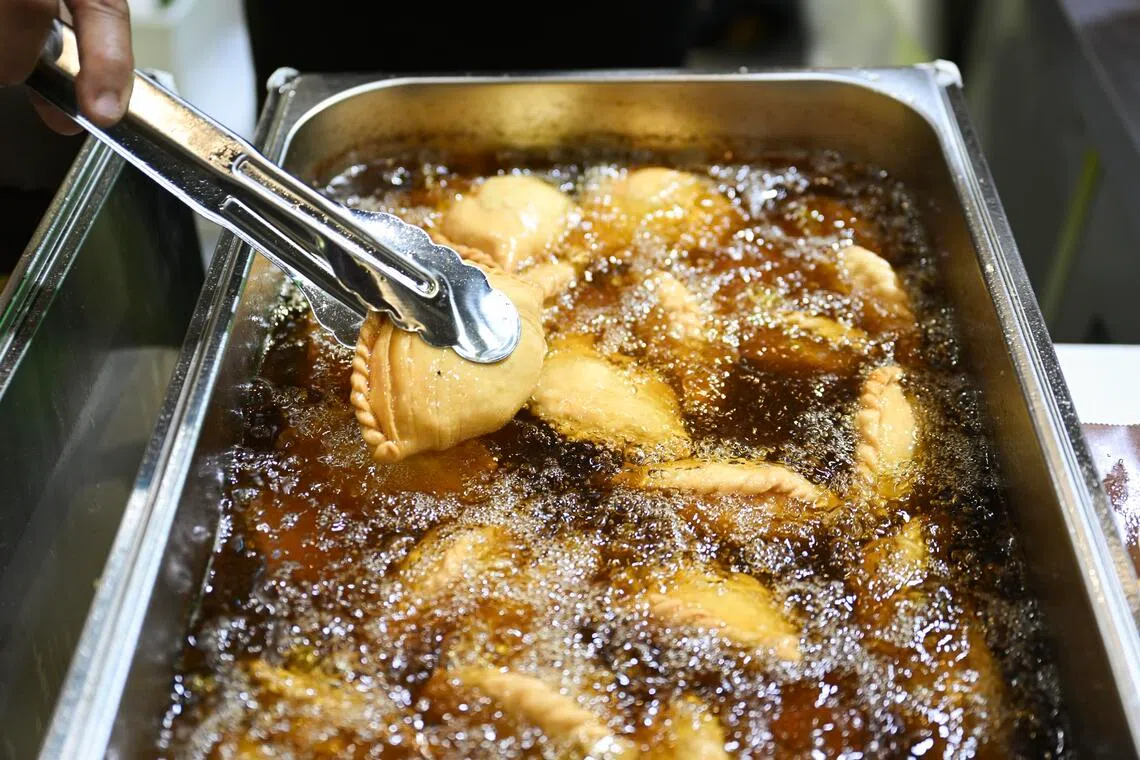
Heritage Tanglin Puff being fried at the China International Import Expo.
ST PHOTO: SHINTARO TAY
Encouraged by the response, Ng is now considering expanding into China.
“It’s my hope also to bring nice Singapore food to China,” he said. “Everyone has been telling us it’s very good and kept on asking if we have a store here or if they can buy online.
“We are thinking about how we can start from here and bring it into the market. We must have the manpower here, and it’s not easy.”
A few potential business partners and organisations have expressed interest.
Another Singapore company looking to grow its presence in China is See Hai Tat Medical Hall, which showcased its roll-on aroma oil at the expo.
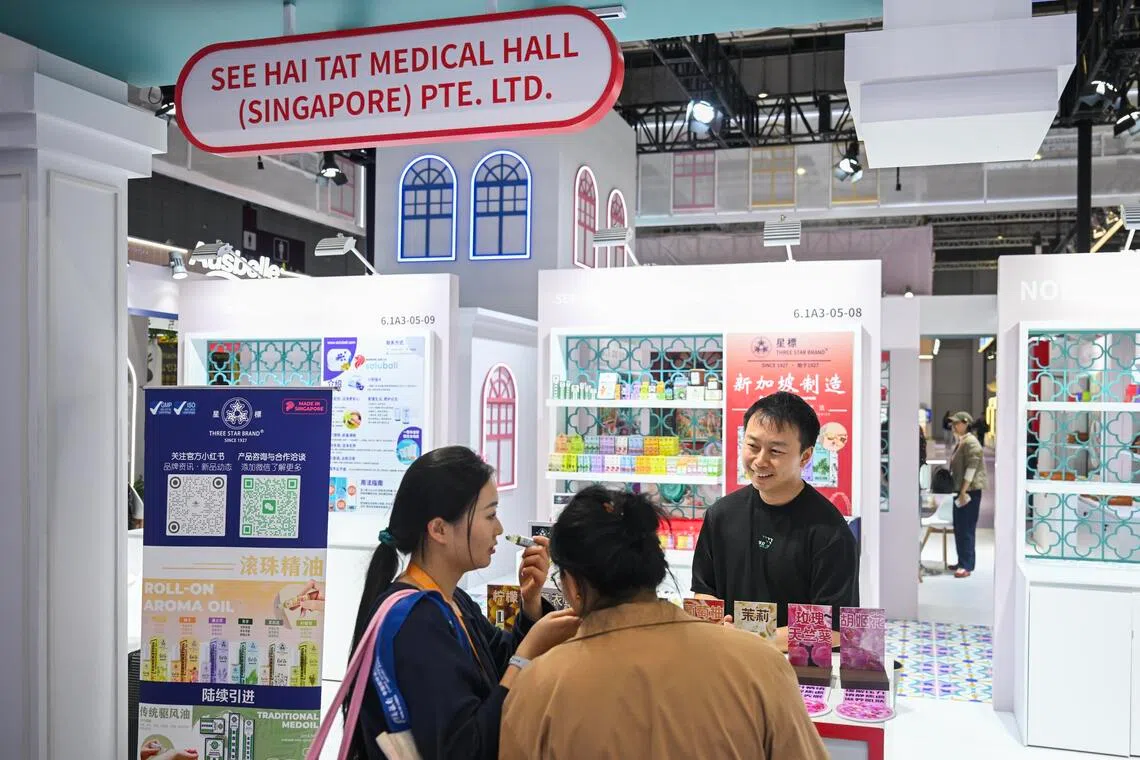
See Hai Tat Medical Hall second-generation leader Tan Yu Chuan promoting the roll-on aroma oil at the China International Import Expo.
ST PHOTO: SHINTARO TAY
For fourth-generation business leader Tan Yu Chuan, the challenge has been to make a traditional product relevant to younger consumers.
The 34-year-old’s great-grandfather came to Singapore from Puning, Guangdong, and began making his Three Star Brand medicated oil in 1927. But as consumer preferences changed, Tan observed younger people becoming less inclined to use traditional medicated oil.
“Since young, I have realised that young people don’t use medicated oil often,” he said.
Some Singaporeans associate the product with their grandparents or with being sick, he added, while others avoid using it in offices or on public transport because of its strong smell.
To appeal to younger consumers, Tan decided the product needed a modern twist.
“We thought, if it’s hard to convince you to use it, how about we innovate something that does not need convincing and you would want to use it yourself,” he said.
With his team, he developed a range of roll-on aroma oils that blend the traditional formula with botanical extracts, in scents such as lavender and orchid.
The idea was to turn medicated oil into something people reach for to feel refreshed, not just when they are unwell.
Tan first brought the Singapore-made product to CIIE in 2024, hoping to gauge how Chinese consumers would take to a traditional remedy with Chinese roots and a modern twist.
“Thankfully, when people try it, they like it, showing us there’s a market here,” he said.
Returning to the expo for the third time, he was surprised by the interest the product generated. He also sees CIIE as a great opportunity to connect with other Singapore companies.
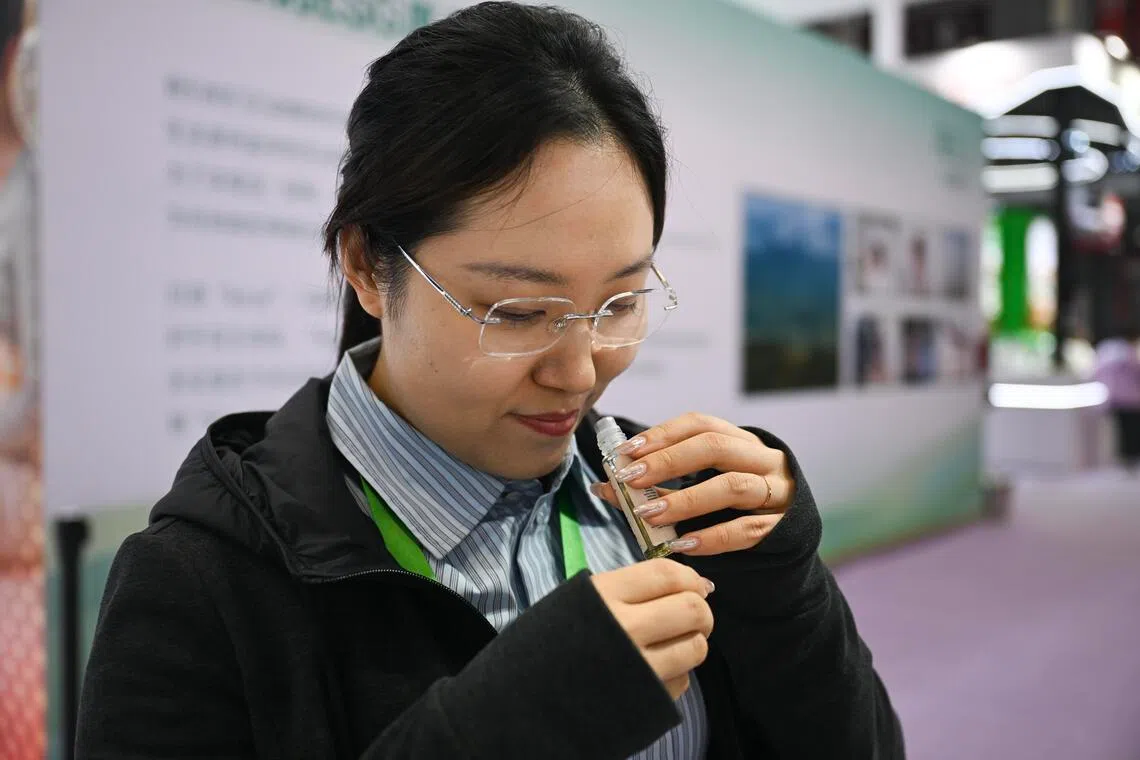
China International Import Expo visitor Duan Siyu trying out See Hai Tat Medical Hall’s roll-on aroma oil on Nov 5.
ST PHOTO: SHINTARO TAY
Expo visitor Duan Siyu from Harbin said the roll-on aroma oil pairs function with a pleasant scent, unlike some traditional Chinese medicated oils that younger consumers may find less appealing.
“This type of product is rarely seen in China. Having tried it today, if it is sold here, peers around my age might buy it. However, if it’s too expensive, people may not buy it,” she added.
Earlier in 2026, See Hai Tat secured a local partner to distribute its products through online platforms in China such as Tmall, Rednote and Douyin. About two months ago, the Singapore company shipped its first batch of 20,000 bottles of Three Star Brand Roll-on Aroma Oil to China, priced at 39 yuan each.
Through the 2026 expo, Tan hoped to build a network of business-to-business distributors and wholesalers across China’s provinces.
He said he has received more than 15 business-to-business inquiries and repeat customers from the previous CIIE.
Since the inaugural CIIE in 2018, Singapore businesses have generated a cumulative trade value of $533 million through the event.
This year’s expo drew 54 Singapore companies across food and agricultural products, consumer goods and services. Nineteen of them were first-time exhibitors.
SBF chairman Mark Lee said the country’s reputation for quality and reliability could give home-grown businesses an advantage when introducing their products to Chinese consumers.
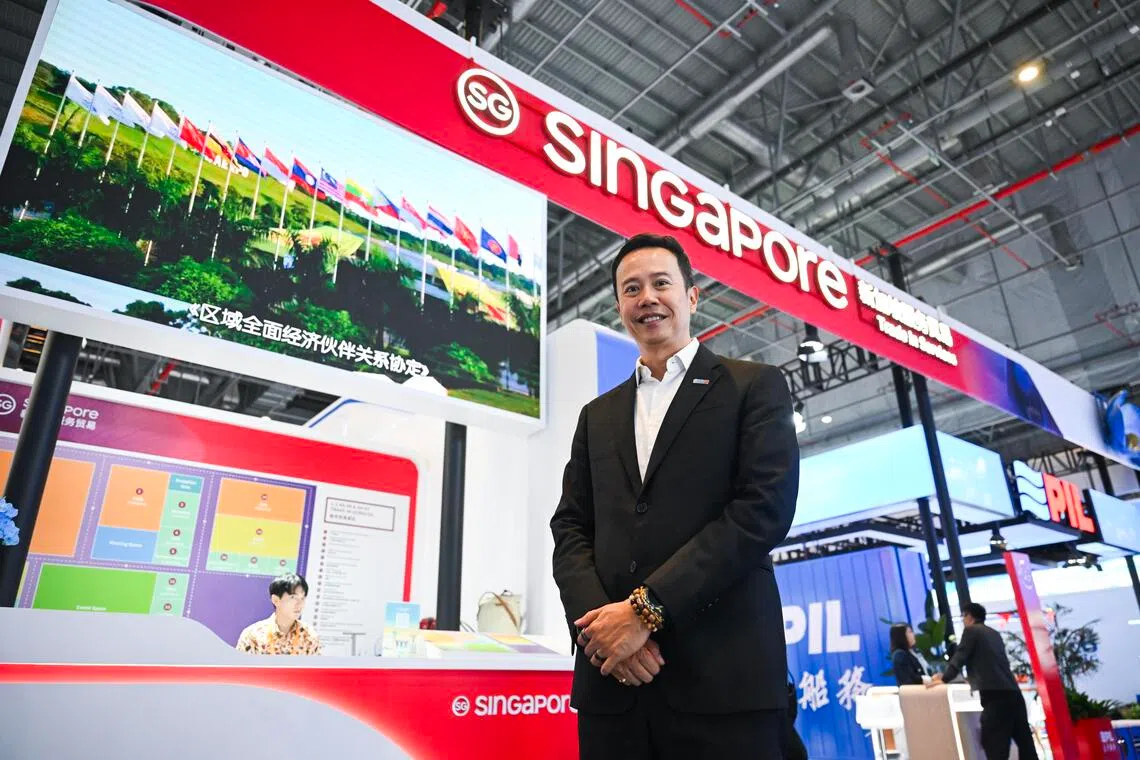
Singapore Business Federation chairman Mark Lee at the Singapore Trade-in Services pavilion at the China International Import Expo.
ST PHOTO: SHINTARO TAY
“People trust the Singapore brand. They trust that when Singapore companies sell food products in China, the brands stand behind good quality,” he said.
China remains an important market for Singapore businesses, given its population of about 1.4 billion and a growing middle class, he added.

The Shanghai central business district on Nov 4.
ST PHOTO: SHINTARO TAY
This year, 11 memorandums of understanding with a total value of about $15 million were signed between Chinese and Singaporean businesses at CIEE.
Lee said some Singapore companies had returned to the expo over the years, expanding their exhibition space, while others had found distributors and business partners through the event.
He also noted growing participation from Singapore’s professional services sector, as Chinese companies look to internationalise their operations and seek expertise in areas such as corporate finance, logistics, human resources and legal compliance.
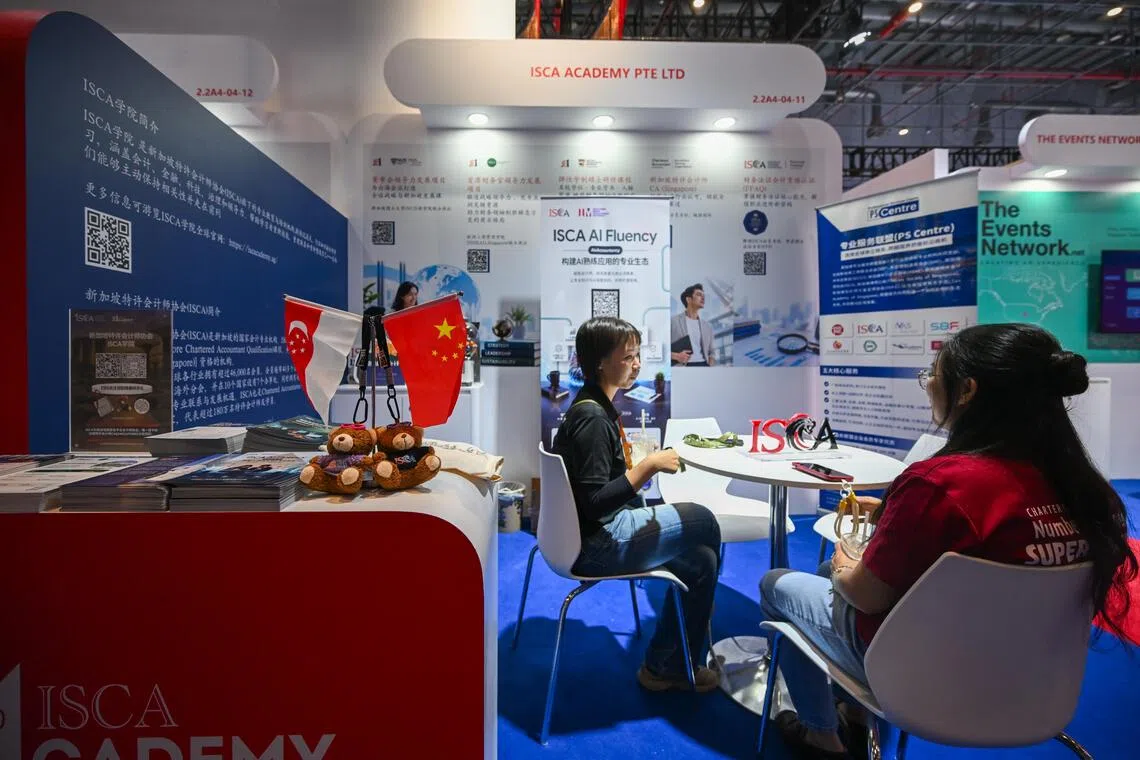
The ISCA Academy booth at a Singapore pavilion at China International Import Expo on Nov 5.
ST PHOTO: SHINTARO TAY
With Singapore taking over as ASEAN chair in 2027, Lee said local companies are also keen to show Chinese businesses their links to other markets in the region.
“If you think this is the right market, you’ve just got to be here and entrench yourself for the long run,” he said.
See Hai Tat’s Tan, for one, plans on doing just that. He hopes that his company will have a bigger presence at CIIE.
“I hope to showcase how our brand from Singapore has grown throughout the years, where consumers know about us and that our products are beneficial for people,” he said.
Added Ng from Heritage Tanglin Puff: “I feel very honoured and happy to have had this opportunity to be here at CIIE. I was able to speak to various businesses that came to discuss and exchange ideas and it was very rewarding.”
-
This photojournalist is in China for a 3½-month familiarisation programme organised by the China Public Diplomacy Association.

