


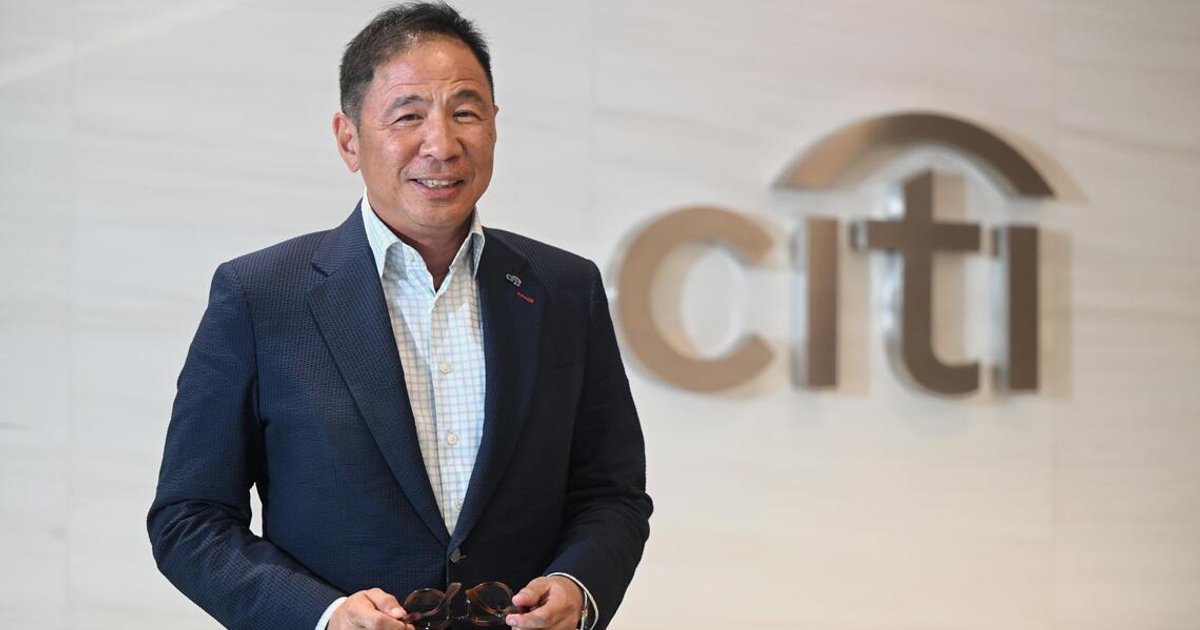
SINGAPORE – Banking veteran Lee Lung Nien says he is not one to chase numbers.
“Focus on clients and products, maintain strong risk management and controls, foster high morale and celebrate wins, and the revenue will follow,” said Citi’s country officer and head of banking for Singapore.
“When you chase the number, you will lose sight of the process and the risk and control piece,” said Lee, who in 2025 became the first Singaporean appointed to the role in 50 years.
There is, however, a number that he is driving Singapore’s private banking sector to chase, and that is to whittle private banking account opening times down to within one month by the end of 2026, from about six weeks or longer currently.
He highlighted the frustration wealthy clients face when navigating lengthy onboarding processes to open a private banking account.
Such delays could drive them to seek services elsewhere, said Lee, a former competitive go-kart racer who represented Singapore.
“If you don’t look after your client, someone else will,” the 62-year-old told The Straits Times in an interview at the Citi office in Asia Square Tower 1.
The race to onboard private banking clients
Lee co-chairs the Private Banking Industry Group (PBIG) account opening working group, which was established in mid-2025.
The working group issued a set of process enhancement tips in May 2026 to speed up private bank account opening for wealthy clients as Singapore rises in importance as a wealth management hub.
The aim is to remove unnecessary bottlenecks and deploy tech tools without weakening anti-money laundering or risk management standards.
Lee, who first joined Citi as a credit analyst in 1990 and led Citi’s franchise in Malaysia from 2014 to 2020, noted that clients often faced extensive questioning and repeated requests for supporting documents, including payslips from as far back as 30 years ago.
Documents submitted in foreign languages also had to be translated, adding to the delays. As a result, the account-opening process could take anywhere from a month to nine months, with some applications ultimately unsuccessful.
The working group aimed to establish clear boundaries, provide direction and guidance, and improve the onboarding experience to make the process more seamless and pleasant for new clients, he said.
Efforts have been successful. Nearly half of all new accounts opened between June and August 2026 at PBIG member banks, including Citi, were opened within a month, PBIG reported in October.
PBIG, comprising senior industry leaders and representatives from the private banking industry, works with the Monetary Authority of Singapore to further strengthen the competency and market conduct standards of the private banking industry here.
But speeding up private bank account opening is a balance between risk and reward, Lee noted.
“If you want to open an account in five days, anybody can do it. The question is, what standard are we talking about? How safe is it to open an account in five days? It’s a risk-reward trade-off,” he said.
Banks must strike a balance between managing risks and remaining open to business.
“It’s about taking risk-appropriate measures. We must also be willing to take some risks. If you shut the door completely, you won’t have any business,” he said.
“The fact that about half of all new accounts can be opened within a month is a significant step forward. As we continue to educate ourselves, learn and adopt more technology, I believe the numbers will improve further,” he said.
Hiring talent: ‘I’m not looking for scholars’
Bankers are also aware that they need to be on top of their game as expectations from wealthy clients have become higher. “If not, they won’t survive,” said Lee.
The principle of focusing on clients, products and the process that he has upheld in his 36-year banking career has also served him well at Citi.
Citi Singapore grew strongly over the past year under Lee’s stewardship, driven by cross-border client activity and increased capital inflows into the Republic.
Singapore-based clients’ cross-border activity – including investment financing, liquidity management and trade facilitation – grew 18% from August 2025 to August 2026.
Inflows into Singapore supported by Citi grew 22% over the same period, with US, China and UK clients, particularly financial institutions and those in the public sector, driving the growth.
For Citi’s bankers, the metrics shifted to reflect changes in the bank’s global strategy over the past 2½ years.
Rather than focusing primarily on deposits, the bank now places greater emphasis on net new investable assets and improving returns, including return on tangible capital, Lee said.
In the light of artificial intelligence reshaping work, Citi plans to upskill all its bankers, financial planners and underwriters, as well as reskill 85% of banking operations employees into redesigned roles by 2028.
One way involves working with the Institute of Banking and Finance to pilot a service relationship manager programme, redesigning the assistant relationship manager role into a dedicated, client-facing role through a structured reskilling pathway.
On a global level, Citi also plans to hire around 100 private bankers and 400 other specialists to support its wealth business.
A significant share of the hiring will be in Asia, which is a key growth engine for Citi’s wealth business.
To meet higher client expectations, Lee is focused on building a high-performing team of talent at Citi Singapore.
He said he can often tell within the first five minutes of speaking to a candidate whether they are suitable for the role.
On what he looks for when hiring talent, Lee highlighted four key attributes, namely intelligence quotient (IQ), emotional quotient (EQ), adversity quotient (AQ) and likeability quotient (LQ).
While those with high IQ and EQ are likely to excel, he said people with high IQ but low EQ often find it difficult to work in teams and lead others.
In contrast, those with average or above-average IQ and high EQ tend to be well-liked, collaborative and effective leaders whom others are willing to support and follow.
Lee said he prioritises real-world experience, teamwork and a willingness to take initiative over academic credentials alone.
“I’m looking for people who are willing to roll up their sleeves, work in teams and help the bank move to another level. I’m not looking for scholars,” he said.

