


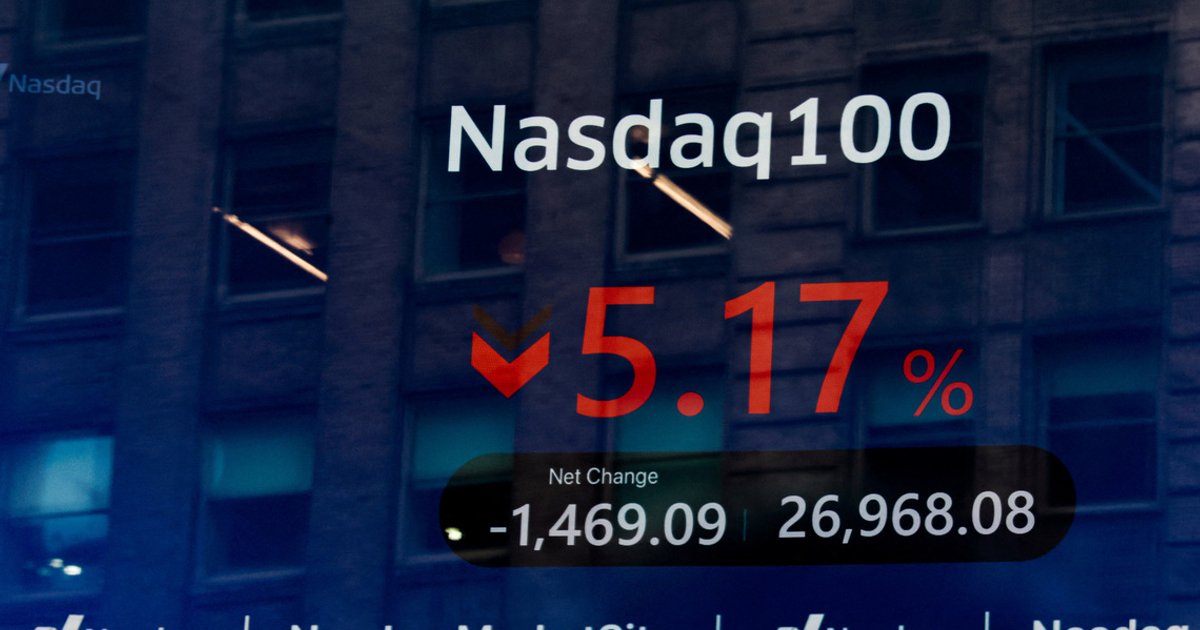
NEW YORK – Phones rang off the hook on Wall Street on Nov 5 as fear-stricken investors sought guidance from the rapid unravelling of the artificial intelligence trade.
Spooked retail investors and hedge funds alike dumped stocks, Wall Street’s fear gauge spiked and traders rushed to hedge as markets went into a tailspin.
“The steamroller showed up today,” said Jim Carroll, senior wealth adviser and portfolio manager at Ballast Rock Private Wealth in Charleston, South Carolina.
The Nasdaq 100 index fell 6.4%, erasing US$2.5 trillion (S$3.2 trillion) in market value on investor fears that the US Democratic Party’s sweeping midterm victory could stall AI infrastructure expansion, adding more uncertainty to a trade that has been on shaky ground for the last several weeks.
“Our phones are exploding with asks for colour,” John Flood, partner and managing director in the global banking and markets division at Goldman Sachs, said in a note.
A person at another large Wall Street bank said investors were increasingly anxious about the unfolding situation.
The selloff sparked hefty hedging in the equity options market as investors braced for further weakness. Wall Street’s most closely watched gauge of anxiety, the Cboe Volatility Index, logged its biggest intraday jump in more than 18 months.
Analysts said much of the selling reflected an unwind of the previous session’s rally and of the crowded AI trade that has driven markets for months.
“There was massive de-risking into midterms and traders were surprised by yesterday’s (Nov 4) move and got sucked back in,” Flood said, adding that hedge funds were selling pockets of the market, like hyperscalers, that they bought the previous day.
Options activity was a mix of traders looking for fresh protection in semiconductors and AI names alongside those taking profits on existing hedges, said Chris Murphy, co-head of derivative strategy at Susquehanna Financial.
Fear-stricken
The VIX, an options-based indicator that reflects demand for protection against drops in the stock market, jumped 11.75 points to an eight-month high of 28.36, a day after markets rallied following Democrats’ victory.
The index closed at 28.18, while the Nasdaq Composite fell 5.5% as investors fretted that a changing of the guard in Washington might slow the pace of AI infrastructure development.
The selloff was in sharp contrast to the upbeat market reaction the day before, when investors largely brushed aside the perceived threat to the AI trade from the election results.
“Yesterday, there was the perception that no one needed protection and now it’s ‘Oh my god, we need it’,” said Steve Sosnick, chief strategist at Interactive Brokers.
Analysts attributed some of the decline to investors looking to get ahead of anticipated selling from strategies that react to market volatility.
Leveraged and inverse exchange-traded funds (ETFs), along with some systematic strategies, typically rebalance near the market close. They also tend to respond as markets grow more volatile, which can amplify market moves.
Leveraged ETFs were expected to sell about US$47 billion of stocks into the close as they rebalance, according to an intraday note from Nomura. That would make it the second-largest amount in Nomura’s data going back to July 2006, with most of it coming from tech and AI-focused funds.
Hedge fund, retail reaction
Hedge funds were also feeling the pain.
According to a Goldman Sachs prime brokerage report sent to clients on Nov 5, large multi-strategy hedge funds were down “significantly” owing to outsized exposure to large AI stocks.
Technology, media and telecommunications-focused funds were down 2.6% from a year ago, Goldman said.
Much now depends on whether investors’ attitude towards the AI trade undergoes a lasting change, analysts said.
“If the re-evaluation of the AI investment theme is secular and not just a trading type of rebalance, that’s problematic,” said Sosnick.
Retail selling added to market pressure.
About one hour before the close, they were on track for their largest day of selling across single stocks since the Covid-19-related crash, said Viraj Patel, global macro strategist at Vanda Research, in an intraday note.
“On a typical sell-off, retail buy the dip. Today, that bid has effectively disappeared from individual names,” Patel said.
In the options market, the stock market drop boosted demand for hedges, with put premiums – the prices investors pay to buy contracts that protect against a market drop – running at about two times what is typical across index products, according to options analytics service Mercury Alerts. REUTERS