


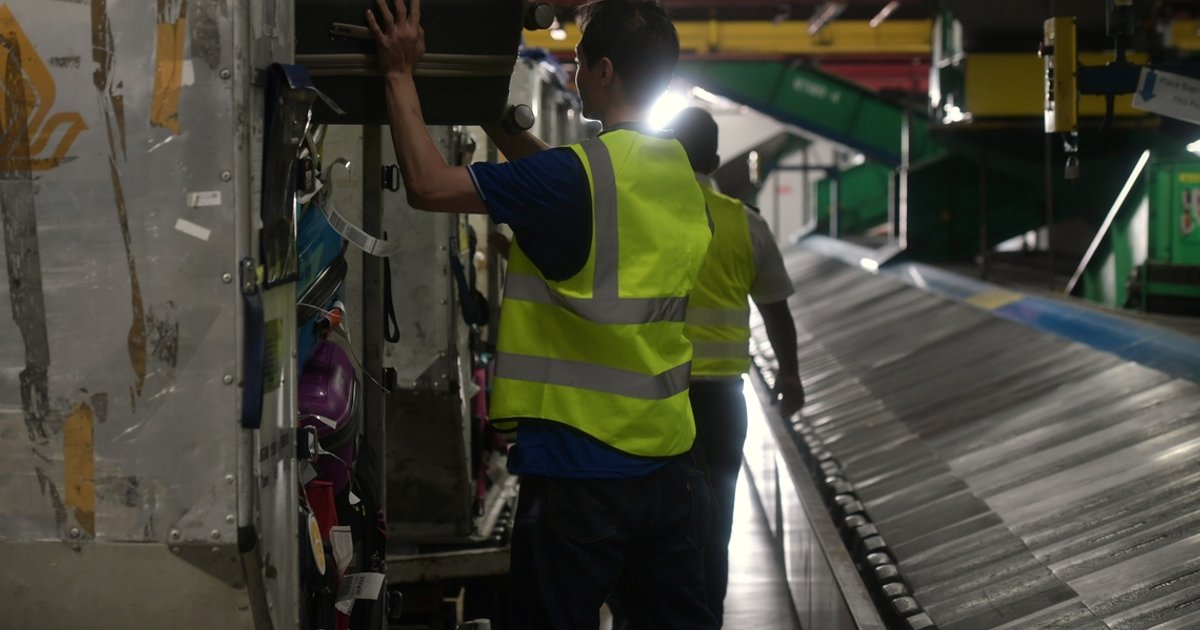
SINGAPORE – Airport jobs, including baggage handling, are drawing interest from local job seekers, but hiring remains challenging as back-breaking duties, irregular shifts and long commutes may cause some applicants to drop out before starting work.
According to recruitment platform FastJobs, close to 600 job seekers applied for baggage handling roles through its portal, with roughly six in 10 applicants being Singaporeans and permanent residents.
But many airport roles often involve round-the-clock shifts, physically demanding work, security clearance before starting, and a long commute to Changi. “These can lead to drop-offs between application and the first day of work,” said FastJobs founder and chief executive Julian Tan.
The recruitment challenges have come under scrutiny following a Ministry of Manpower (MOM) investigation into suspected work pass infringements involving around 45 companies.
The probe covers about 270 workers hired by ground handler SATS’ contractors and sub-contractors, some of whom are suspected of being employed on Employment Passes (EPs) meant for professionals, managers and executives, but deployed to lower-paid jobs such as baggage handling.
SATS said it had initiated a wider review of its contracted firms and made operational adjustments, including redeploying staff, to maintain airport services.
The investigation has raised questions about whether restrictions on hiring foreign workers for lower-paid service jobs are contributing to the use of irregular work pass arrangements.
Under Singapore’s foreign manpower framework, employers in the services sector can hire Work Permit holders from Malaysia, China, Hong Kong, Macau, Taiwan and South Korea.
Employers can also recruit workers from some non-traditional source countries such as India, Bangladesh and Myanmar, but only for selected occupations such as cabin attendant, childcare worker and heavy vehicle driver.
Baggage handling is not among these occupations, MOM said in response to queries from The Straits Times.
The ministry added that it regularly reviews the list of occupations in consultation with sector agencies and unions, taking into account the degree of shortages in local manpower and from other approved Work Permit sources.
EP misuse
Migrant worker advocacy groups Transient Workers Count Too (TWC2) and Humanitarian Organization for Migration Economics (HOME) said the suspected misuse of EPs extends well beyond baggage handling.
According to MOM guidelines, Work Permit and S Pass holders can make up no more than 35% of a company’s workforce in the services sector. There is however no foreign worker quota or levy when companies hire EP holders.
Executive director of HOME, Stephanie Chok, said these EP applications are used to circumvent Work Permit quota and source country restrictions imposed by MOM.
“Our work pass system, which restricts the number of lower-paid work permit holders in many sectors, does not reflect labour market demand, leading to employers and agents circumventing regulations to fill it,” she said.
In a report published in May, TWC2 highlighted the cases of two Indian nationals recruited in October 2025 as “logistics managers” at Changi Airport, with monthly salaries of $8,000 declared in their EP in-principle approval (IPA) letters.
One held a bachelor’s degree and the other a master’s degree. But upon arriving in Singapore, both were deployed as baggage handlers, loading and unloading luggage from aircraft, for just $1,500 a month.
TWC2 executive director Ethan Guo told ST that the two workers had approached the group for a brief consultation, after learning that their work passes were cancelled.
In another case, TWC2 encountered two foreign women assisting transit passengers at Changi Airport in March, although their IPA letters listed their occupations as “data entry” with monthly salaries exceeding $12,000. They told TWC2 they were forced to sign 12 months’ worth of salary slips upon arriving in Singapore.
“Prior to arriving in Singapore, however, their agent had told them their actual salary would be $1,400, but that a higher amount needed to be declared for them to enter under Employment Pass,” Guo said.
Beyond baggage handlers, Guo said, 55 other EP holders also sought advice from TWC2 on similar situations in 2026. Most of them had job titles like managers and supervisors, but were in fact working as dishwashers, cashiers, and warehouse or delivery workers for e-commerce platforms, earning about $1,000 a month.
While some workers had agreed to lower salaries, Guo said, many are “genuine victims of employment scams” who are trapped in illegal work. They are hesitant to report such cases to the authorities as they fear being accused as complicit in deceiving MOM.
Chok from HOME added that workers typically receive their IPA letters only shortly before departure.
Job scams
“Many are assured by agents that discrepancies in their occupations and salaries were merely administrative requirements. Having already paid the recruitment fees, they are under tremendous financial pressure to continue working in Singapore,” she said.
Both Chok and Guo said the recruitment fees could be as high as $10,000.
“We have experienced cases where workers are unwilling to report their employers for fear of blacklisting and repatriation,” Chok said. “For every worker that comes forward, there are often many others in the same company too afraid to do so.”
The advocacy groups urged MOM to strengthen checks on work pass applications.
“The current method of waiting for workers to report the matter to MOM is clearly not working because of their vulnerability and the power imbalance between employer and migrant worker. All the workers who spoke to us about this EP issue, for instance, have not opted to seek help from MOM,” said Guo.
Chok added that migrant workers caught in such situations should not be penalised. They should receive support to recover wages and recruitment fees, and be given meaningful opportunities to secure lawful employment in Singapore.
“They should not be punished for work pass irregularities organised for them by employers and agents, under a complex work pass system many do not understand.”

