


SINGAPORE – As tech titans continue pouring massive amounts of money into data centres and equipping them with ever more expensive chips, growing investor scrutiny on the AI build-out is pulling down stock prices and pushing up borrowing costs.
The selling pressure isn’t just pounding hard on Big Tech; their most consequential partners in the global AI supply chain, semiconductor chipmakers, have also suffered.
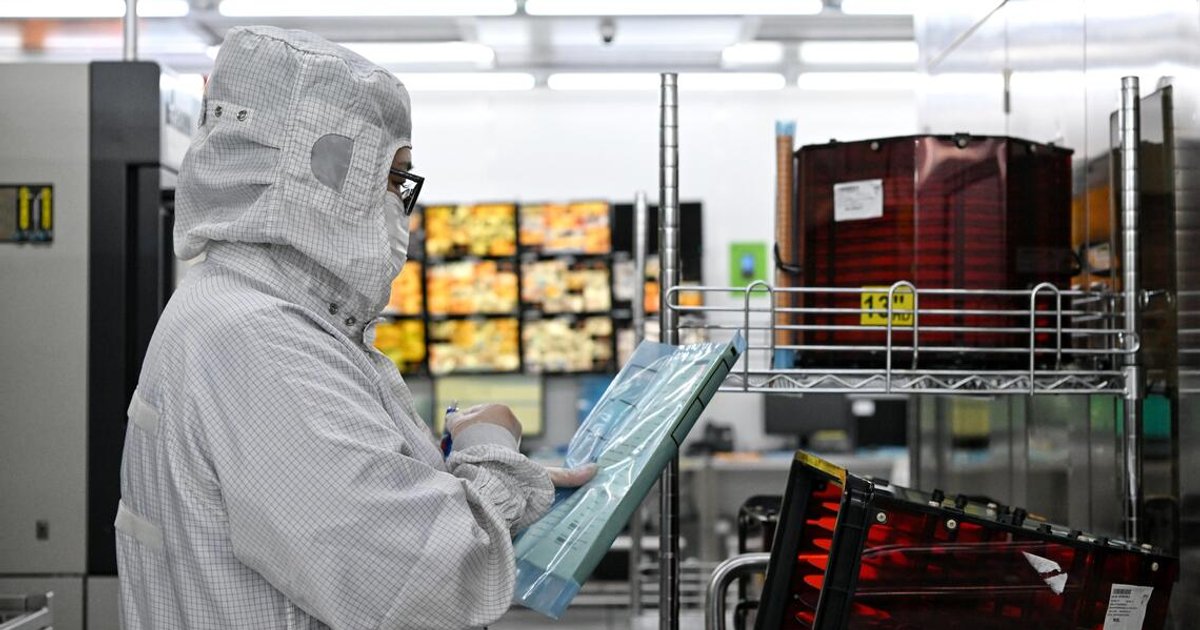
Given that the bulk of chip manufacturing capacity is in Asia, the AI boom’s fate has the potential to redefine the region’s economic outlook.
Hence, investors and policymakers in Asia’s top chip-exporting nations, including Singapore, are watching Wall Street’s attempt to reset the AI trade with measured trepidation.
The International Monetary Fund recently noted that global trade rose 8.3% between 2023 and 2025 – a figure that would be closer to 4.6%, or nearly half, without AI-related products.
The Monetary Authority of Singapore’s latest Macroeconomic Review said Singapore’s technology-related sectors accounted for around 75% of overall year on year GDP growth in the third quarter of 2026.
Why can’t Big Tech just slow down?
On the face of it, the question investors are asking seems plain: Does revenue justify massive capital outlays?
The market evidently doesn’t think so. Google’s parent, Alphabet, for instance, saw its stock drop by as much as 13%, erasing US$500 billion in market capitalisation, following its third-quarter 2026 earnings report released on Oct 28.
Even as Alphabet posted strong revenue growth of 25% and a doubling of Google Cloud revenue, its stock was hammered after it reported US$9 billion in negative free cash flow, driven by a massive US$51.4 billion in capital expenditure, mostly on AI infrastructure. Free cash flow is the money left with a company after paying day-to-day operations and maintaining or expanding physical assets.
So why aren’t companies that are leading the charge on AI giving in to the demand for fiscal discipline?
For tech firms investing in AI infrastructure, including computing and memory chips, sufficient compute capacity is a must. This capacity is the single most important driver of AI capability, speed and competitive advantage.
In the tech world, the concept is known as Scaling Laws. A framework of predictable mathematical relationships in AI that shows how a large language model’s performance improves – it gets smarter and makes fewer mistakes – as the resources driving it increase over time.
According to the Center for Governance of AI, a non-profit research organisation, compute capacity is also the primary gatekeeper of AI diffusion, acting as the bridge that transforms elite lab research into affordable, ubiquitous commercial tools.
Economic experts refer to this process as compute deflation, which reflects the rapid, sustained drop in the cost per unit of processing power, memory and AI inference.
As the falling cost of compute replaces the cost of labour and production, it exerts downward pressure on the general price of software and tech-enabled services.
That’s why some AI hyperscalers are also designing their own high-performance AI accelerator chips – specialised semiconductor hardware designed to process AI, machine learning, and deep-tech learning workloads much faster and more efficiently than standard chips.
Big Tech is also investing in chips
The shift toward custom silicon is reshaping the entire cloud computing industry.
To break free from Nvidia’s hardware monopoly and drastically lower operational costs, all major cloud hyperscalers – including Amazon Web Services and Microsoft Azure – have aggressively built out their own proprietary chips.
Alphabet disclosed in its third-quarter earnings report that more than 100 significant Google Cloud customers – including Anthropic and Apple – are now running AI using Google’s own tensor processing units (TPUs), an alternative to Nvidia’s AI chips.
Consumer tech platforms are also designing custom silicon – Meta’s MTIA, or Meta Training and Inference Accelerator, chip family, for instance – to power their internal AI tools and ad engines.
This competition in semiconductor chips and devices aims to break old hardware monopolies and force down pricing.
Epoch AI, a non-profit research firm, estimates that total available computing capacity from AI chips across all major designers has grown by approximately 3.3 times per year since 2022, enabling larger-scale model development and consumer adoption.
NVIDIA-designed AI chips still account for over 60% of total compute, but Google and Amazon now make up much of the remainder, it noted.
A game of chicken nobody can quit
Japanese investment bank Nomura estimates there is a 75% chance that the AI spending race will not stop and that demand for chips may not just prevail but may, in fact, rise further.
Changwon Chung, joint head of APAC equity research at the Japanese investment bank, said that while shareholder pressure remains a concern, the AI industry’s fear is simple: “If you fall behind, even the core business is at risk. It is a game of chicken which nobody can quit.”
Data centres going live next year were planned two to three years ago. Meanwhile, agentic AI, which can accomplish a specific goal with limited supervision, has created new demand.
The supply deficit is not restricted to leading-edge AI accelerator chips.
The demand for mature-node chips, which many Asian chip plants including the two dozen in Singapore produce, has improved significantly in the past couple of years because of the AI boom.
For example, every watt of electricity powering an AI accelerator runs through power-management integrated circuits, voltage regulators, gate drivers, and analogue-power semiconductor devices – almost all of which are built on mature nodes.
However, most analysts agree that the race to boost computing power means big tech is unlikely to satisfy Wall Street’s profitability expectations for the next several quarters.
That would result in bouts of tech and chip stock sell-offs like the one in October amid the third-quarter earnings season, and keep the risk of a meaningful slowdown in AI investment alive even if the probability of a so-called bubble burst remains low.
US investment bank Morgan Stanley’s economists Chetan Ahya and Derrick Kam said in a recent research report: “Computing demand still outweighs supply, with an imbalance that is set to persist.
“Even if funding, power and other regulatory constraints may delay US AI capex (capital expenditure), it should still be higher in 2027 as compared to 2026.”