


SINGAPORE – A multibillion-dollar hack at cryptocurrency exchange Binance shook the industry this week, sending prices lower amid concerns over the safety of investors’ assets on trading platforms.
Bitcoin fell about 5% over 24 hours since the Oct 29 incident, while Ether lost about 5.7%. Both extended their declines on Oct 30 before recovering some ground. On Nov 1, Bitcoin was trading at around US$77,450, while Ether was US$2,249.
About US$6.4 billion worth of cryptocurrencies were stolen on Binance within 30 minutes, with attackers linked to North Korea draining Binance’s internet-connected “hot wallets”, then rushing to exchange stolen stablecoins for cryptocurrencies such as Ether.
Unlike stablecoins, whose issuers can freeze assets, Bitcoin and Ether have no central issuer able to block their movement.
Approximately US$2.8 billion in stablecoins has been frozen by investigators, law enforcement agencies and stablecoin issuers so far.
In a video circulated on social media on Oct 30, Binance co-chief executive Richard Teng said the exchange has been working non-stop to recover the stolen assets, and added that it had reserved more than US$6.4 billion of its own money to cover all losses.
Teng said customer assets were safe and would not be used to cover the losses, and attributed Binance’s ability to absorb the losses to retained earnings and reinvestment into the business.
He added that withdrawals from the exchange, which have been suspended pending a security overhaul, are expected to resume by Nov 1.
In Singapore, the Binance.com trading platform operates outside the Monetary Authority of Singapore’s regulatory safeguards.
[embedded content]
MAS placed the platform on its Investor Alert List in September 2021, warning that it was not regulated or licensed to provide payment services here. It also ordered Binance to stop providing such services in Singapore and cease soliciting business from residents.
Investors dealing with unregulated platforms forgo protections under MAS regulations.
Wilmar discloses sales to haze-linked firms
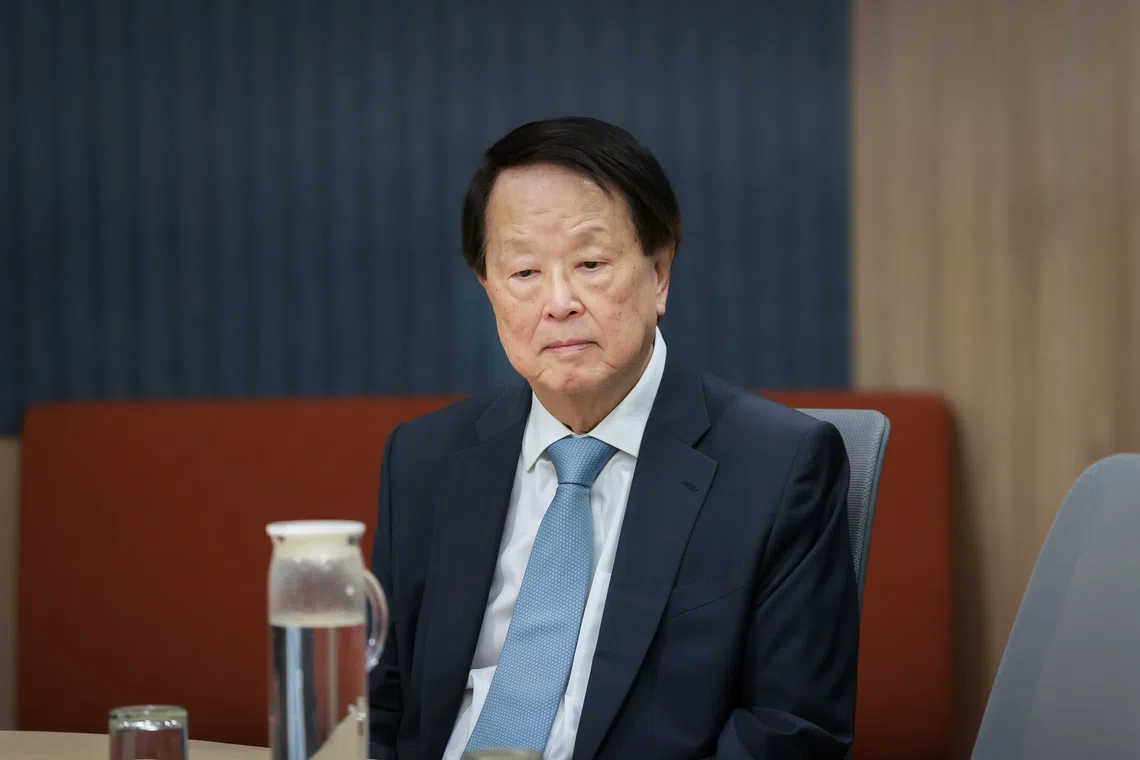
Wilmar International Limited was represented by Kuok Khoon Hong, its chairman and chief executive in a meeting at the Treasury Building on Oct 28.
ST PHOTO: GAVIN FOO
Wilmar International on Oct 31 disclosed that it sold fertilisers and diesel for heavy equipment to six of the 10 companies named by the National Environment Agency (NEA), generating revenue of around US$22.5 million in financial year 2025.
Updating its Oct 28 response to SGX RegCo based on newly received information, Wilmar said none of 10 companies named were its subsidiaries. It added that it had no operational or supply-chain ties with six buyers, and no operational, supply-chain or business relationship with the remaining four companies.
Shares of Wilmar International took a beating during the week, whacked by rising raw materials costs, which ate into its earnings, and elevated risks arising from a Government-led haze-related probe.
The shares fell 11% across the week to close Oct 30 at 3.01.
The conglomerate said its food products segment was hit by higher raw material costs, and the feed and industrial products segment by weaker soybean crushing margins, triggering several analyst downgrades on the stock.
Wilmar said in a separate announcement that it has reviewed available information and assessed that the fires in Indonesia and transboundary haze have neither resulted in, nor is expected to result in any material operational, financial, legal or regulatory impact on the company.
This was after 10 Singapore-registered, Indonesian oil palm-related companies, which included Wilmar, were issued preventive measure notices by NEA under the Transboundary Haze Pollution Act.
The Government has begun investigating companies linked to the haze, and on Oct 28 met with the senior leadership of the Singapore-linked businesses allegedly linked to haze-related activities.
Kuok Khoon Hong, chairman and CEO of Wilmar, was one of the executives present in the meeting. Besides Kuok, the bosses of Golden-Agri Resources, First Resources, Bumitama Agri, Indofood Agri Resources, Kencana Agri, and representatives from TSH Resources and the Sinar Mas Group, which includes Asia Pulp & Paper (APP), were also at the meeting.
On Oct 31, NEA said seven Singapore-registered companies had indicated their willingness to engage assessors to examine their links to fires contributing to transboundary haze.
Five companies – Wilmar, Golden Agri-Resources, APP Company, APP Company (China) and Indofood Agri Resources – have agreed to engage assessors from the Panel on Transboundary Haze and cooperate with the assessment process, following meetings with NEA.
The agency will also meet Kencana Agri, which has expressed willingness to voluntarily engage assessors.
NEA said it was awaiting written confirmation of First Resources’ participation in the assessment process.
In its statement, NEA also welcomed First Resources’ recent public statement that it was prepared to engage an investigation firm and a law firm to assess whether the group had any involvement in, or connection with, the fires in Indonesia that contributed to transboundary haze.
The Government on Oct 30 had appointed seven investigation and law firms, as well as an individual to a specialist panel assembled to investigate firms linked to the transboundary haze.
AI carnage

Investors dumped the stock after the company reported negative free cash flow of US$9.1 billion for the third quarter as a result of soaring AI-related costs.
PHOTO: REUTERS
US-listed tech stocks, including stalwarts like Alphabet, Amazon and Nvidia, had a rough week, as fears around artificial intelligence (AI) spending collided with disappointing earnings.
Heavy infrastructure spending by mega-cap tech firms have led to cash flow strains and heightened investor sensitivity toward execution and investment returns, hitting the valuations of companies like Alphabet.
Google’s parent suffered its worst one-day percentage decline on record on Oct 29, falling as much as 12.6% and wiping out almost US$500 million in market value.
Investors dumped the stock after the company reported negative free cash flow of US$9.1 billion for the third quarter as a result of soaring AI-related costs. The stock closed on Oct 30 at US$278.22.
Intel also took a hit. Its shares plunged almost 29% to close at US$65.76 on Oct 30, marking one of the chipmaker’s worst single-day declines since the 1970s.
Intel released weaker-than-expected guidance due to an explosion and prolonged shutdown at an Israeli factory, which constrained shipments of server processors, and added to delivery bottlenecks.
The chipmaker also reported weakening demand in the personal computer (PC) market due to an AI-driven squeeze on memory chip supplies, which is pushing up component costs, and prompting PC makers, its key clients, to cut inventories and slow orders.
Intel’s problems also had an impact on other stocks, notably rival chipmaker Advanced Micro Devices (AMD), whose shares fell almost 11% to close at US$504.80 on Oct 30 as concerns that it could face similar pressures swelled.
In Singapore, AEM Holdings also took a hit, falling as much as 11% on Oct 30 before paring loses to close at $7.45.
AEM has a longstanding, strategic relationship with Intel as a key supplier of advanced semiconductor test solutions.
Mi Material, which makes chip packaging materials and debuted on the Singapore Exchange (SGX) mainboard on Oct 28, was also affected. Its shares slid more than 16% from its listing price of $1.80 to close Oct 30 at $1.51.
Semiconductor equipment manufacturer UMS Integration was down over 7%, while PC Partner, a global manufacturer of computer electronics and hardware, fell more than 4%.
Other market movers
Property giant Mapletree Investments could be headed for an initial public offering on the SGX in 2027, the media learned this week.
The new development comes after previous plans for a merger between SGX-listed CapitaLand Investments (CLI) and privately held Mapletree Investments fell apart earlier in 2026 due to concerns about valuation, and disagreements over restructuring, among other things.
Both Mapletree Investments and CLI are backed by Temasek. A combination would have created one of Asia’s largest real estate asset management groups, with more than US$150 billion in assets under management.
Shares of Sheng Siong are down by more than 6% this week, closing Oct 30 at $2.67 despite it reporting strong financial performance for the third quarter.
The supermarket operator posted a third-quarter profit of $44.6 million for the period ended Sept 30, up 1.9% from the third quarter of 2025, while revenue grew by 6.2% to $415.5 million over the same period.
The group attributed the increase in revenue to a rise in total stores in Singapore, now at 92.
Still, Sheng Siong noted that the grocery retail landscape remains competitive, and sustained promotions may pressure revenue and margins moving forward.
Japan Foods returned to profit after cutting nearly a third of its outlets in Singapore and turning its focus to halal dining concepts and affordable meals.
The Singapore-listed restaurant operator had been loss-making since 2023.
The group, which operates Japanese cuisine brands including Ajisen Ramen and Yakiniku Shokudo, had 46 restaurants as at Sept 30, down from 68 a year ago.
Besides closing poorly performing outlets, it also converted some existing restaurants to newer concepts, including its proprietary halal Steak 99 brand, which serves steaks for just $9.90. Launched in October 2025, Steak 99 had grown to 14 outlets by Sept 30.
As a result, Japan Foods posted a net profit of $234,000 for the six months ended Sept 30, against a loss of $3.3 million a year ago. This was despite revenue falling 18% to $30.2 million as its restaurant network shrank.
What to look out for next week
Americans will vote on Nov 3 to decide who controls Congress for the final two years of Donald Trump’s presidency.
Markets will be watching to see whether the vote produces a divided US government, as this could complicate decisions on taxes, spending and government funding.
According to the media, analysts expect fights over funding and the debt ceiling in 2027 regardless of the outcome.

