


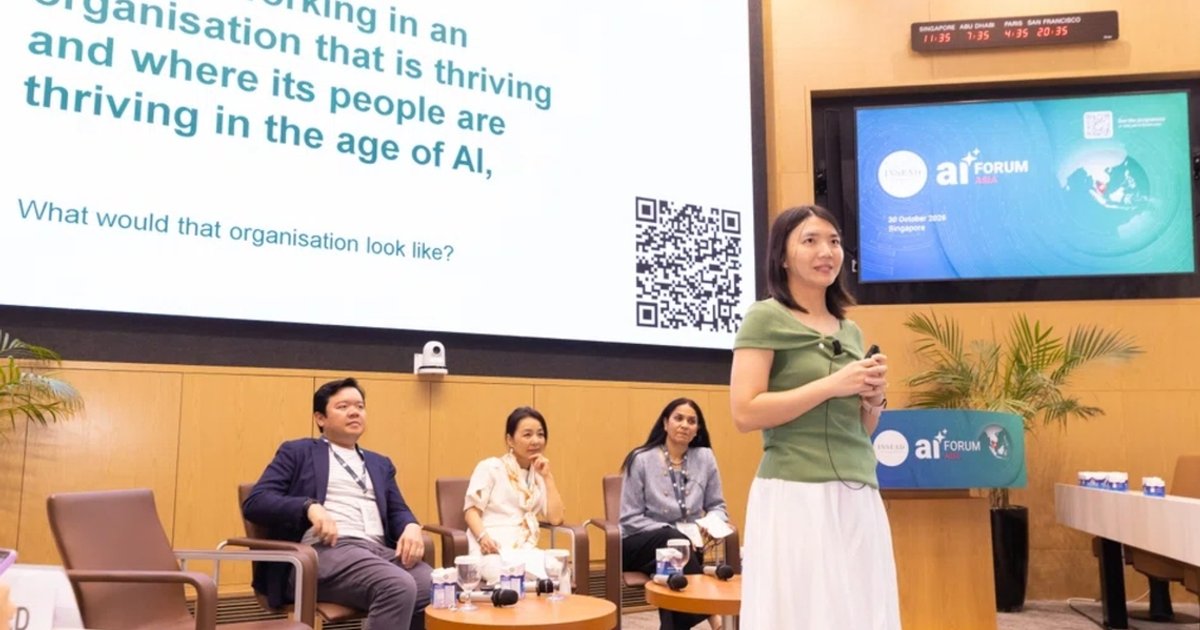
SINGAPORE – French business school Insead said on Oct 30 that it has launched a research initiative examining how artificial intelligence could affect human connectivity, meaning and well-being at work and in life.
The Research Lab for Human and Organisational Thriving, or Insead Thrive Lab, was unveiled at the Insead AI Forum Asia 2026 at the school’s Asia campus in Singapore.
The global initiative received US$3 million (S$3.83 million) in funding from Google.org and Google DeepMind, the tech giant’s philanthropic arm and AI research unit, respectively.
Winnie Jiang, an associate professor of organisational behaviour at Insead’s Singapore campus, will serve as the laboratory’s academic director.
The lab is housed within Insead’s Human and Machine Intelligence Institute, a cross-disciplinary research institute.
The institute’s core academic team includes Philippe Aghion, the 2025 Nobel laureate in economics, and Phanish Puranam, recipient of the 2025 Oskar Morgenstern Medal. The medal is conferred by the University of Vienna to honour distinguished academic contributions to business, economics and statistics.
Insead said the lab will focus on three interconnected domains: learning, working and relating.
It will also support emerging scholars through a PhD research award and postdoctoral fellowship, convene an annual global conference, and build partnerships with organisations, schools and governments to translate research into practice.
Insead said that AI is emerging as “the most consequential technology that profoundly shapes how people learn, work, live and interact with one another”.
While it presents near-limitless possibilities, the school added that AI’s potential risks require careful attention.
Therefore, the lab’s research will examine how human, social and psychological capital can be strengthened amid rapid technological change, and how academic institutions need to evolve, Insead said.
Sepi Hejazi Moghadam, Google.org’s head of foundations of science, said the success of AI “will not be measured solely by efficiency or productivity gains, but by whether it empowers people to live more fulfilling lives”.
“Navigating this rapid transformation requires thoughtful research and an unwavering commitment to human well-being,” he added.
Prof Jiang said the lab aims to “have real-world impact and generate actionable insights” through research into what enables people and organisations to not just adapt to a rapidly changing world, but also to thrive in it.
“We want to understand how people can expand their capabilities, build economically viable and psychologically meaningful working lives, and cultivate strong relationships with others in the age of AI,” she said. THE BUSINESS TIMES

