


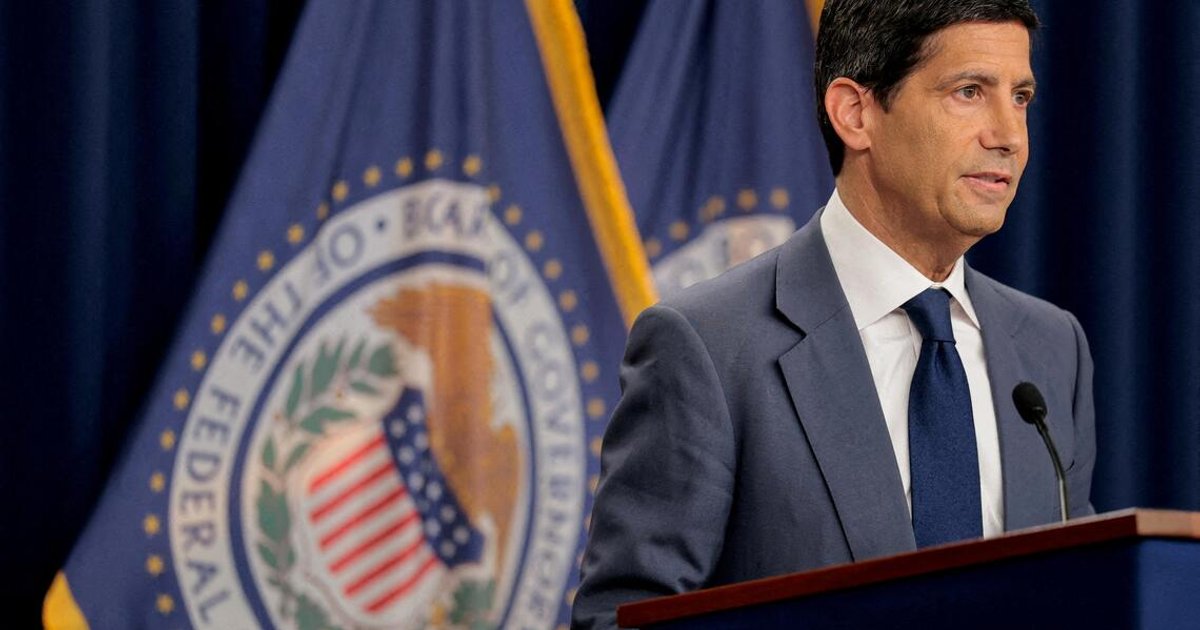
Investors are worried that Federal Reserve chairman Kevin Warsh’s plan to reduce the number of interest-rate decisions each year could be a recipe for more volatility in the US$32 trillion Treasury market.
Announced by Warsh after the Fed left rates unchanged at the Oct 28 policy meeting, the plan would phase in a shift to six rate decisions a year from eight, with the remaining two gatherings reserved for broader strategic discussions. The move, which would cut the number of decisions down to seven next year, is intended to give officials “time and space” for deliberations, he said.
To traders, however, it adds to a broader shift under Warsh toward a less predictable Fed, including his retreat from forward guidance – essentially telegraphing policy moves – that could increase market turbulence over time.
Bigger gaps between decisions could mean the Fed will need to occasionally deliver larger rate cuts or increases, they said. The shift also raises the likelihood of emergency action between scheduled meetings, potentially fuelling bigger swings in short-dated notes and boosting the premium investors demand to hold longer-term debt.
“This is the clearest signal yet that his Fed has no interest in being a vol suppressor in rates, and is perfectly willing to add to volatility with surprise announcements if conditions warrant,” said Isaac Wheeler, managing director of balance sheet strategy at Derivative Path.
Fewer policy decisions could also reduce opportunities for the Fed to tighten monetary policy in the current cycle, during which it is expected to continue raising rates in order to stave off inflation. That is bullish for shorter term yields on the whole, even as policy uncertainty threatens to lift longer term rates, traders said.
The announcement, coupled with Warsh’s dovish tone at the press conference, helped drive a rally in shorter-dated Treasuries on Oct 28. Longer maturities underperformed, steepening the yield curve. Thirty-year yields have risen about 10 basis points relative to two-year yields since Oct 28.
Over the long term, “you’re building more risk premium into the curve because you inject these volatility episodes,” said Scott DiMaggio, head of fixed income at AllianceBernstein.
Regime change
Warsh has suggested that forward guidance limits the Fed’s flexibility and should be reserved only for times of economic crisis.
He has promised to bring “regime change” since taking office in May, and commissioned a task force to examine the US central bank’s communication strategy, including the press conference schedule and the dot-plot of officials’ policy projections.
Warsh first raised the idea of reducing the number of policy decisions at the Fed’s July meeting. On Oct 28, he said the change would allow policymakers to think “anew about big questions”.
The Oct 28 announcement “marks the start of a new era of ‘forward silence’ at the Fed, and further changes to Fed communications,” said Kerry Craig, global market strategist at JPMorgan Asset Management in Melbourne.
For now, measures that gauge rate volatility over a two-year horizon have barely moved, in part because details of the new schedule remain scarce, traders said.
The Fed has yet to say which 2027 meeting will be converted into a strategy discussion, beyond indicating it will be in the fall. Traders and economists say the October meeting, which does not include quarterly economic projections, is the most likely candidate.
The immediate impact may also be limited because most market participants are betting the Fed will be done hiking rates a year from now. Overnight-indexed swaps are broadly flat between the September and December meetings, suggesting little disruption if October is dropped as a decision date.
Still, investors say the longer-term consequences of combining fewer rate decisions with less Fed guidance could be far-reaching.
“Fewer decision meetings plus no forward guidance are a recipe for bigger repricing around each one, and more volatility around rates than markets are currently pricing,” said Ali Hassan, portfolio manager at Thornburg Investment Management. BLOOMBERG

