


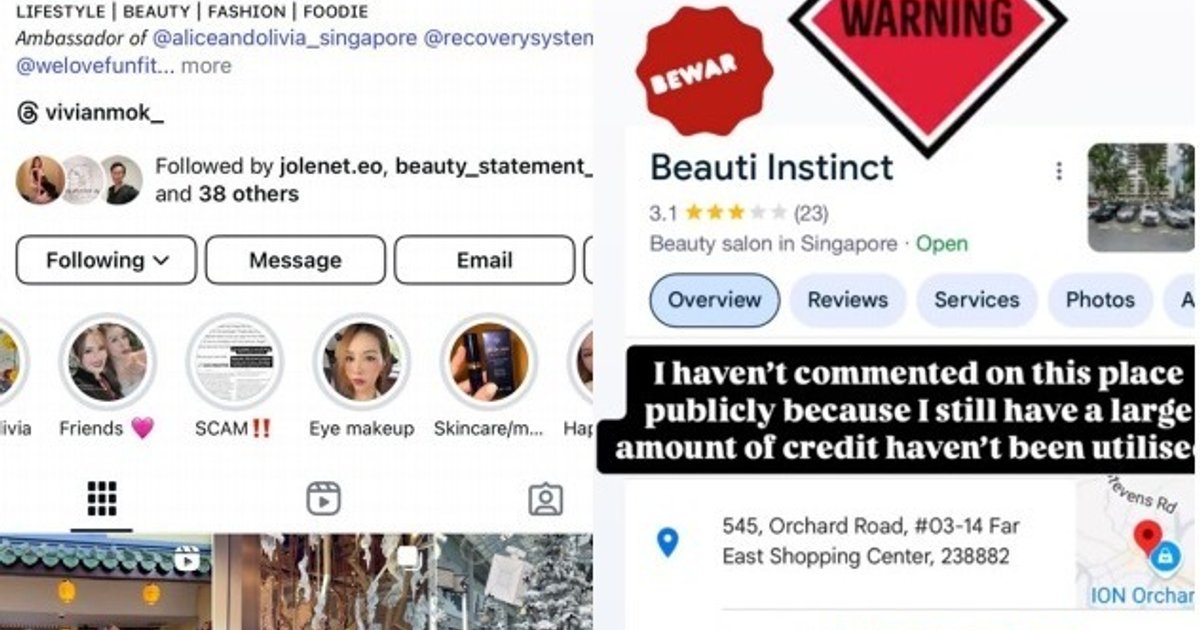
SINGAPORE – A content creator who labelled a beauty salon a “scam” on Instagram after becoming unhappy with its prepaid treatment packages has been ordered to pay the business $15,000 in damages for defamation.
District Judge Sim Mei Ling found that while the customer had genuine misgivings about the salon’s practices, she had not proved that it was an unethical business designed to cheat or defraud customers.
In a written judgment released on Oct 15, the judge also found that the woman did not genuinely believe what she had stated in her Instagram posts, which she had pinned to her profile under the title “SCAM !!”.
However, the judge declined to award the salon additional damages for alleged lost sales, or to grant an injunction to prevent the woman from repeating the allegations.
The court heard that Mok Wai Kwan – who goes by the handle @vivianmok_ on Instagram – had been a customer of Beauti Instinct in Far East Shopping Centre from 2020 to early 2025.
She first bought a six-session “Silk Peel” facial package for $488 through the beauty salon’s website in January 2020.
At her first consultation, salon director Cheang Norita told her that her skin was too sensitive for the treatment and that she needed other treatments, the court heard.
Mok said she felt pressured into signing up for a membership. She eventually bought a trial membership costing $1,000, which gave her 1,000 treatment credits and access to treatments at discounted rates.
In November 2020, she bought a Gold membership for $5,000, which entitled her to 6,340 treatment credits. She later bought promotional treatment packages costing thousands of dollars.
Mok’s unhappiness stemmed partly from occasions when she said she had gone to the salon expecting a treatment but instead spent time discussing packages or buying products.
On one occasion in December 2022, she received a treatment costing $757 when she had only 537 credits remaining in her membership. She had to pay an additional $220.
The salon charged Mok the full price for the treatment and not the discounted member’s rate because her remaining credits were insufficient to pay for the session in full.
Cheang acknowledged in court that she had not told Mok the treatment’s cost before carrying it out.
On this issue, the judge said: “It is good business practice for a business to be upfront and transparent about pricing, so that customers can make an informed choice about whether to proceed. This would also minimise any subsequent dispute.”
Another source of frustration arose in November 2023, when Mok was told that some of her remaining treatment credits could not be used without doing the “Silk Peel” treatment, but she was down to her last credit for that service.
On Feb 13, 2025, after a further disagreement over her remaining Silk Peel credits, Mok decided to stop patronising the salon and give up her unused credits.
By then, she had received treatment at the salon on 26 occasions over about five years.
She then posted a series of Instagram stories recounting her experiences. The posts described the salon as “HELL”, said it should be reported to the Consumers Association of Singapore, and alleged that she had been trapped by an “unethical business model”.
She later pinned the stories to her Instagram profile as a highlight under the title “SCAM !!”. Two months later, on April 11, 2025, she changed the title to “BEWARE!!”. The highlight was subsequently removed around July that year.
The salon sued her for defamation, arguing that the posts portrayed it as a business that cheated customers, engaged in fraudulent operations and used deceptive practices.
Mok argued that her posts merely described the salon’s unethical business practices and were justified by her experiences. She also relied on the defence of fair comment.
The judge drew a distinction between the stories themselves and the additional “SCAM !!” title.
Viewers who saw the stories directly would understand them to mean that the salon employed unethical business practices or had an unethical business model, Sim found.
Those who viewed them through the highlight while it was titled “SCAM !!” would also understand Mok to be accusing the salon of being a business designed to cheat or defraud customers.
The judge noted that although the word “scam” appeared only once, that was enough to convey an accusation that the salon was fraudulent.
The judge accepted Mok’s account of what happened during her first consultation was true and that she had felt trapped and had misgivings about the salon.
But she said Mok had not proved that the salon’s practice of recommending treatments based on Cheang’s assessment of customers’ skin needs was unethical.
The judge also found that Mok had no evidence that Cheang’s assessment of her skin was false, or that the salon director had knowingly made an untrue statement.
“I find that the defendant did not genuinely believe what she stated in her stories,” the judge said of Mok.
Mok had acknowledged that she was not forced to buy the memberships and had benefited from the treatment packages. She continued visiting the salon until early 2025 and had made few documented complaints during that period.
She had also published a promotional Instagram post about the salon in exchange for sponsored treatments.
“At best therefore, this was a case of buyer’s remorse,” the judge said.
The salon had sought $50,000 in general damages, as well as additional damages and compensation for lost business.
The judge awarded $15,000 in general damages, taking into account the seriousness of the allegations, the extent of publication and the circumstances of the case.
But the salon failed to prove that Mok’s posts caused its sales or customer numbers to fall. The judge said the figures showed that the business had already been experiencing a downward trend, and the evidence did not establish that the posts caused the subsequent decline.
The court therefore rejected the claim for special damages and declined to grant an injunction, as there was no evidence that Mok was likely to repeat the allegations.
Costs are to be agreed between the parties or determined by the court.

