


SINGAPORE – The future of chip manufacturing lies in producing customised chips with specialised materials that improve reliability and heat management, and Mi Material sees enormous potential as a major supplier in this sector ahead of its listing on the Singapore Exchange.
The Singapore-based semiconductor materials firm is looking to raise $215 million through its Mainboard share offering, including $139.5 million from the initial public offering (IPO) launched on Oct 19 and $75.5 million from the placements to cornerstone investors.
The offer of 77.5 million shares at $1.80 per share comprises a public offer of 6.2 million shares here and 71.3 million shares offered to institutional and overseas investors. OCBC is the issue manager, and serves as joint bookrunner and underwriter with CGS International.
A separate cornerstone tranche of 41.9 million shares has also garnered interest from seven fund managers, which will account for the remainder of the funds raised. These include three under the Equity Market Development Programme – Amova Asset Management, Fullerton Fund Management and Manulife Investment Management (Singapore).
Mi Material’s public offer closes at noon on Oct 26, and its shares are expected to commence trading on Oct 28 at 2pm.
The solder sphere supplier is one of the two largest in the world, accounting for 24% of the global serviceable market in 2025. Solder spheres are tiny spherical pellets that connect semiconductor chips to circuit boards and packaging in mobile and wearable devices, and in more demanding applications in data centres, edge AI and renewable energy.
Mi Material’s parent company, Bursa-listed Mi Technovation, builds die-sorting and inspection machines for outsourced semiconductor assembly and test companies (OSAT) that handle the final post-fabrication stages of chip-making.
The materials business began as Taiwanese firm Accurus in 1998 before it was acquired by German chemicals giant Henkel in 2006. Following a management buyout in 2010, the firm pivoted to its current business of patented solder sphere manufacturing, which Mi Technovation subsequently took over in 2021.
Mi Material’s total revenue for FY2025 was US$65.3 million, with net profit at US$10 million.
Three of its largest customers – which are end-market chip designers in the premium consumer electronics, AI application-specific integrated circuits, and high-bandwidth memory sectors – made up 50% of its revenue in the financial year ended Dec 31, 2025.
Meanwhile, its top five direct customers, including OSAT and fabrication companies, contributed around 46% of its revenue.
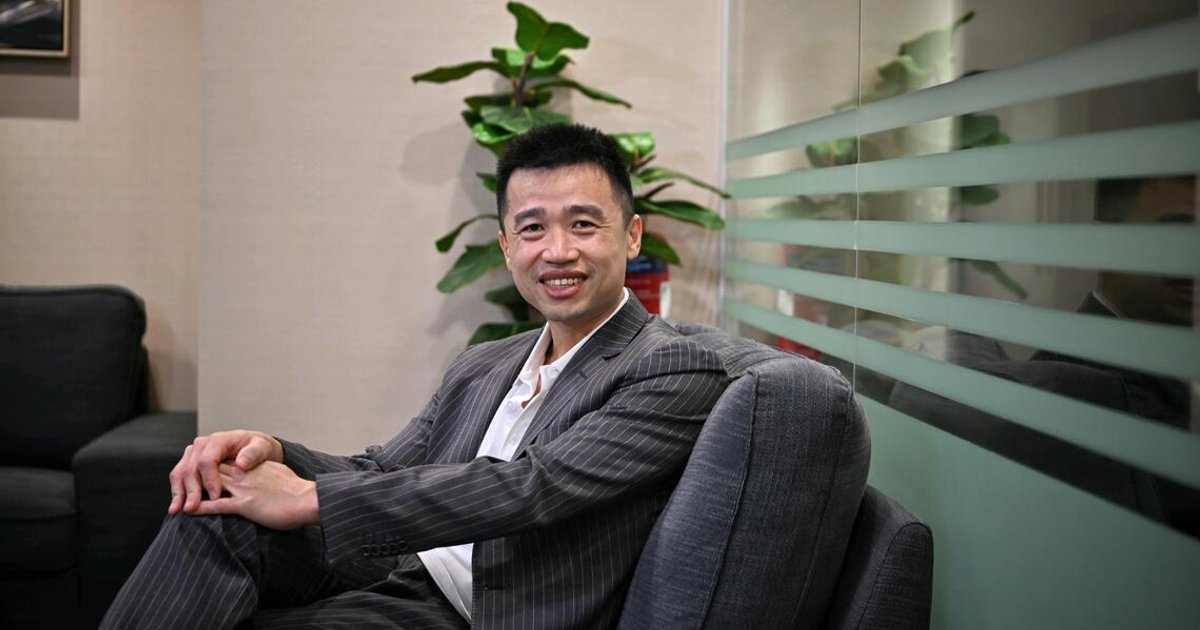
Chief executive Kevin Tan said at a media briefing on Oct 19 that the company has seen its compound annual growth rate (CAGR) rise to around 28% over the last three years, which is rare for a company that has been established for close to three decades.
“Bear in mind that we are not a vanilla IPO where we started from a start-up – in those cases a few hundred per cent increase is very normal. But we are already the top two in the world for this technology, and to grow at 28% CAGR is actually a very difficult thing.”
The company has two facilities in Tainan, Taiwan, and Ningbo, China, and its third facility in Senai, Malaysia, is close to completion, with trial production runs underway. It is expected to have seven production lines by next year.
Most of the IPO’s $168.2 million proceeds will be invested in a research and development centre in the US, which will also serve as a demonstration platform for Mi Material’s US-based clients.
The company will also set up an R&D laboratory in Singapore, bringing it closer to its clients’ regional headquarters, and upgrade its existing facility in Taiwan.
Asked whether the lacklustre performance of recent IPOs on the SGX was a concern, Tan said the company’s priority is to ensure healthy earnings.
“No matter what we tell the investors about the equity story, at the end of the day we must be able to recognise it in terms of earnings,” he said, adding that higher earnings will naturally convince the market about its business performance and sustainability.
“We present a very nice opportunity for investors to have exposure to the semiconductor industry, and yet still be defensive because we are more of a materials business and have recurring sales that are very different from a semiconductor equipment business that is affected by cyclical ups and downs.”
Mi Material aims not only to grow its customer base with more chipmakers, but also to work with existing customers to develop new products for future chip models.
In particular, it will be focusing on developing a new kind of thermal conducting layer using specialty alloys, which will render chips more heat-efficient than conventional models.
The company has already designed three such proprietary alloys, which would allow it to capture a greater market share and higher margin than standard alloys made of tin and silver, Tan said.
He added that longstanding relationships with existing clients, especially the end-market chipmakers, give Mi Material an edge over its competitors, as they can collaborate closely to design new products that would then become new industry standards adopted by the fabrication companies.
Tan cited Mi Material’s strong performance in the third quarter of FY2026 – with revenue growing 15.6% from the previous quarter to US$37.8 million and gross margin stable at 47.5% – as proof that the company’s business will continue to remain resilient amid fears of an AI bubble collapse.
He added that the company is not deterred by the recent tech sell-off on Wall Street that sent tech stocks plunging over the past week, and instead will “focus on the things that we can control”.