


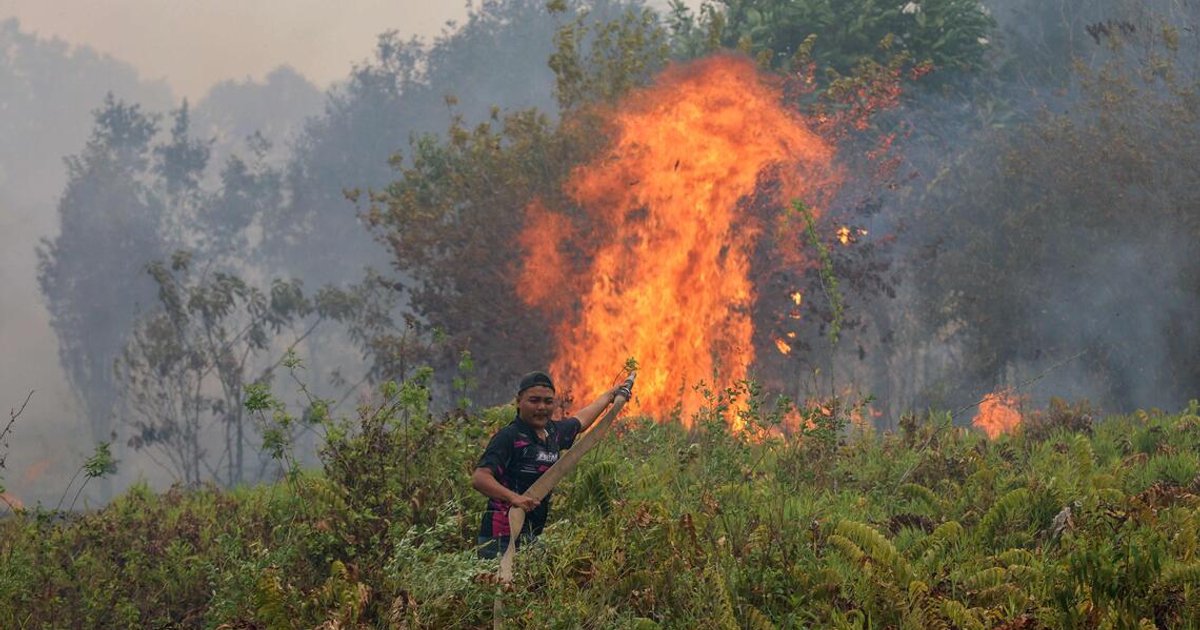
SINGAPORE – As fires continue to burn in Indonesia and smoke spreads across to neighbouring Singapore, the search for those responsible is intensifying.
On Oct 16, Singapore’s National Environment Agency issued preventive measure notices to seven companies in Indonesia, saying there were indications that smoke from fires on their concession lands could have reached the Republic, and requiring them to extinguish the fires and prevent their recurrence.
But investors in palm oil companies, including those listed in Singapore, have a role to play in reducing the risk of another haze crisis.
Beyond asking whether production and profits are safe, they should question how well the businesses they own are managing risks they have prepared for and known about for years, and what more they can do before the next round of burning.
In an Oct 16 Singapore Exchange (SGX) filing, First Resources disclosed that fires in Indonesian’s West Kalimantan had not significantly affected its 2026 production targets or adversely affected its revenue, profit or asset values. The company has an Indonesian subsidiary, ANJ, which operates in the area.
Other oil palm companies listed on SGX have also issued similar statements.
These disclosures may reassure shareholders, but they say little about the costs borne by people and businesses affected by the smoke, or the damage to landscapes and wildlife.
The wider consequences include lost productivity, disruption to tourism and higher healthcare spending in Indonesia and its neighbouring countries, including Singapore. For weeks now, people here have had to adjust their daily routines to manage the haze, while the longer-term health and environmental consequences may take years to become clear.
These costs may not show up in an oil palm company’s accounts, but investors should take them into consideration when deciding whether a business is operating responsibly and if it is worth investing in.
Looking beyond who started the fires
So far, SGX-listed First Resources and Bumitama Agri have come under scrutiny after Greenpeace identified fires and smoke in concessions linked to the two companies.
In response, First Resources said some fires originated outside its boundaries before spreading into areas under its management. Some became too large and fast-moving to contain despite its firefighting efforts.
Similarly, Bumitama said some incidents appeared to have developed outside its directly managed areas before spreading. It said its preliminary investigations had not established evidence linking its operations to the initiation of the fires under investigation.
Meanwhile, Kencana Agri disclosed on Oct 16 that Indonesian authorities were conducting a preliminary inquiry into suspected land clearing by burning at a subsidiary’s concession in North Kalimantan. The group said fires had affected about 62 hectares across its North and East Kalimantan concessions, but maintained that they had spread from neighbouring land.
When queried by Singapore Exchange Regulation about their possible links to the haze, the impact on their operations and their response measures, other SGX-listed oil palm companies like Golden-Agri Resources, Indofood Agri and Wilmar International issued similar statements.
Still, explaining where the fires began does not address how well the companies managed the threat or delivered on its fire-prevention commitments.
Preparations should produce results
The sustainability reports of these companies show that they have long anticipated and prepared for the risk of fires.
First Resources’ 2025 report describes annually updated fire-prone maps, ground verification of hotspots, firebreaks and water storage. It assigned 2,311 firefighters across its operations and trained 773 during the year.
Bumitama’s 2024 sustainability report describes monitoring within its concessions and a two-kilometre zone beyond their boundaries, while its 2025 annual report details thermal-imaging drones, AI-enabled monitoring towers and weather stations to improve early detection.
Golden Agri-Resources said it has a 10,000-member emergency response team and has piloted technology capable of detecting faint traces of smoke up to 17km away.
In an Oct 19 statement in response to SGX queries, IndoFood Agri reiterated that its estates are equipped with firefighting vehicles and equipment, while specialists receive regular prevention and emergency-response training.
In 2025, it conducted 56 fire-control training days across 75 estates and mills. Its community programmes have engaged 130 villages, and it implemented measures required under Indonesia’s tightened plantation fire-prevention rules.
Investors should now ask how well those measures worked, what should follow if evidence shows avoidable failures and what can be changed before the next dry season.
Did the companies get enough warning about how the fires started and began spreading, for example? Were firefighting teams and equipment deployed in time? What prevented them from containing the spread?
Their disclosures also show that fires have remained a recurring problem.
Bumitama recorded 92 fires affecting 91.3 hectares in 2025, causing it to miss its zero-fire concession target, and acknowledge that improvement was needed.
Meanwhile, Golden Agri-Resources recorded 275 fires affecting 317 hectares, compared with 240 fires affecting 324 hectares in 2024.
First Resources said there were 155 confirmed fires within its concessions in 2025, up from 137 in 2024, although this was due to an expanded landholding.
Kencana Agri reported zero concession fires in 2025. Wilmar said it has maintained a strict no-burning policy since 2006, and added that its field activities since 2013 have been limited to replanting at existing cultivated areas. This has been carried out without the use of fire, the company said.
Investors have a choice
To be fair, the companies cannot reasonably be expected to stop every fire. Investors, though, are in the position to ask whether their equipment, manpower and fire-prevention procedures are adequate enough to prevent recurring incidences and minimise the wider economic costs.
Companies’ sustainability disclosures already give shareholders a basis for asking whether management has delivered on these commitments.
When targets are missed, investors should expect explanations on what went wrong and what will change. They have the right to ask for evidence of whether prevention measures are working, including response times, the extent of damage and whether fires recur in the same locations.
Shareholders can press boards to integrate climate-related risks into strategy and capital allocation, set deadlines for corrective action and ask how environmental performance affects management rewards. Where oversight repeatedly falls short, they can vote against the directors responsible.
If management fails to address the risks, shareholders can also choose to sell their shares and withdraw their support of a company.
More prospective investors can also consider a company’s environmental record alongside its financial results, and invest elsewhere if evidence shows that a business contributes to environmental harm without making credible improvements or providing solutions.
With sustainability reporting mandatory for SGX-listed companies, investors have more information to demand accountability beyond growth and dividends. They should use it to question whether the businesses they back are taking responsibility for the environmental and social costs of their operations.
Otherwise, companies may continue to regard assurances that earnings are unaffected as enough, while the wider public bears the cost.