


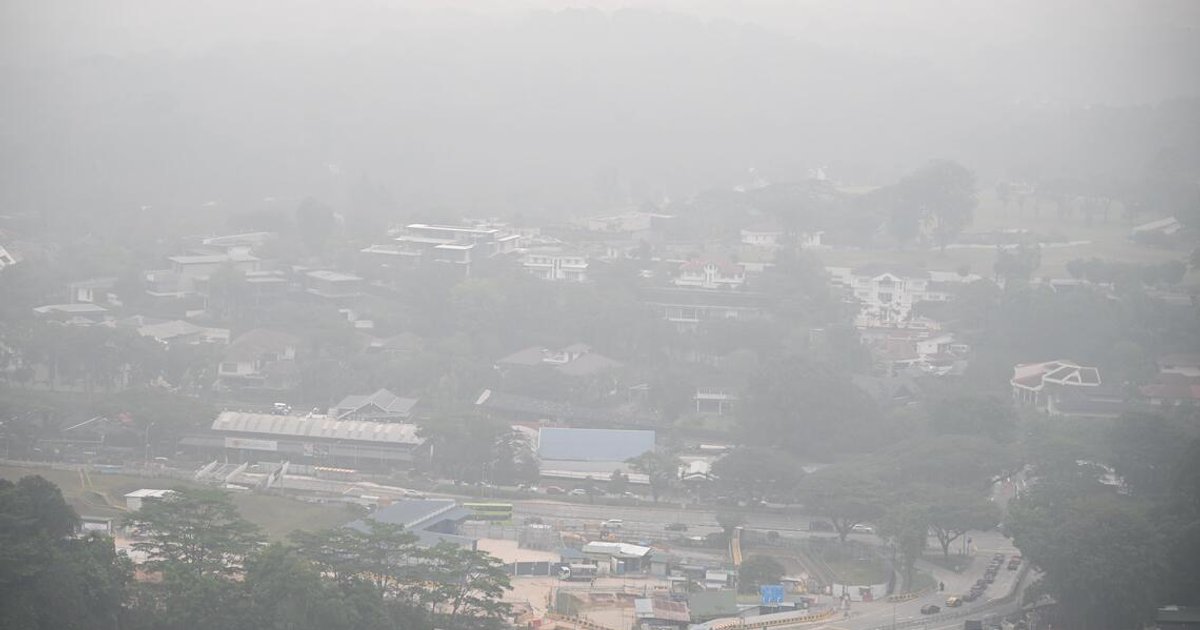
SINGAPORE – The worsening haze across Singapore in recent weeks has cast a pall over the skies and certain stocks.
Palm oil shares took a tumble when some Singapore-listed companies were linked to plantation areas in Indonesia where fires and smoke were detected.
Prime Minister Lawrence Wong also said on Facebook on Oct 15 that Singapore is looking into which companies may be responsible for haze-causing fires.
He added that Singapore will take action under its Transboundary Haze Pollution Act and explore joint action with other countries, where warranted.
The law, which was enacted in 2014, targets those responsible for causing or condoning fires if the haze causes the Pollutant Standards Index (PSI) to stay in the unhealthy range in any part of Singapore for 24 hours or more.
Air quality is considered unhealthy when PSI levels are 101 and above. The PSI levels have been over 200 in some areas over the last few days.
Agribusiness group Wilmar International and palm oil company Golden Agri Resources were among the Singapore-listed firms that have addressed their involvement in the ongoing forest fires in Indonesia.
In response to queries on Oct 16 from the Singapore Exchange Regulation, both said that they have no-burning policies in place.
Golden Agri said that it “is not aware of information indicating that its operations or activities have caused or contributed to the recent transboundary haze”.
Wilmar said that it has not undertaken any new oil palm planting in its plantations in Indonesia since 2013. Since then, the firm’s field activities in Indonesia “have been limited to the replanting of existing planted areas, which is carried out mechanically and without the use of fire”.
Meanwhile, palm oil company Bumitama Agri said that some of its operations in Indonesia were affected by fires spread from surrounding land.
In a Singapore Exchange filing on Oct 16 evening, it said that based on internal observations and preliminary investigations, “no evidence has been established linking the Group’s operations with initiation of the fires under investigations and to the haze in question”.
The firm, which had earlier called for a trading halt, was named in an investigation by environmental group Greenpeace along with Singapore-listed palm oil company First Resources.
First Resources on Oct 15 said the fires detected within its Indonesian palm oil concessions were largely caused by external blazes spreading across its boundaries.
Privately held company First Borneo Plantations, which has ownership links to Singapore-incorporated companies, was also named in the Oct 5 report.
The report identified plantation concessions associated with the three companies where fires and smoke were detected between August and September. A concession grants a company the right to use or develop an area of land.
Wilmar’s shares closed 1.2% down on Oct 16, while Golden Agri-Resources saw shares tumble 3.5%.
First Resources saw shares fall by nearly 7%.
Bumitama Agri’s prices fell by 4.8% before the company requested for a trading halt before the afternoon session.
Deluge starts trading on the SGX
In a quirk of timing, fire-protection specialist Deluge started trading on the SGX mainboard on Oct 16.
Its initial public offering (IPO) was 3.86 times subscribed. The offering comprised 15.6 million shares at $0.60 apiece. Of these, 14.8 million were placement shares, and 800,000 were for the public offer.
The gross proceeds from the offering and cornerstone tranche are about $23.4 million. After deducting listing expenses, net proceeds are expected to be about $20.1 million.
Deluge said it plans to use the proceeds to invest in infrastructure, facilities and operational capabilities, pursue strategic partnerships through installations and lifecycle services, and strengthen its integrated fire-detection platform.
Deluge opened at $0.63 and closed 6.7% higher on its first trading day at $0.64.
Tech stocks recover
Tech stocks started to show signs of recovery on Friday after a six-day rout that wiped some US$1.6 trillion off global semiconductor stocks.
Hotter-than-expected US inflation data stoked fears of further Federal Reserve rate hikes, along with unease over AI investment, causing the S&P 500 to fall 1.11% – its largest margin since July – while Asian markets also tumbled.
Investors have questioned whether companies borrowing heavily to build AI infrastructure can generate enough cash to service their debts.
Chief executive Hock Tan of semiconductor and infrastructure software company Broadcom added fuel to the fire at a DBS AI event here on Oct 12 when he likened AI investors to gambling in a casino.
Asian markets, however, recovered ground on Oct 16, with South Korea’s benchmark Kospi index jumping nearly 4%, after falling over 7% the day before. Japan’s Nikkei also rose nearly 2%, after falling 5% on Oct 15.
US Federal Reserve boss Kevin Warsh also buoyed tech sentiment by saying he believed AI was the most consequential change to the global economy, predicting positive effects even though the path forward might be “bumpy”.
Speaking at the International Monetary Fund (IMF)-World Bank Annual Meetings in Bangkok on Oct 16, he said AI would bring “huge benefit” to the global economy, although the investment boom would drive prices up in the short term.
Analysts also pared their bets on a rate hike, as Warsh did not dispel expectations of a rate hold at the next Fed meeting at the end of October. He reiterated that the Fed will deliver price stability.
The S&P 500 recovered slightly, by 0.33%, while the Nasdaq rebounded by 0.08% on Oct 16, but both dipped again as the day wore on.
SGX delivers resilient performance, adds AI-themed SDRs
Investors gained access to five companies across the global AI value chain through new Singapore Depository Receipts (SDRs) that started trading on the Singapore Exchange (SGX) on Oct 16.
The new SDRs cover chipmaker TSMC, semiconductor firm SK Hynix, memory-interface chip producer Montage Technology, optical interconnect solution provider Zhongji Innolight and large AI model developer Z.AI.
SGX said these new SDRs allow investors to access leading Hong Kong- and US-listed growth stocks in smaller denominations.
Investors can also trade in Singapore Dollar, with no foreign exchange conversions needed. They can also conveniently access these stocks through the SGX during local trading hours.
SGX also announced four new Singapore Dollar-traded ETFs that offer exposure to the S&P 500, Nasdaq and developed markets.
The four Xtrackers UCITS ETFs are eligible under the Supplementary Retirement Scheme (SRS) and give Singapore investors more ways to add global market exposure into their portfolios, SGX said.
SGX Group head of global financial markets Ng Yao Loong said: “Investing globally should not mean having to look offshore.
“With these four low-cost ETFs trading in Singapore dollars on SGX, Singapore investors can access established US and developed market strategies through the home exchange they are already familiar with.”
Also listed on the SGX was a Belt and Road Bond Index ETF, which tracks a diversified portfolio of renminbi-denominated bonds linked to China’s Belt and Road Initiative.
Separately, SGX announced resilient performance for September, with securities market turnover rising 27% year on year to $42.2 billion.
The exchange said this performance came as “global investors sought trusted markets and risk-management tools amid persistent uncertainty marked by elevated energy prices and higher borrowing costs”.
The Straits Times Index (STI) notched another record to 5,801.96 on Sept 4, up 22% year on year for the July-to-September period, making it the best-performing ASEAN bellwether over the period.
Retail investors were net buyers of the Index segment for a third straight quarter, with net inflows climbing to a high of $1.18 billion over the three months, SGX said.
The STI closed up 0.22% at 5,415.53 on Oct 16.
September was also a record month in net inflows to STI exchange-traded funds (ETF), with $293 million of net creations lifting combined STI ETF assets under management to above $6 billion for the first time.
It also marked 19 successive months of net inflows to STI ETFs totalling $1.96 billion, SGX said.
Meanwhile, gold ETFs attracted $163 million in net inflows to extend a record streak to 28 months, bringing cumulative net inflows over the period to $2.9 billion.
SGX was trading up 0.5% to $21 on Oct 16.
Other market movers
Sheng Siong recovered slightly after its stock tumbled earlier in the week, as analysts downgraded the supermarket, citing a weaker growth outlook.
Analysts said that Sheng Siong has benefited from resilient consumption, market share gains and targeted vouchers that channelled spending directly to supermarkets, but that support is weakening.
The supermarket’s shares closed up 0.7% to $2.84 on Oct 16.
Meanwhile, Jardine Matheson upgraded its earnings guidance, stating that underlying earnings for 2026 are expected to be between US$5.50 and US$5.65 per share, up from the previous guidance of US$5.33 per share.
This comes as the stock emerged as one of the highly traded board lots, after SGX cut standard board lot sizes for an initial 11 stocks on Oct 5.
Separately, Malaysia’s king acquired a 2.25 per cent stake in Singapore-listed Southern Alliance Mining. The $6.1 million deal came as the iron ore producer expands its presence in Malaysia’s rare earths industry.
Sultan Ibrahim Iskandar acquired the stake at $0.425 per share, the company said in a filing on Oct 13.
What to look out for next week
Singapore will be releasing its consumer price index on Oct 23, which tracks core and headline inflation in September.
The US will also see a big earnings week where firms report their third quarter earnings. This includes 74 companies on the S&P 500. Names to watch out for include Tesla and IBM.