


SINGAPORE – Applying artificial intelligence is not enough – it has to be harnessed towards intentional business and work outcomes, said DBS chief executive Tan Su Shan on Oct 12.
Human judgment is also vital in AI usage, said TikTok CEO Chew Shou Zi.
The CEOs were speaking separately at the inaugural DBS Asia Future Forward Conference at the Suntec Singapore Convention and Exhibition Centre. Organised by DBS, the new flagship event brings together global leaders across technology, business and investment to examine the forces shaping the region’s future.
In this first edition, the focus was on artificial intelligence (AI) and how such technology is transforming industries, business models and the nature of work.
Tan spoke about Asia’s emergence as a region and how it has proven that AI can be brought to everyday use cases, from enterprises to solving health issues and supporting finance.
“I think Asia’s proven and shown that we are able to use AI for good business outcomes and good human outcomes – whether it’s to help the elderly at home, whether it’s to redesign workflows,” she said during her opening address.
She added that simply applying AI is not good enough.
“We call that AI lipstick. That’s not going to work,” Tan said.
“What we have to do is we really have to rethink our workflows and our work processes so that we can truly unlock our potential. So just adding AI in it might help marginally, but it’s not going to change the way we work.”
She made these remarks in conjunction with the release of a DBS report on AI outcomes. The report noted that as AI capability becomes more widely available, technical advantage becomes harder to sustain.
“Competitive advantage increasingly depends on identifying important problems, earning the trust required for adoption and connecting intelligence to real-world outcomes,” it said.
The report said that businesses can start with the intended outcome.
“Redesign workflows, partnerships and operating systems around that outcome, then demonstrate that it improves organisational performance and delivers measurable value for customers,” it said.
It added that for Asia, the challenge is to turn regional strengths into shared advantage.
Tan also said in her speech that countries need to be better connected with one another, and mentioned agreements such as the Regional Comprehensive Economic Partnership (RCEP) signed by 15 Asia-Pacific countries, and the Future of Investment and Trade (FIT) Partnership, which was co-convened by New Zealand, Singapore, Switzerland and the United Arab Emirates.
Better connections have to be made, even while countries become increasingly protectionist, Tan said.
She noted that AI depends on everyone trading with one another, because each country has its own niche area. For instance, Taiwan has the semiconductor foundries, South Korea has the memory components, and the raw materials come from China and South-east Asia.
“So if we don’t cooperate, we will continue to have blockages in our AI supply chain. Even if we want sovereignty, you need to have some trade cooperation,” Tan added.
“So stay connected, but keep your sovereignty with your models or data. We have sovereignty, but we also stay connected.”
She added that AI has created both visions of a dystopian future where technology takes over, or a utopia where AI helps to solve many issues.
“What we need now is for humans to exercise good judgment, good wisdom, good creativity to ensure that this AI journey that we take together as a human race will take us up the right path,” Tan said.
Chew said during a panel discussion that human judgment is also important in AI.
He brought up the “paperclip example”, which suggests that if a machine is asked to produce more paperclips, it ends up doing only that one thing at the expense of everything else.
“My view is that in the next two to three years, we’re going to have a real scientific breakthrough: physics, biotech, chemistry, material science, because of AI,” he said.
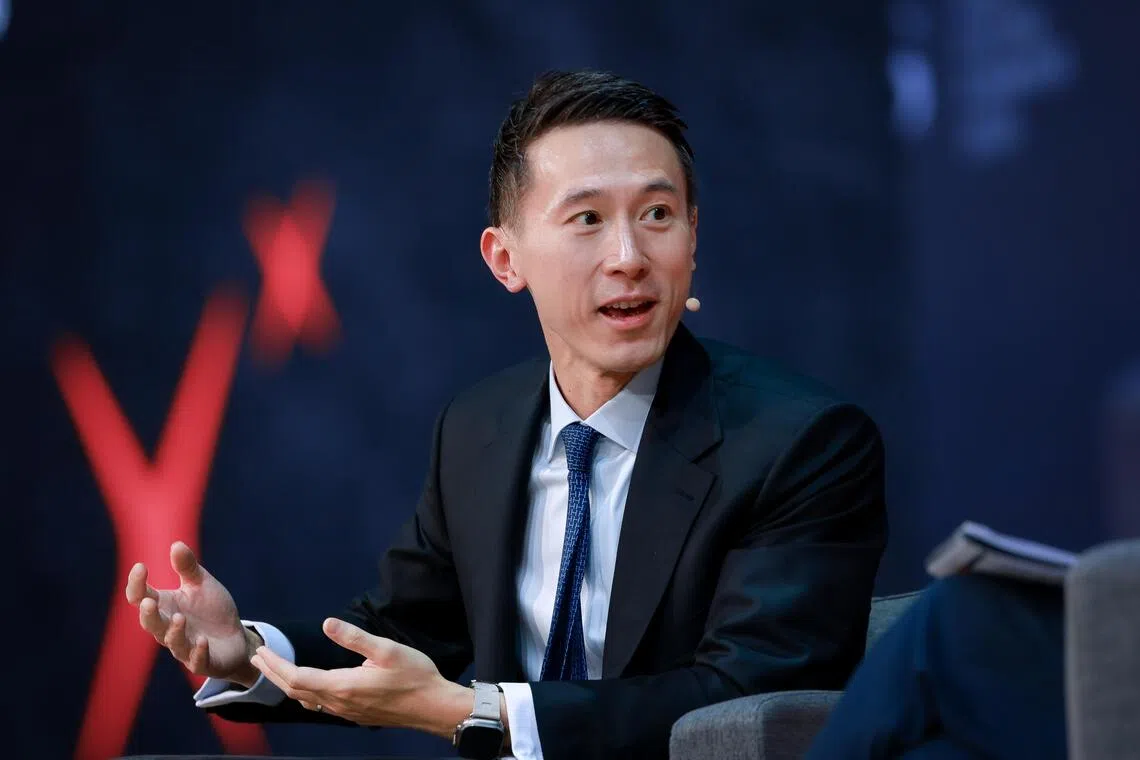
TikTok CEO Chew Shou Zi speaking at the DBS Asia Future Forward Conference at Suntec Convention and Exhibition Centre on Oct 12.
ST PHOTO: GAVIN FOO
“It’s very, very, very possible. And if that happens, then you know the question will be: How do you align the models? How do you align the machines to be doing things that is obvious to us as human beings?” he said.
Chew added that for humans, the boundaries of what should be done morally and ethically are “very obvious”, but it is not do for technological machines.
“I think it really is a very complex issue but it will matter in the age of AI,” he said.
Human creativity is also a very relevant question especially for TikTok, Chew added. He noted that AI content has not totally taken off yet, and views are in the low single-digit percentages.
“I think people still value authenticity when they see a video, and it’s very obviously … artificially generated. I think there’s still a little bit of pushback in terms of consumption. People still want to see very real, very authentic things. So I agree that human creativity will continue to be important,” he said.
Chew added that in the long term, AI agents might do more things autonomously, especially as the trust and guardrails are built.
But in the short term – referring to the next two to three years – Chew said that what matters is developing skills to be able to use AI effectively.
“I think that’s probably the most important thing for us internally. We are encouraging not just our engineers, but also our lawyers and people working in corporate functions, to have more first-hand experience,” he said.
“If you don’t use these products yourself, you cannot figure out what exactly it can or cannot do just by reading about it.”
He added it is about being curious and hands-on, while understanding the boundaries of this technology.
Education is also important, he said, especially as AI does bring cybersecurity risks with it.
This is particularly so when users give agents permission to do things for them, such as credit card permissions, without fully understanding what the technology does.