


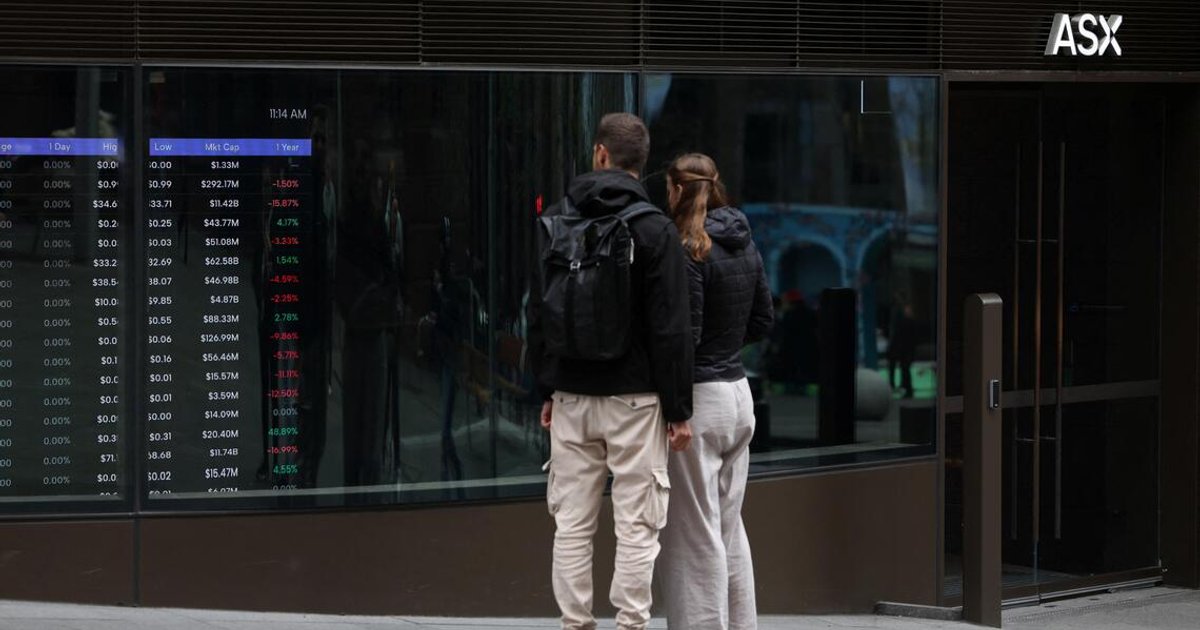
The dramatic cancellation of an Nvidia-backed data centre company’s initial public offering is revealing fresh cracks in the AI funding boom.
The planned US$5.5 billion (S$7 billion) listing by Australia’s Firmus Grid foundered after the deal failed to attract enough support for the A$11 marketed share price. Some investors turned cautious just days after the company said it received indications of interest well above the offer size, putting it on track for a US$30 billion valuation.
After closing order books on the morning of Oct 9 Sydney time, Firmus announced it was withdrawing the IPO and would pursue capital from private markets, confirming earlier reporting by Bloomberg News.
The failed deal underscores growing concern over how much capital AI infrastructure companies are demanding from public markets at a time when borrowing costs are rising.
Much of Firmus’ valuation was based on the company successfully building a pipeline of data centres across Asia serving customers such as Meta Platforms and OpenAI.
Currently it operates two data centres. The IPO proceeds were needed to help fund construction of the broader network.
“Investors still believe in AI,” said Maxence Visseau, Dubai-based chief investment officer at Arkevium Capital, a multi-strategy investment firm. “What they won’t do is pay any price for companies that spend huge amounts on data centres, depend on a few big customers, and promise profits years from now.”
Concerns about Firmus ranged from its lack of a proven track record to high valuations and the risk that existing shareholders could flood the market soon after listing – with about 58% of shares free to trade from day one – according to discussions with at least 10 investors and advisers.
Increasing regulatory scrutiny and tighter financing conditions of data centres were also cited as a deterrent.
In its Oct 9 statement, Firmus said that due to “recent market volatility and prevailing market conditions” the board decided that the terms on which the IPO could proceed would not “appropriately reflect” its business and long-term growth outlook.
UniSuper, one of Australia’s biggest pension funds, was among institutional investors that did not take part in the IPO process.
“We think that Firmus indeed has a compelling story. It just doesn’t have a compelling valuation,” chief investment officer John Pearce said in an investor update published on Oct 8. “So much has to go right to justify the valuation.” The fund was also concerned that Firmus would have to continue to raise debt and equity to fund its expansion plans, he said.
“Investors are increasingly on edge,” Phil Wool, head of portfolio management at Rayliant Global Advisors, said on Oct 8. “Firmus was going to be one of the biggest Australian IPOs ever, so from that perspective, it registers as a historical fail.”
Firmus was founded in 2019 as a bitcoin miner by Oliver Curtis – who served a prison sentence for insider trading – as well as Tim Rosenfield and Jonathan Levee. The company became the subject of tabloid fodder in 2026 as the prospect of an IPO materialised, partly due to Curtis’ criminal background and his partner being PR executive Roxy Jacenko, a prominent socialite.
Around the world, investors are beginning to question the ambitious targets and lofty price tags attached to AI endeavours.
In September, data-centre company Accelevation Holdings priced its US debut below its marketed range. South Korea’s Kospi is down 27% from its June peak as a boom around memory chipmakers Samsung Electronics and SK Hynix subsided.
Warnings about inflated valuations are getting louder.
Billionaire Ray Dalio said this week that AI is a “classic bubble” that is near bursting due to the huge amount of debt taken on to fund the technology and rising rates. Michael Burry, famous for betting against the US housing market before the financial crisis, said in an X post on Oct 6 that the stock market is “quite obviously in its first stage of grief, denial. Per 2000 and 2008, this stage lasts six to nine months”.
Bain & Co projects the AI industry needs to earn US$6 trillion in annual revenue by 2031 to justify the capital being deployed to build data centers.
Investor scepticism
Firmus was valued at US$10.5 billion in early August after a fund-raising round which included Jane Street and Blackstone, meaning it was looking to nearly triple its valuation in two months.
The Australian company, which had revenue of US$51 million in the 2026 financial year, plans to build data centres it calls AI factories using hardware from backer Nvidia. It has a pipeline of 912MW, of which only 46MW has been built, according to investor documents seen by Bloomberg.
“There’s a lot of investor scepticism in terms of this IPO,” said Jun Bei Liu, co-founder and lead portfolio manager at Ten Cap Investment. “The challenge is they are yet to build a lot of those data centres,” she told Bloomberg Television on Oct 8.
Companies are increasingly running into resistance when building data centres. Oracle cited force majeure in late September in relation to its New Mexico data centre project. Apollo Global Management is working to ensure the AI infrastructure deals it finances do not get derailed by local opposition, its head of infrastructure Olivia Wassenaar said on Oct 7.
Some AI cloud companies are turning to risky debt to raise capital. At the same time as JPMorgan Chase & Co was joint lead manager on the Firmus listing – along with Bank of America, Morgan Stanley and Morgans Financial – it was also pitching a yield of about 11% on a US$5 billion leveraged-loan sale on behalf of Volta Infrastructure Holdings to finance a data centre complex in Norway.
Reflecting concern over the fate of Firmus’ IPO, shares of Maas Group – which holds a stake in the company and has at least A$855 million (S$760 million) in electrical infrastructure contracts tied to its buildout – fell by a record 30% in Sydney on Oct 8, before paring losses to 22%.
What was supposed to be a blockbuster share sale has turned into a lesson on hubris. But with KKR & Co estimating US$8 trillion is needed to complete the global AI buildout, pressure will only intensify for companies to raise capital. That includes Anthropic, which is targeting a mega IPO as early as November.
“I don’t think it will be the last AI-related IPO to disappoint as enthusiasm for the theme crests and investors grapple with just how much future growth the last couple years’ tsunami of issuance will require to make any financial sense,” said Rayliant’s Wool. Bloomberg

