


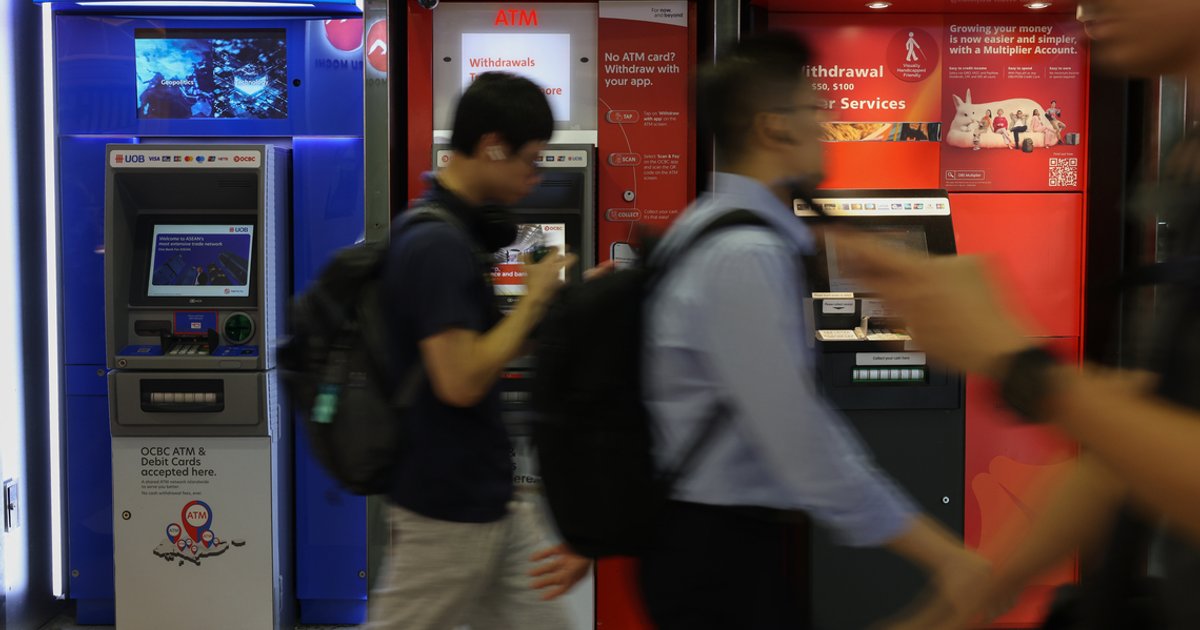
SINGAPORE – Shares of Singapore’s three local banks extended their losses on Oct 8 following declines the day before.
At the midday trading break, OCBC shares were down 4.29% to $29, with over 14.9 million shares changing hands.
DBS shares fell 4.48% to $74.02, with more than 9.6 million shares traded, while UOB declined 4.92% to $40.35, with 4.14 miliion shares changing hands.
Charu Chanana, chief investment strategist at Saxo, said the continued weakness in Singapore bank shares appears to reflect profit-taking, concerns over earnings expectations and broader volatility in global bond markets.
Citi on Oct 7 cited softer-than-expected third-quarter 2026 earnings expectations for OCBC and downgraded the stock to “sell”.
The downgrade also raised questions about whether market expectations for Singapore-dollar interest rates are too optimistic, and whether the banks can sustain their strong wealth-related income from the first half of the year.
Higher global bond yields are also adding pressure, as they could weigh on credit demand, bond portfolios and investor appetite for dividend stocks.
Still, the recent declines are not expected to be start of a prolonged downturn across the banking sector, given the lenders’ strong capital positions and dividend support.
“In the near term, further volatility is possible as investors reassess earnings expectations and valuations,” said Chanana.
“A more sustained recovery would likely depend on third-quarter earnings showing that net interest margins (NIM) remain resilient and recurring fee income can offset any normalisation in wealth-related revenue.”
NIM is the core profitability metric for banks and measures how much money a bank makes on its loans and investments compared to the interest it pays out on deposits and borrowings.
James Ooi, market strategist at Tiger Brokers, said higher Singapore-dollar interest rates may not necessarily benefit banks, as rising funding costs could offset the higher returns earned on loans and other assets.
“For banks, what matters is not just where rates are going, but whether asset yields can keep pace with rising funding costs to defend net interest margins,” he said.
Ooi added that the upcoming earnings season in about a month should provide a clearer picture of whether these concerns are reflected in the banks’ financial results.
Eugene Koh, sales trader at CMC Markets Singapore, said DBS has the strongest profitability among the three banks, but its premium valuation means that earnings which merely meet expectations may not be enough to support its share price.
For OCBC, investors will be watching whether its strong fee, trading and insurance income in the first half of the year can be sustained, while UOB faces the risk of higher credit costs eating into revenue growth despite its less demanding valuation.
Koh expects trading to remain volatile ahead of the banks’ results in November, although their strong profitability and capital buffers suggest that a “balance-sheet crisis” is unlikely.
“A sustained recovery needs resilient underlying earnings, controlled credit costs and reassurance that capital-return commitments hold. Better sentiment alone will not be enough,” he said.
Share prices of the three Singapore banks recently hit record highs – DBS and OCBC’s in early September, and UOB’s in July.
They were among 11 stocks that were selected for board lot size reduction and saw immediate trades in the smaller trade sizes on Oct 5, according to SGX.
From Oct 5, for stocks priced between $10 and $100 a share, the minimum trading quantity was cut from 100 units to 10.

