


SINGAPORE – Shopping with real money helps children become more financially savvy.
This thought crossed my mind while volunteering on a shopping trip with UOB Heartbeat volunteers on July 22.
I was paired with UOB’s Ho Ying Ying and Najwa Chua, 12, who has participated in these outings since she was eight.
We began by reviewing the shopping list that Najwa had put together with her parents, before taking a short walk to FairPrice at Rivervale Plaza.
Najwa went about getting the items on her list: bananas, grapes, 30 eggs, chicken and bread.
Since the chicken was on sale, she picked up two packets. After all, her family loves curry chicken.
However, she had to forgo her favourite Lay’s sour cream potato chips because they did not fit her budget. Instead, she opted for two packets of FairPrice house-brand chips, which were on sale.
Najwa tried to keep a running tab in her head, but got overwhelmed as her shopping basket filled up, and she asked to borrow Ho’s phone to check the final sum.
Her careful budgeting left her enough to buy a bottle of Thai sweet chilli sauce that her parents love. Her final bill came to $49.98, within the $50 she was allocated.
It was clear that Najwa actively looked out for deals and knew which brands offered more bang for her buck.
She shared that she had picked up budgeting skills and practical tips from the volunteers during previous shopping stints.
A spokesperson from Children’s Wishing Well, the charity leading this financial literacy initiative, said that these hands-on experiences and interactions with the volunteers have helped Najwa become more confident in making spending decisions.
Today, she knows how to manage her money and adapt her choices to stay within her budget – and not just on these organised shopping runs.
Her mother has even entrusted her with the family’s weekly provisions, allowing her to head to the supermarket after school to buy the items on her own.
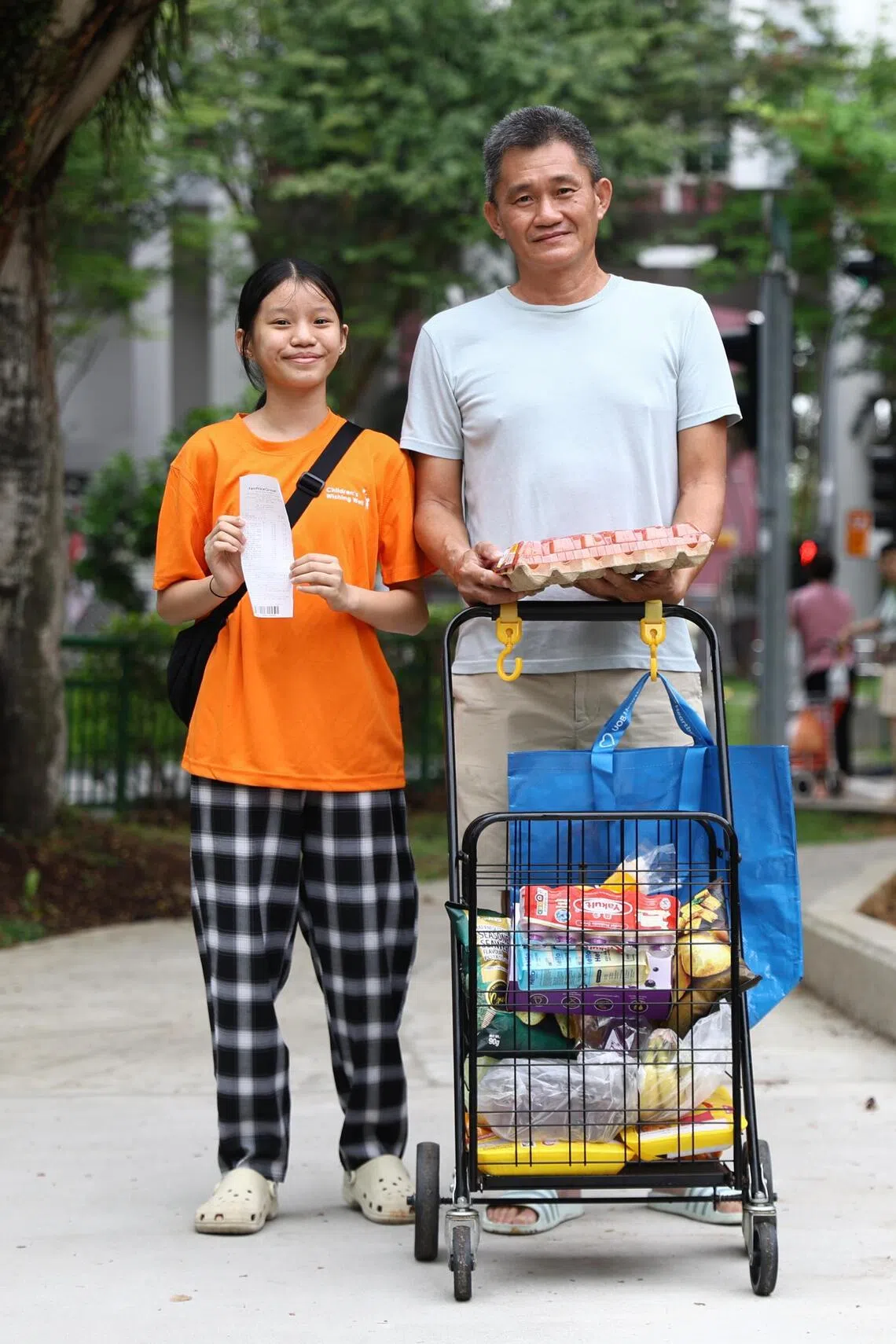
Najwa Chua Ai Xin (left), 12, and her father, Chua Peng Huat, 54, with her grocery purchases and receipt.
ST PHOTO: SARAH LEE
Hearing how much Najwa has grown, I thought: “Why not try this out on my daughter?”
She is in Primary 2 and will turn eight later in 2026.
I started by increasing her daily allowance for school meals to $5, which she can use for both her morning snack and lunch.
The experiment is still a work in progress.
While her school has taught her about needs and wants, she still tries to justify her wants as a need.
Once, she spent $2.50 at the bookshop on a mechanical pencil and pencil leads.
When I asked why she bought them when she had normal pencils, she replied, “I need the mechanical pencil to write.”
My daughter chose to spend on her perceived “need”. With only $2.50 left for the day, she spent $1.80 on two cheese sticks for her morning snack and decided to skip lunch – which to me is a “need”.
Hoping to drive home the “needs versus wants” lesson through play, my husband and I decided to take our daughter to explore Curiosity Cove.
During our visit, my husband observed that the financial literacy elements at Curiosity Cove are more of a sideline, and the educational concepts are relegated to “secondary amusement” for the children after they finish playing.
Venturing outside Curiosity Cove, we spotted some activity stations around the Mandai area.
One station focusing on needs and wants required children to build a virtual buggy. To do so, they had to decide which car parts they needed to buy and which parts they could skip.

The Super Savers Trail at Curiosity Cove, one of the outdoor stations taught children about needs versus wants.
ST PHOTO: CHOR KHIENG YUIT
Another station touched on savings and interest. By shifting a marker on a slider board, children can see how interest grows as their savings increase – so the more they save, the more they earn.
However, these displays would not automatically spur any meaningful discussion or learning unless parents step in to talk about the concepts, using the posters to convey the financial lessons to their children.
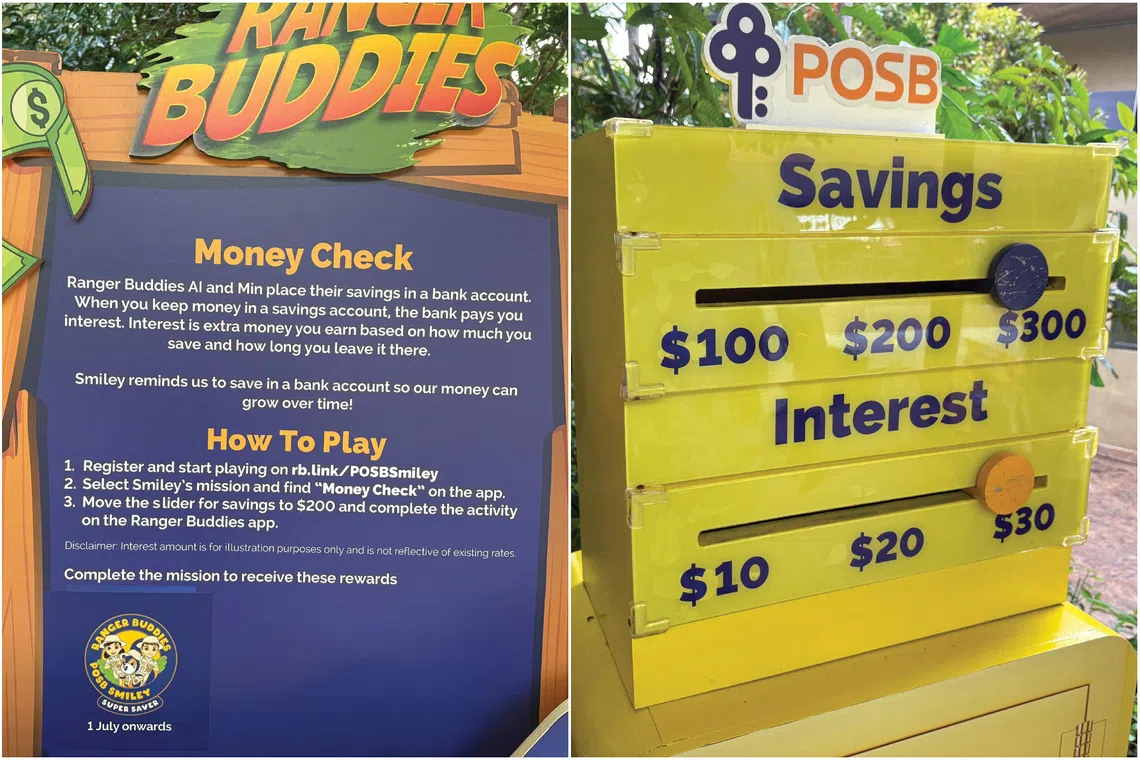
A simple visualisation of how interest grows as children save more.
ST PHOTOS: CHOR KHIENG YUIT
Banks are offering digital tools to keep that dialogue going.
Nelson Neo, DBS’ head of retail banking and head of POSB, noted that the Smart Buddy app enables parents to keep tabs on their children’s spending.
“Knowing their spending habits allows the parents to have conversations with their children in a very meaningful manner,” Neo said.
For me, that conversation is a daily routine. Every evening, I find myself asking my daughter something along the lines of: “You spent $1.30 at the bookshop today. What did you buy again?”
Her replies have ranged from “I bought scotch tape” and “I bought rubber bands”, to “I bought a highlighter” and “I bought five flag erasers”.
There is always something she “needs” from the bookshop.
She has started to pause before telling me what she bought. Has my daily nagging made her more aware, or has it just made her more guarded?
Perhaps that is what raising a money-smart child looks like: not one big lesson, but a series of small conversations, experiments and everyday decisions. Now, how can I take a leaf from Curiosity Cove and make it fun?

