


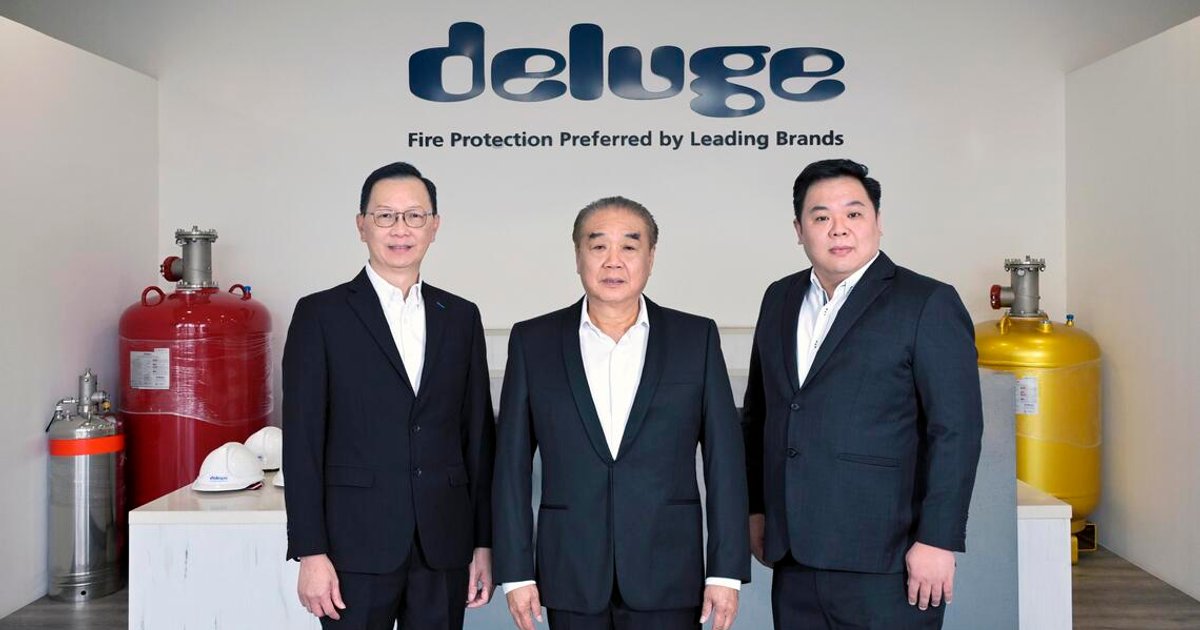
SINGAPORE – Homegrown fire protection company Deluge is looking to raise gross proceeds of $23.4 million for new infrastructure and acquisitions through an initial public offering (IPO) on the Mainboard of the Singapore Exchange.
The company on Oct 6 lodged documents for the IPO comprising 15.6 million shares at 60 cents per share, with 14.8 million placement shares and 800,000 public offer shares. A separate cornerstone tranche will account for the remainder of the funds raised.
SAC Capital is the issue manager for the IPO, and serves as the joint book-runner and underwriter with Maybank Securities.
Deluge’s shares are expected to start trading on Oct 16.
Before deciding to take the company public, Deluge founder and chairman Vincent Cheo said he had been in discussions to sell the business to Hong Kong-based conglomerate Jardine Matheson.
Founded in 1983, Deluge specialises in fire suppression systems, fire alarms and fire-fighting equipment, spanning the full fire protection lifecycle from design, prefabrication and installation through to maintenance and servicing.
These include active fire systems such as fire alarms and water-based sprinkler systems, as well as passive fire systems like fire-resistant structural elements.
The majority of Deluge’s business – around 92% – is primarily based in Singapore. The company recently began expanding into the data centre sector in Johor, and counts Singapore-based operator DayOne, as well as construction companies Sunway and Gamuda, as customers.
As at March 31, Deluge had an order book of $410 million, of which 87% comprised of government contracts.
These contracts helped Deluge secure the largest share of Singapore’s fire-protection market in 2025, at about 8.3 per cent, according to Frost & Sullivan.
In addition, it is one of only eight contractors in Singapore to hold the highest L6 grade certification from the Building and Construction Authority, which allows it to bid for jobs of unlimited contract value.
Chief investment officer John Paul Chen told analysts and the media on Oct 2 that Deluge’s 8.3 per cent share of a market comprising 775 fire-protection contractors pointed to a highly fragmented industry, presenting significant scope for growth through acquisitions and consolidation.
A highly fragmented industry is one made up of many small competitors, with no company controlling a large share of the market.
Chen noted that the current market is “very disorganised with low accountability”, which could pose a danger to residents and building tenants.
“If your condo is being maintained by six different fire contractors over a 10-year period, I think you should be worried because everyone would not know what they are checking, and I think that’s a problem.”
With consolidation, Deluge would be able to ensure that smaller contractors are accountable for their work, and “eliminate” those that are not compliant.
Since its founding, it has secured projects totalling more than $1 billion across Singapore’s critical infrastructure, including a $109 million contract in relation to the ongoing construction of the North-South Corridor, and a $73.5 million contract from the Land Transport Authority for the Cross Island MRT line.
Other major projects include the Changi East train depot, which will support the Cross Island Line, as well as offshore and marine projects like liquefied natural gas plants and offshore platforms.
Chen said Deluge’s revenue streams are sufficiently diversified, reducing its dependence on large integrated projects.
He sees significant growth potential in its lifecycle services segment, which provides recurring maintenance and servicing of fire-safety equipment throughout its useful life.
He added that competition is not a threat to Deluge’s existing projects as the barriers to entry are very high, with most of its current maintenance contracts already signed on longer terms.
At the same time, there are plenty of older buildings whose fire protection contracts will be up for renewal in the next few years. Many would possibly need a complete overhaul of their equipment, and Deluge sees this as a good opportunity to increase its market share.
Citing the Cross Island Line project, for which Deluge was awarded a 20-year maintenance contract, he said: “Fire protection is a long-term business. You do not have a building that you build and then later change your fire contractor every few years. It doesn’t work that way.
“If we installed it, we are probably the best people to also maintain it efficiently and productivity-wise.”
Deluge also benefits from longstanding client relationships, having worked with most of the customers in its order book for between 10 and 20 years.
For the 2026 financial year (FY) ended March 31, lifecycle services contributed close to half of the company’s gross profit of $38.8 million despite only making up one-third of its revenue, compared to integrated projects. Net profit was $11.8 million.
Revenue in FY2026 was $116.7 million, lower than FY2025’s $140 million but 3.1% higher than FY2024.
Chen pointed to FY2025’s record figures as an anomaly as it had been awarded a one-off electric vehicle fire-safety test project by LTA, which spanned about nine months and added $12 million to its revenue. It was also involved in the upgrading of the United Microelectronics Corporation facility which lasted 14 months, generating further revenue that year.
The company expects its revenue to increase as it further expands its operations in Singapore and Malaysia.
The company will invest 90% of the IPO’s net proceeds in organic growth, with $9 million used for strategic partnerships, acquisitions, joint ventures and regional expansion. Another $9 million will be set aside for business expansion through taking part in more tenders to secure larger-scale contracts, and $2.1 million will be invested in its infrastructure, facilities and operational capabilities.
The company currently does not have a fixed dividend policy, but intends to issue dividends of at least 25% of its net profit after tax in FY2027 and FY2028.

