


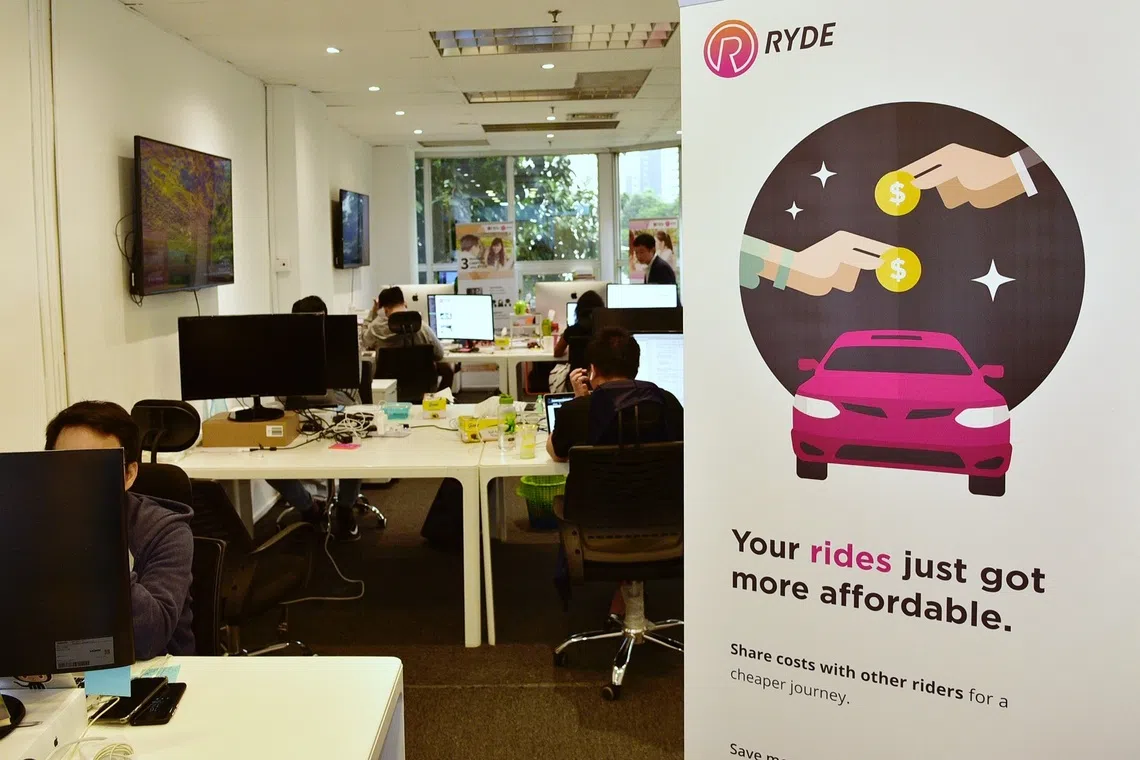
SINGAPORE – Homegrown ride-hailing firm Ryde has come under mounting legal pressure after the company was named in two legal cases filed in the US and the Cayman Islands recently.
It is facing a class action lawsuit for allegedly making false or misleading statements about its business, which led to a collapse of its stock price in Sept 2024 – a few months after it launched its initial public offering (IPO) on the New York Stock Exchange.
Separately, a Singapore-based investment firm has filed a petition in the Cayman Islands over concerns about Ryde’s corporate governance and share issuances. It is primarily seeking to have Ryde buy its remaining shares at fair value, with the winding up of the company sought as an alternative.
In a filing with the US Securities and Exchange Commission (SEC) on Sept 18, Ryde acknowledged both cases, saying it intends to “engage litigation counsel and actively defend” the US class action suit.
It added that the Cayman Island proceedings, which were filed in July, remain at an early stage and no findings have been made by the court on the allegations.
No liquidator has been appointed and the directors remain in control of the company, with the proceedings having no impact on its operations, Ryde said in its filing.
Ryde’s services in Singapore and its other markets remain operating as usual.
Pump-and-dump allegations
The US lawsuit was filed on Sept 10 by Shari Weiss, a US-based investor, and also represents all other affected shareholders.
The plaintiff claimed that Ryde had misled investors into purchasing its shares between March 6 and Sept 11, 2024, during which the company saw unusually high trading activity.
According to Weiss, the structure of Ryde’s March 2024 IPO on the New York Stock Exchange resembled those of several other recently listed foreign micro-cap companies that had been implicated in alleged pump-and-dump schemes in the US.
A pump-and-dump scheme is a form of market manipulation where fraudsters artificially inflate a stock’s price using false hype before selling their own shares at the peak, causing the price to crash.
The lawsuit alleged that these IPOs shared several features: unusually small public floats, with often less than 10% of their shares available for trading; strong insider control through shares carrying extra voting rights or offshore affiliates; and limited public disclosure.
Ryde’s share price rose from its IPO price of US$4 in March to around US$10 in May, before tumbling back down to just above its IPO price a few weeks later.
On Sept 6, however, its shares suddenly surged over 40% and hit a peak of US$22.49 on Sept 11 – 500% higher than its trading price a few weeks earlier – before crashing by around 75% to close the following day at US$2.08.
Weiss’s lawsuit alleged that Ryde used social media to orchestrate a pump-and-dump scheme to defraud investors. It claimed that people impersonating legitimate financial advisers promoted Ryde in online forums, chat groups and social media posts using “sensational but baseless claims” to fuel a buying frenzy among retail investors.
This led to the artificial inflation and subsequent collapse of Ryde’s stock price, it said. The plaintiff claimed she and other investors suffered damages as a result of the misleading statements.
She claimed that she had clicked on a Facebook ad in July 2024 promoting the founder of a reputable US investment firm, and was subsequently added into a WhatsApp chat group where she was instructed to buy and hold large quantities of Ryde shares, with a promise of “triple-digit returns”.
“However, in reality, this was merely a theft orchestrated by the defendants and their co-conspirators.”
The claim names several defendants in addition to the company, including founder and chief executive Terence Zou; former chief financial officer Lang Chen Fei; four of the company’s independent directors; auditor Kreit and Chiu; and IPO underwriter Maxim Group.
The lawsuit alleged that Ryde’s executives and directors failed to warn investors about false claims circulating online while the company’s share price surged amid unusual trading activity.
Shareholder dilution and petition
In the separate Cayman Islands proceeding, Singapore-based Octava Management is seeking to have Ryde wound up or, alternatively, to have its remaining shares bought out at fair value. Ryde is incorporated in the Cayman Islands.
Octava, a company shareholder, alleged that Ryde issued additional shares to Zou in a manner that unfairly diluted Octava’s shareholding and voting rights while shifting control of the company heavily in the founder’s favour.
According to its petition, Octava had 39.8% voting rights and Zou 42.69% when Ryde launched its IPO in 2024. That changed in March 2025 when the company issued additional Class B shares to Zou, significantly increasing his voting rights to 58.7% while diluting Octava’s to just 23%.
In the US, Class B shares are a separate class of stock that typically carries different voting rights from ordinary Class A shares, allowing companies to give certain shareholders more control.
The proposal was set out in a memorandum sent by Ryde’s then CFO Lang, and recommended by the company’s compensation committee in less than 16 hours without consulting Octava, its petition alleged.
Octava said this followed an earlier proposal in November 2024 to increase the voting power of Class B shares, which it had rejected.
It alleged that both proposals breached an understanding dating from 2019 that Octava and Zou would maintain near-equal voting power and jointly make key corporate decisions, but the March 2025 issuance left it unable to block special resolutions or call a shareholders’ meeting.
Ryde said in an internal memorandum that the shares recognised Zou’s contributions, including taking the company public, and that strengthening his voting control would ensure continuity of leadership and quicker decision-making.
Octava, however, described the issuance as a “contrived attempt” to increase Zou’s control after it rejected the earlier proposal.
Lang resigned from Ryde on July 6, the same day that Octava filed its petition.
Ryde in the red
According to Octava’s petition, Zou and an executive of Nomad X, an early investor in Ryde, first sought urgent financial support from Octava as a “white knight investor” in late 2019, when the company was on the brink of insolvency.
Octava alleged that Ryde’s cash reserves were so depleted that it was unable to meet payroll obligations for the following week. It also lacked sufficient funds to honour near-term cash-out requests from driver-partners through its carpooling app, and a non-fulfilment would have “caused an immediate and public loss of trust.”
Ryde’s financial difficulties continued between 2020 and 2023 as it encountered a series of financial setbacks due to the Covid pandemic. Ryde sought further funding support from Octava, entering into two loan agreements in 2021 and 2023 totalling $4 million, of which Ryde repaid. Octava also provided five rounds of cash advances totalling $1.8 million for working capital while Ryde completed the IPO process.
Octava said despite providing significant support to Ryde, it did not use its position to strong-arm Zou into awarding it more shares, and it had acted consistently with the parties’ shared understanding that they would jointly oversee key decisions.
Octava also pointed to Ryde’s deteriorating financial position. Its shares fell from their US$4 IPO price to 25 US cents by March 31, 2025, while the company recorded a net loss of $18.7 million for FY2024.
In May 2025, the NYSE notified Ryde that it had fallen below continued-listing requirements because its shareholders’ equity was under US$4 million and it had recorded losses in three of its four most recent financial years.
Ryde regained compliance in May 2026 but remains subject to enhanced monitoring for 12 months.
When contacted by The Straits Times, Ryde declined to comment on the two cases, citing ongoing legal proceedings.

