


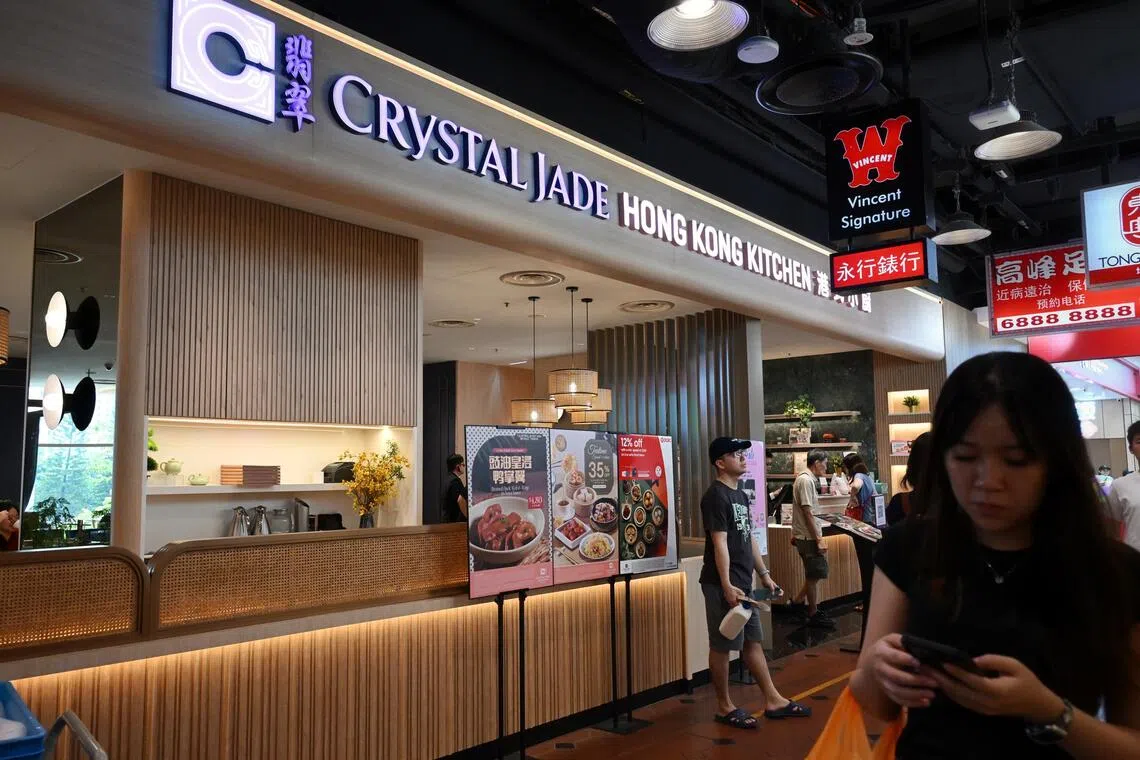
SINGAPORE – Crystal Jade’s holding companies in Singapore and Hong Kong have been placed under receivership – but what does that mean?
There has been a slew of recent news about distressed companies, ranging from those under receiverships to those that face liquidation.
The different circumstances a distressed company finds itself in also affect employees differently. For workers, the key question is whether they will continue to be employed and paid. This, in turn, depends on whether the company continues to operate.
What happens when a company is liquidated?
“Winding up” and “liquidation” are used interchangeably to refer to the process in which a company’s assets are sold off and the proceeds are used to pay off its debts.
Once the liquidation is completed, the company no longer exists. Workers will lose their jobs.
There are different ways to wind up a company depending on whether the company can pay off its debts.
In the case of members’ voluntary winding-up, a company’s members or shareholders may decide to pass a resolution to wind it up and appoint a liquidator.
But the company is still able to pay its debts in full within 12 months after starting the winding-up process.
On the other hand, there are other cases where the company cannot pay its financial obligations or debts when they are due. A company is considered as being “unable to pay its debts” if a creditor is owed more than $15,000, has served a demand to the company, and has still not been paid for three weeks or more.
The company can have a creditors’ voluntary winding-up, where it can convene a meeting with its creditors to consider its proposal to wind up the company. If the resolution is passed, the company appoints a liquidator.
However, in the case of compulsory winding-up, the company itself, creditors, or other parties present a winding-up application to the High Court. The court then appoints a liquidator for the company.
The role of the liquidator is to investigate the affairs and assets of the company, the conduct of its officers, and the claims of creditors and third parties.
The liquidator also has to recover the company’s assets and realise their value in the most advantageous manner to the company.
The liquidator will also have to hear the claims of all the creditors and ensure that the company’s assets are equitably distributed.
This can mean distributing payments to secured creditors like banks, others like employees who might not have been paid, as well as shareholders.
For example, in September, it was announced that Baker’s Brew, or BB Atelier, was going into liquidation. The company decided at a meeting with creditors on Aug 31 to enter creditors’ voluntary liquidation.
In September, fitness chains True Fitness and True Yoga in Singapore also shuttered, with their Hong Kong parent company declaring that it was winding up the businesses due to market competition and cost pressures.
The directors of True Yoga and True Fitness passed resolutions saying they were unable to continue their businesses owing to their liabilities.
Singapore’s consumer rights watchdog said True Fitness and True Yoga members have reported losses of more than $609,000.
What happens when a company is under receivership?
Unlike liquidation, a company under receivership still exists and can continue to operate.
In the case of Crystal Jade, it closed five outlets in 2026, but outlets like the one at Takashimaya Shopping Centre remain open.
“Receivership occurs when a secured creditor appoints a receiver or manager to collect and sell assets which the creditor holds a security interest over,” said Leon Yee, chairman of law firm Duane Morris & Selvam.
“Receivership does not necessarily lead to winding up. The company may resume normal operations once the secured debt is satisfied.”
Advisory firm Kroll, which is reviewing Crystal Jade’s financial and operational affairs, told The Straits Times that this receivership does not mean a closure of the business, and that “Crystal Jade is not exiting the food and beverage market”.
A Crystal Jade spokesperson also said that “customers can continue to enjoy the same quality, service and dining experience at Crystal Jade restaurants”.
Robson Lee, a senior corporate and capital markets lawyer, said that the receivership allows the company to still collect earnings.
“If you kill the company now, creditors like banks and other parties like suppliers will be worse off,” he said.
What happens when a company undergoes judicial management?
Judicial management is the process whereby a company that cannot pay its debts seeks temporary respite from creditors and its liabilities, said Khelvin Xu, director of law firm Covenant Chambers.
A judicial manager is then appointed and a moratorium put in place, which means that the company is protected from legal proceedings such as those from creditors.
The judicial manager then tries to turn the company around or realise the company’s assets at a high value compared with fire-sale prices.
If the judicial manager successfully turns things around, the company may continue to operate. If it cannot, the company may be wound up.
An example of this is beleaguered water treatment firm Hyflux, which was put under judicial management in 2020. This meant that founder Olivia Lum and the rest of the board were no longer in control of the company.
However, this failed, and in 2021, the judicial managers filed an application to wind up the company, after unsuccessful negotiations with an investor and a failed restructuring attempt.
But others have found success under the judicial management route.
Singapore-based sofa maker HTL, which owed various banks US$46 million (S$65 million) in 2020, sought judicial management, citing a cash-flow crunch due to the pandemic.
The sofa-maker was given a lifeline when co-founder Phua Yong Tat signed an agreement to buy back the company under his entity Golden Hill Capital. This ensured its survival, while protecting the jobs of thousands of employees.
How about bankruptcy?
Bankruptcy applies to individuals and sole proprietorships, not companies, Xu said.
An individual who cannot pay their debts may be declared bankrupt, and if so, their property will be vested in a court-appointed trustee, who will manage the bankrupt person’s financial affairs.
“Unlike companies being wound up, individuals who have been made bankrupt certainly do not cease to exist,” he said.
An individual being made bankrupt may not affect the employees of a company they own.
For instance, it was reported in August that a bankruptcy order was made against Singapore permanent resident Ramu Palani Velu, who is the director of seven companies that provide air-conditioning, plumbing and building services.
A total of 407 workers from these companies lodged claims for unpaid wages, with some having not been paid for more than two months.
However, Xu said that it is not a straightforward case because it is the company, not the individual, that employed the workers. Hence, it is the company that is obliged to pay salaries, not the director personally, and the director’s bankruptcy does not change whether he is personally liable to the workers.
What happens when a company restructures?
Cases of layoffs have made the news recently, with companies often saying they are undergoing restructuring and hence had to retrench some workers.
Xu said that “restructuring” is a very broad term that refers to the reorganisation of the company’s internal structures. It does not necessarily lead to the company ceasing to exist.
Lee added that a restructuring can be initiated internally without receivers, judicial managers or liquidators. Typically, it aims to help a company to wind down non-core businesses, realise non-performing assets and deploy manpower to other divisions of the business.
It can also mean a company sells off certain parts of its business and keeps the core business that can help the company get back on its feet.
There are usually structural changes to the business and manpower allocations in a restructuring.
What happens to employees in these scenarios?
In the case of a company being wound up, the employees have priority but there is no guarantee that they will be paid if the assets of the company are insufficient, Yee said.
Employees’ claims rank higher in priority than other ordinary unsecured creditors, but lower than secured creditors like banks.
Xu said: “However, the unfortunate reality is that in many instances, there may be little or no assets left by the time it is employees’ turn to be paid. If there are no more assets left, then employees may not be able to recover unpaid salary or CPF contributions.”
But if a company is under judicial management, the company can continue operating and employees continue working.
If employees have claims, these will be handled directly by the appointed judicial manager, Yee said.
Meanwhile, if the company is in receivership, employees might also be affected if the receiver sells or scales down the business.
Yee said: “The best practice for employees is to ensure that they are paid on a timely basis.”
In the event of non-payment or delay in payment, employees should immediately take action by seeking mediation through the Tripartite Alliance for Dispute Management, and thereafter filing a claim with the Employment Claims Tribunal, he said.
If the employee is not eligible to file a claim with the tribunal – if their salary is too high, for example – they should seek legal advice and/or resign immediately.
“Failing to pay salary is usually grounds for resigning without notice,” Yee said.
“The worst choice for employees is to continue working even after a company has failed to pay them, as they may not be able to recover their wages once the company is insolvent.”

