


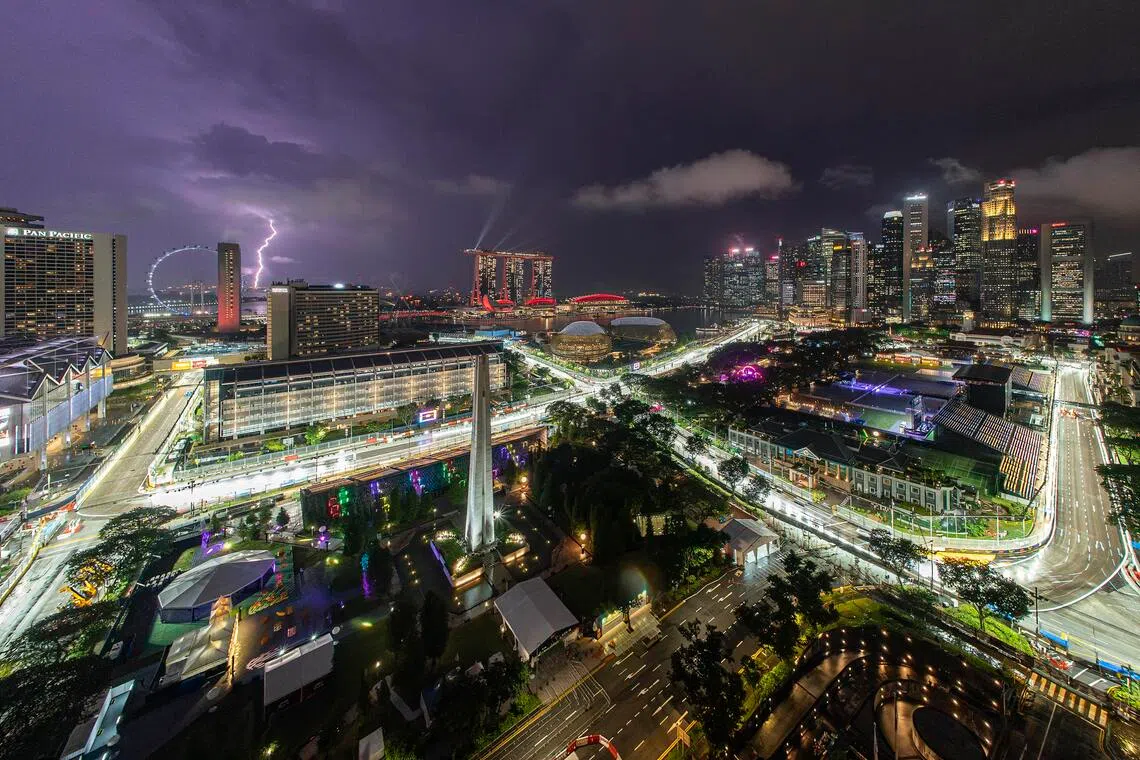
SINGAPORE – For 18 years, Singapore has marketed its Formula 1 Grand Prix not just as a motor race but as a showcase of what the Lion City can do when it turns several kilometres of floodlit roads along the waterfront at dusk into a global stage.
Since September 2008, the Marina Bay Street Circuit has become one of the most iconic events on the F1 calendar, offering something no other city did – the first-ever night race.
The spectacle helped establish Singapore as a distinctive stop on the F1 calendar, while giving the city-state a high-profile platform to promote its hospitality industry, infrastructure, business environment and ability to stage a complex international event.
Now, a few countries in the region seek to replicate Singapore’s success and join the F1 bandwagon in hopes of global attention and attracting high-spending visitors.
After a nine-year hiatus, Malaysia is set to host an F1 race at Sepang again in October, while Thailand is targeting a street race in Bangkok’s Chatuchak area as early as 2028.
The emergence of new Asian contenders raises questions about whether the Singapore Grand Prix can continue to distinguish itself or will fans be drawn away to rival races.
Market observers and economists believe it can.
“F1 is still delivering benefits to Singapore that outweigh the cost of hosting the event,” said Brian Lee, an economist at Maybank.
“While the direct tourism benefits may face diminishing returns, the race remains valuable as a platform for attracting high-spending visitors, business events and global capital,” he added.
He noted that last year’s F1 race weekend drew a sell-out crowd of more than 300,000 fans. That was the second-highest attendance in the event’s history and an almost 12 per cent jump from 2024, suggesting the novelty remained.
Guy Llewellyn, academic director of Asia Pacific at EHL Hospitality Business School, said it would be hard for other cities to replicate Singapore’s experience after it has run the event for 18 years, coordinating different stakeholders and building a strong international reputation.
“Singapore’s strategy has gradually evolved from hosting a sporting event to hosting a city-wide festival. The concerts, entertainment zones, dining experiences, and new Barge Stage programming mean that visitors can spend an entire day at Marina Bay without focusing exclusively on racing,” the assistant professor said.
The Barge Stage waterfront amphitheatre will be unveiled this year along with a lineup of international DJs.
“Few destinations can offer a Formula 1 circuit, internationally branded hotels, fine dining, nightlife and entertainment venues all within walking distance of one another,” Llewellyn said.
However, while the first night race was once a powerful differentiator, the novelty naturally fades over time, making the broader ecosystem increasingly important in setting the experience apart, he added.
Faizal Bin Yahya, senior research fellow at the Institute of Policy Studies at Lee Kuan Yew School of Public Policy at the National University of Singapore, also believes the race should go on.
The returns have been “a massive net positive”, as Singapore has gained a lot economically, strategically, and in terms of its global image, Yayha said.
Since the inaugural night race in 2008 up until 2024, the event has generated around $2.2 billion in incremental tourism receipts, mostly for accommodation, attraction tickets, food and beverage, shopping and airfares. It has also attracted over 720.000 visitors over the period.
Lee said this is equivalent to $129 million a year in incremental spending from tourists attending the race. That is 0.4 per cent of Singapore’s 2025 aggregate tourism receipts.
While this may be close to the $140 million annual cost of organising the race, there are other beneficiaries that are not captured by the tourism receipt figures.
These include companies involved in the track and venue setup, advertising and other that support the event, ranging from raw material suppliers, equipment rental, logistics and even laundry and cleaning services, Lee said.
Beyond grandstand ticket sales, F1’s ripple effect extends to drawing other high-profile events around the race period.
Every year, some 25 to 30 international conferences – including the Forbes Global CEO Conference, the Milken Institute Asia Summit and TOKEN2049 – have been held around race week, bringing in around 90,000 c-suites to Singapore.
High-net-worth travellers, who make up 30 per cent of F1 visitors, account for 40 per cent of tourist spending during race week, pushing up occupancy rates and hotel room rates even outside the race vicinity.
A large share of the race’s contracts is subcontracted to Singapore-based small and medium-sized enterprises including firms in engineering, construction and hospitality, the Ministry of Trade and Industry (MTI) said.
About 30,000 staff, contractors and stakeholders work on each race. More than 1,000 students from the Institute of Technical Education and polytechnics are also trained each year for roles around the circuit, giving them exposure to the organisation of a major international event.
“This creates temporary employment for over 30,000 workers and students across logistics, advanced engineering, hospitality, and specialized event staging,” Yahya said.
With millions of people around the world watching the Singapore race on television and online, the event is a global advertisement for Singapore, showcasing its infrastructure, safety, business environment, and city life, he added.
The 2019 Singapore Grand Prix was estimated to have generated $70 million to $75 million in media value, according to a McKinsey study cited by MTI.
Maintaining the head start
This year, Singapore will host its first-ever F1 Sprint Race, on Saturday, Oct 10 – a two-day, 100km race that is hosted by just six circuits this year.
The Sprint format alters the dynamic of the traditional Marina Bay Street Circuit weekend, and could make the Singapore race weekend feel like two big race days instead of one, said Llewellyn.
Saturday gets its own race, giving fans another reason to come earlier and stay longer.
For hotels, it offers an opportunity to earn more if more guests arrive on Thursday and stay longer.
It remains to be seen whether fans will see the Sprint as a must-attend event, since this is Singapore’s first time hosting a Sprint, he said.
To keep its competitive edge, experts said Singapore must continue to convert more F1 race visitors into long-term tourists and business connections by linking race week with high-value conferences, business cum leisure packages, as well as meetings, incentives, conferences, and exhibitions (MICE) events.
Regional travel partnerships can encourage onward trips across ASEAN, while digital matchmaking connects delegates with local businesses. Hosting networking events in Marina Bay and Orchard Road can further showcase Singapore’s commercial ecosystem.
The Singapore Grand Prix was never just a sporting event from the start. It is being used as a tourism draw, a business-networking platform, a showcase for local companies and a recurring global advertisement for the city.
“The issue is less about whether Singapore should continue hosting F1, and more about whether it can continue extracting scarcity value from the event as competing cities replicate the street-race model,” Lee said.

