


SINGAPORE – Businesses can now tap a new portal to benefit from support including government grants and tools to help them navigate challenges like tariffs when expanding overseas.
The BizSG portal, which is the first offering of a wider initiative to make government support easier to access, went live on Sept 30, said Minister-in-charge of Trade Relations Grace Fu.
The BizSG initiative is jointly led by the Ministry of Energy, Trade and Industry (METI), and Enterprise Singapore (EnterpriseSG).
On top of navigating trade rules, Fu acknowledged that businesses venturing overseas have to straddle multiple websites to get information on government grants and support schemes.
During a speech at the Future of Trade Forum at Shangri-La Singapore, Fu said: “This is why METI and EnterpriseSG announced BizSG, a whole-of-government initiative that uses emerging technologies to make government support easier to discover and navigate, and transactions easier to complete.
“Our ambition is for BizSG to become a digital concierge for SMEs, so that they have more time to focus on business growth.”
Small and medium-sized enterprises (SMEs) are companies which have an operating revenue of not more than $100 million, or which employ 200 workers or fewer. They make up 99% of businesses in Singapore.
Key features of the BizSG portal include a grant directory where details on available grants are listed.
The portal also hosts an AI-powered grant recommender, which directs businesses to relevant government support.
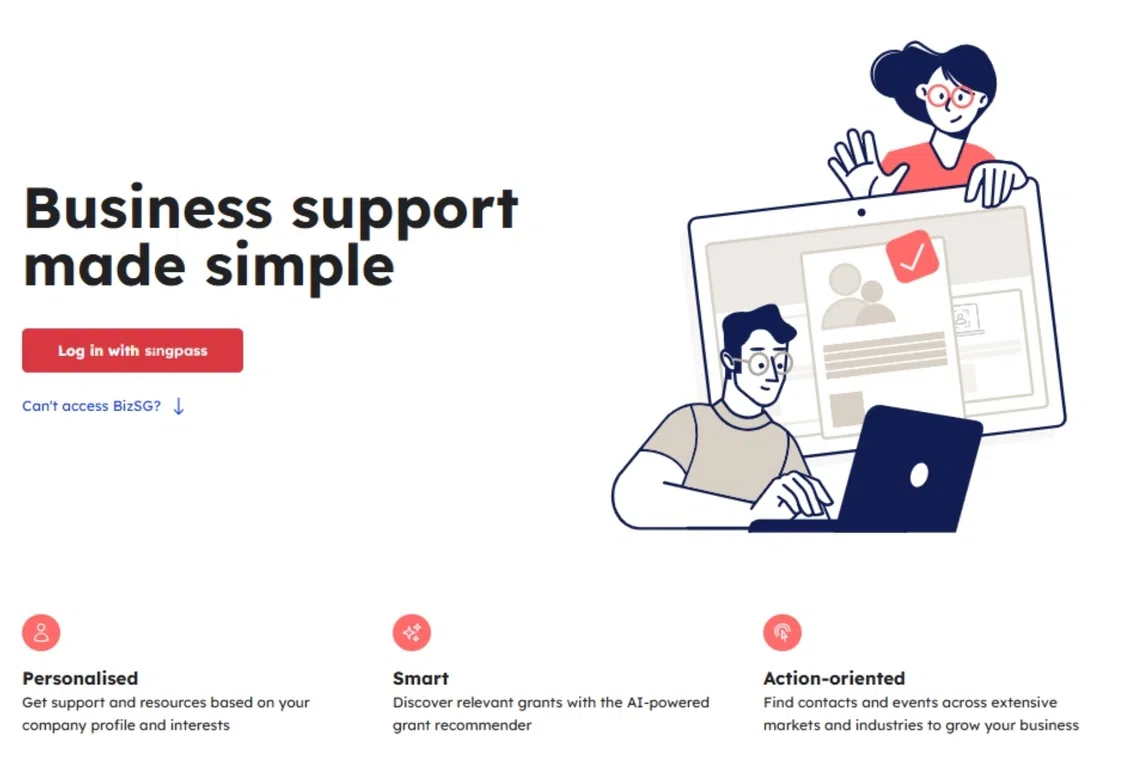
Key features of the BizSG portal include a grant directory where details on available grants are listed.
PHOTO: SCREENGRAB FROM BIZSG.GOV.SG
There is also a grant eligibility checker that draws on official records to determine if a business qualifies for grants and programmes.
This is currently limited to EnterpriseSG’s EDGE Grant, which offers funding support across eight business areas, and grants by the Skills and Workforce Development Agency. More grants will be added in the future.
In addition, the portal allows businesses to calculate tariffs and learn about the savings brought about by free trade agreements. It also has a function powered by trade flow data to help firms decide whether an overseas market is worth pursuing.
Companies can also access networks and events which are relevant to them.
The support comes as the environment for trade is becoming more complex.
While globalisation has been the primary engine of global prosperity for decades, the playbook has been rewritten as trade has been weaponised by geopolitical considerations, Fu said.
“Fragmentation is challenging the foundational rules of global commerce. We see the effects in how goods move, where capital is invested and how supply chains are organised,” she added.
Even so, she noted that the shifts are creating opportunities for businesses to diversify their markets, strengthen supply chains and capture new areas of growth.
“Competitiveness will increasingly depend not only on efficiency, but also on resilience and agility in a volatile and complex trading environment,” she said.
Fu added that Singapore will use its position as the next ASEAN chair to deepen regional integration and strengthen the group’s capacity to respond to change.
Also on the agenda is expanding ASEAN’s partnerships with new and existing partners, she added.
The Republic is set to take over the role from the Philippines on Jan 1.

