


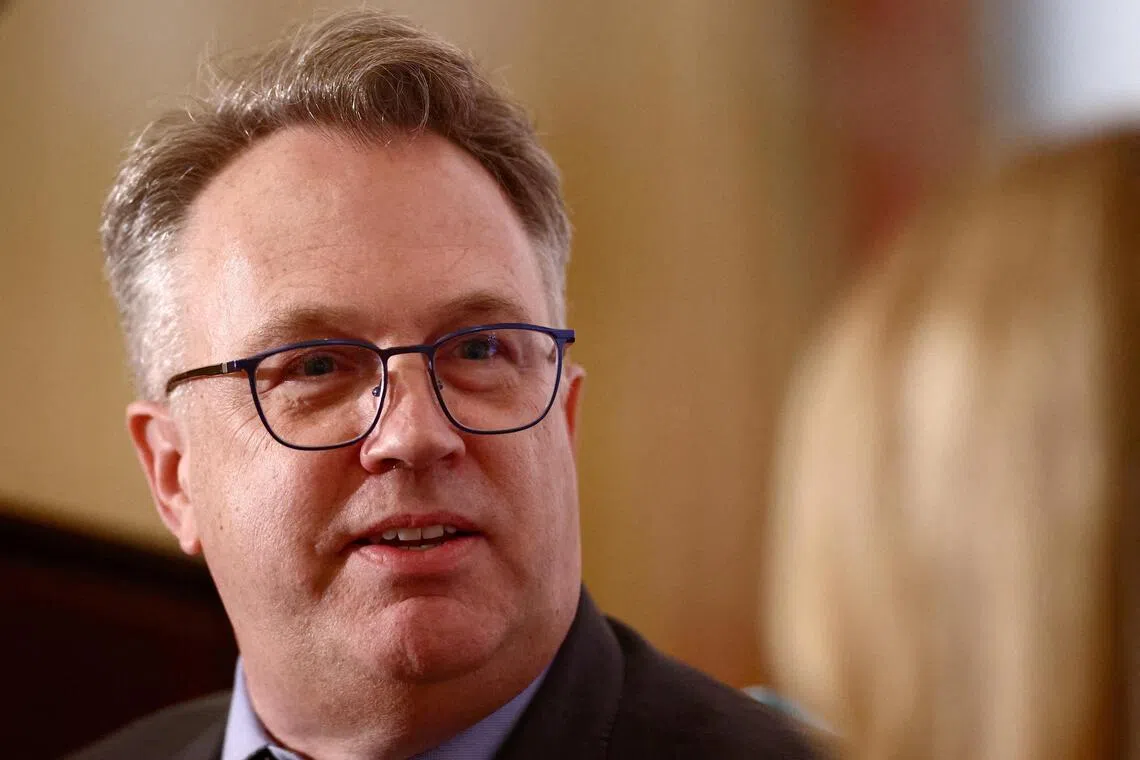
Federal Reserve Bank of New York president John Williams said one more interest-rate hike “late this year” may be appropriate to help contain inflation, prompting investors to dial back their expectations for an increase in October just before the US midterm elections.
Williams underscored the point by saying there was no urgency to act following the central bank’s decision to lift rates earlier this month.
“If the economy evolves in a manner broadly consistent with my forecast, one further upward adjustment of the federal funds target range may be appropriate late this year to support a timelier return of inflation to target,” he said during an event hosted by the University at Buffalo on Sept 29.
Fed officials raised interest rates by a quarter percentage point in September, their first hike since 2023. Williams said that action gave the central bank time to gather more data that could provide more clarity on the economic outlook.
“With the policy action we took at our September meeting, there is no need for urgency, and we have time to gather more information,” he said.
Following Williams’ speech, the probability of a rate increase at the Fed’s Oct 27-28 meeting dropped to about 50% from 70%, based on pricing in federal funds futures contracts.
“Williams has pushed back unambiguously against a back-to-back Fed rate hike in October,” analysts at Evercore ISI wrote in a note to clients. “We read this as most consistent with skipping October and hiking in December.”
As president of the New York Fed, Williams is a permanent voter on, and vice-chair of, the central bank’s rate-setting panel, the Federal Open Market Committee. He was long viewed as close to former Fed chair Jerome Powell, and so financial markets took note when he gave a clear signal on his views ahead of a policy meeting. It is unclear how closely he aligns with the new chairman, Kevin Warsh.
Speaking to reporters after his remarks, Williams said his view on future policy would depend on the evolution of underlying trends for inflation and his assessment of the balance between demand and supply in the economy.
Among the current drivers of inflation, AI is “really the one that is still a question mark,” he said.
The proximity of October’s rate-setting meeting to the midterm elections is not a factor to consider “at all,” Williams added.
The New York Fed chief said higher long-term bond yields were a result of a strong outlook for the US economy and strong demand for investments related to AI. The response to higher oil prices is also resulting in higher yields, he said.
“The good news here is, this is not a story about shifting views on inflation over the medium or longer term,” he said.
Hiking chorus
A chorus of Fed officials have warned that tighter monetary policy is still needed.
In their updated economic projections released after their rate decision, most policymakers expected one more quarter-point hike this year while eight saw a similar move in 2027.
On his speech on Sept 29, Williams said the conflict in the Middle East and the build-out related to artificial intelligence remain the main drivers of higher inflation.
Tariffs, on the other hand, are no longer adding to inflation in goods prices.
“In particular, the inflationary impact of the AI-related demand shock is increasingly salient, and I now expect somewhat larger and longer-lasting effects from energy prices on inflation,” he said. Still, there is no evidence of spill overs into broader and more persistent price pressures, he added.
With the economy proving resilient and the labour market solid, Williams said risks to inflation have increased.
“While monetary policy cannot move ships or reopen pipelines and refineries, it can diminish the risk that these supply shocks spill over into broader and more persistent inflation,” he added.
The New York Fed chief said he sees inflation at 3.5% this year, and slowing to just above the central bank’s 2% goal in 2027. The Fed should hit its goal in 2028, he said.
In separate speaking engagements on Sept 29, three other Fed officials kept up the calls for higher interest rates.
During a speech in London, St Louis Fed president Alberto Musalem said rates are still not high enough to weigh on economic growth and tame price pressures. Even after the Fed’s September rate increase, monetary policy remains “somewhat accommodative,” Musalem said.
Chicago Fed president Austan Goolsbee reiterated his view that the US central bank may need to raise rates in reaction to persistent supply shocks. Central bankers typically do not adjust rates in response to supply shocks because the inflationary impact often is temporary.
“The tough reality is, if we’re going to start getting permanent or very persistent supply shocks, I think the Fed, to maintain a credible – we have a 2% target, we’re going to get inflation there – I think we have to consider responding to those persistent shocks,” he said.
Fed Governor Michael Barr, at an event in Detroit, repeated a warning that further increases will likely be needed to slow inflation.
“In my base case, further policy adjustments are likely to be needed to ensure inflation comes down to target in a timely fashion,” Barr said in remarks prepared for an event in Detroit. “I don’t yet see a clear trend toward a timely return to 2%” inflation. BLOOMBERG

