


SINGAPORE – Singapore is expanding its foothold in the global semiconductor supply chain with the opening of its first plant producing advanced substrates used in AI and networking applications.
Officially opened on Sept 29, the 95,000-square-metre Advanced Substrate Technologies (AST) facility in Jurong Lake District will produce Flip Chip Ball Grid Array (FC-BGA) substrates.
FC-BGA substrates are components that provide high-density connections between semiconductor chips and circuit boards, allowing higher data speeds and signal integrity.
AST is a joint venture between Japan’s Toppan Holdings and US chip-design firm Broadcom.
Toppan did not disclose the capital investment in the plant, but Japanese media in 2024 put the figure at about 50 billion yen (S$405 million), with future expansion expected to push the total beyond 100 billion yen.
The facility also houses research and development capabilities to meet future performance demands, alongside close collaborations with Singapore’s technology institutions.
AST has already hired more than 300 staff here, including high-tech engineers and skilled technicians, and said it will continue to recruit as high-volume manufacturing begins later this year.
Output will increase in the next phase of expansion to meet the fast-growing demand for advanced substrates across next-generation computing applications.
“This investment reflects both Toppan and Broadcom’s long-term commitment to Singapore as a critical hub in our global manufacturing network and strengthens the resilience of the semiconductor supply chain,” said AST chief executive officer Yoshiyuki Iida.
The shortage of substrates will grow more acute as AI data centres and devices proliferate across the globe, AST noted, adding that the plant will address one of the global semiconductor industry’s most critical supply-chain capacity constraints.
The Singapore plant will also complement Toppan’s main production hub in Niigata, Japan.
Speaking at the opening event, Deputy Prime Minister Gan Kim Yong said AST will diversify Singapore’s semiconductor ecosystem, which has capabilities across chip design, wafer fabrication, equipment manufacturing and advanced packaging.
Alongside these activities, Singapore has also developed a network of suppliers, research institutions and skilled workers.
“Together, they provide a strong foundation for companies to grow and undertake increasingly sophisticated work,” he said.
“As technology advances and global competition intensifies, we must build on this foundation and develop capabilities that are difficult to replicate.”
In semiconductors, this means ensuring that each new investment strengthens the capabilities of the wider ecosystem, and creates opportunities for companies and people to advance.
AST does this by adding its specialised capability, which complements the semiconductor activities already here and broadens what Singapore can contribute to the global industry, said Gan, who is also Minister of Trade and Industry (Trade).
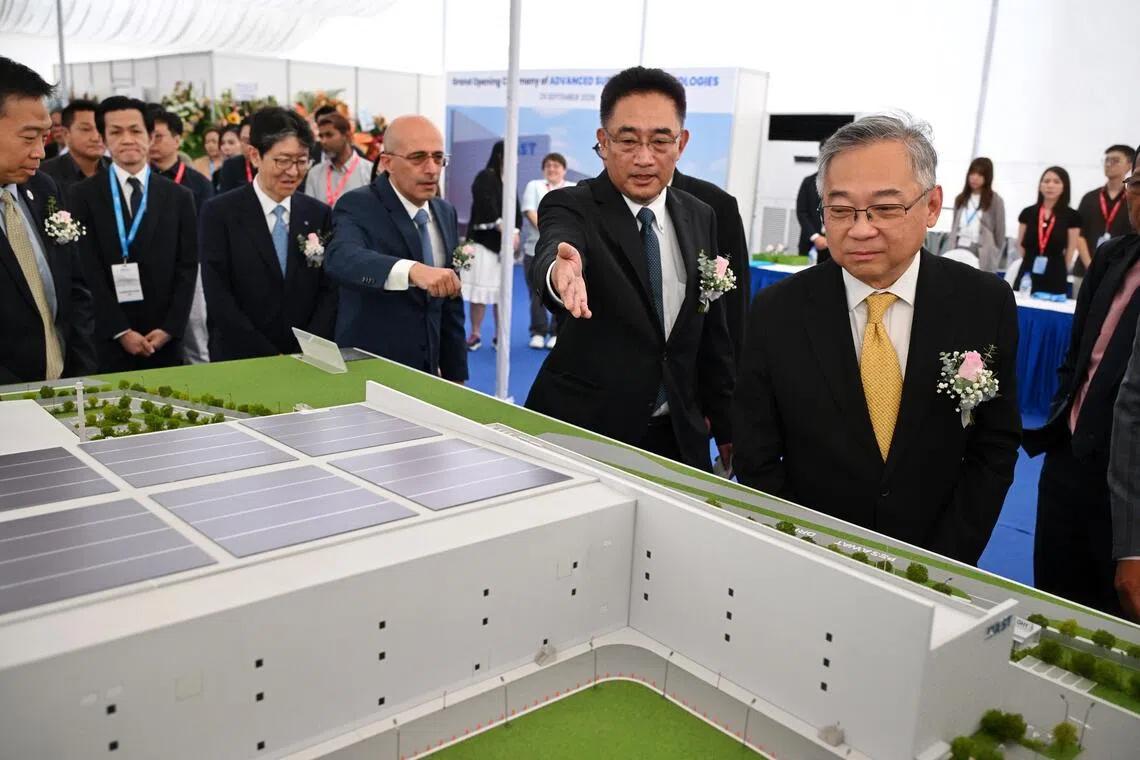
DPM Gan Kim Yong (right) looking at a scaled model of Advanced Substrate Technologies’ new plant. With him are AST CEO Yoshiyuki lida (second from right) and Charlie Kawwas, president of Broadcom’s Silicon Solutions Group (third from right).
ST PHOTO: KUA CHEE SIONG
Charlie Kawwas, president of the semiconductor solutions group at Broadcom, said that beyond being the joint venture partner, his company will also be AST’s primary customer.
“AST’s FC-BGA substrate capacity in Singapore gives us meaningful flexibility and differentiation as demand for AI and networking silicon continues to climb,” he said, adding the facility strengthens Broadcom’s supply chain resilience by delivering vital relief while the industry is constrained by substrate shortages.
Singapore is a key node in the global semiconductor supply chain, accounting for one in 10 chips and one-fifth of global semiconductor equipment produced annually.
According to the Economic Development Board (EDB), Singapore’s semiconductor industry contributes close to 6% of the country’s gross domestic product and employs more than 35,000 people.
Png Cheong Boon, chairman of Singapore’s lead investment promotion agency, said EDB will continue to work with Toppan, Broadcom and AST to build new capabilities to support global demand for semiconductors, and create new jobs and opportunities here.

