


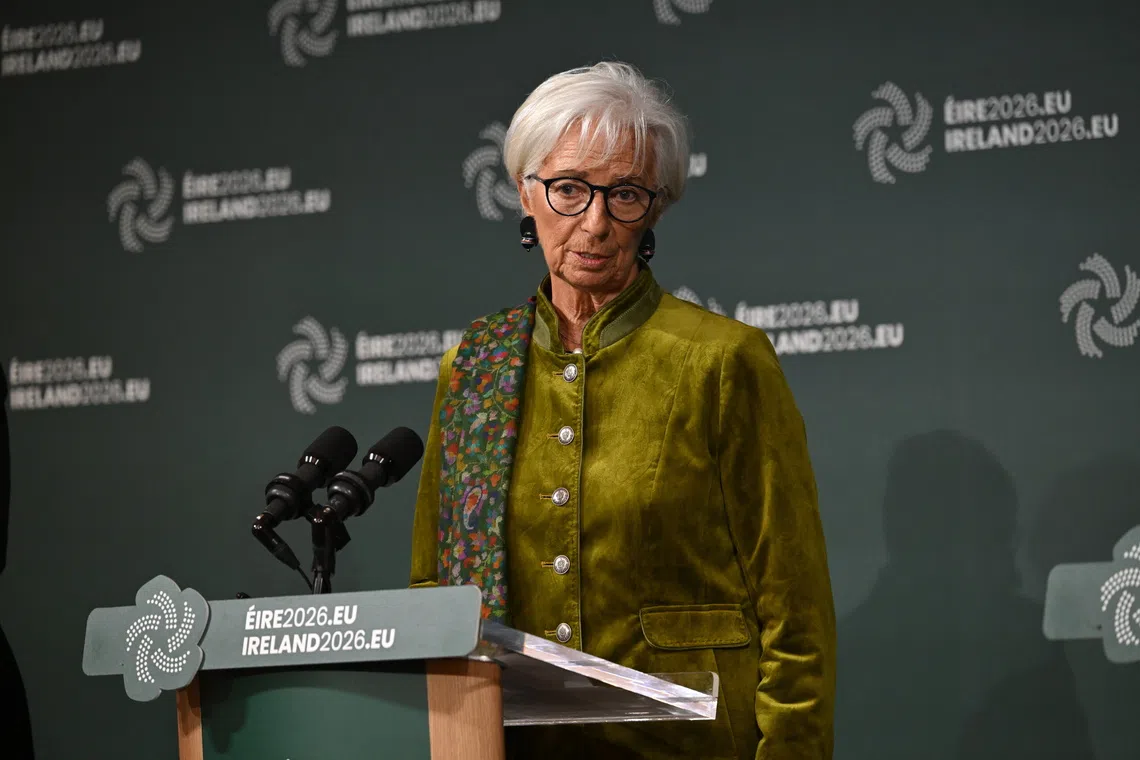
The early exit of Isabel Schnabel from the European Central Bank (ECB) is set to intensify the contest for top jobs there including that of President Christine Lagarde.
The announcement on Sept 24 that Germany’s executive board member will leave in January 2027, one year before her term expires, creates a vacancy within the institution’s top echelon in little more than three months, putting the onus on governments to act soon.
With Lagarde and Chief Economist Philip Lane also scheduled to go in 2027, and the president hinting at a swifter departure too, a package deal looks very probable. There are three European Union (EU) summits left on the calendar in 2026 where horse-trading could play out.
Such manoeuvring might set the scene for another high-stakes showdown between leaders, much as happened in 2019 when Lagarde was appointed, as nations stake a claim to seats comprising half of the executive board that steers monetary policy in a region of almost 360 million people.
“Now there really is time pressure to come up with a package solution,” said Holger Schmieding, chief economist at Berenberg.
“It will be difficult. But that’s what politicians are for, to find solutions even when decisions are difficult.”
The accelerated timeline is colliding with an awkward juncture for the euro area’s biggest economies. The government of Germany, the region’s biggest member, is in crisis after a string of defeats in state ballots, while France is beset by political stalemate before its upcoming election. National votes are also approaching in Italy and Spain.
As with any EU decision, the danger of gridlock cannot be excluded.
Schnabel herself alluded to that possibility when she sent a farewell message to ECB staff that was obtained by Bloomberg.
“A successor will be appointed by the European Council,” she said.
“If necessary, my responsibilities will be temporarily reassigned among the remaining members of the Executive Board after my departure.”
Schnabel’s exit is the clearest wake-up call yet to governments to begin negotiating in earnest, especially because any delay could risk an overlap with the timetable to elect a successor to French President Emmanuel Macron, starting in April 2027.
The urgency is not just about filling the shoes of an official tasked with overseeing markets at a volatile time, with a global bond rout bringing about the highest US 30-year yield in more than two decades.
The prospect of Lagarde quitting before her own term is up in October 2027 is also a live one.
The ECB president has committed only to staying on until the end of 2026, in remarks following months of speculation on whether she was about to run the World Economic Forum instead.
She will even publish a memoir in January 2027, something that people in high positions tend to do only after they leave office.
The strongest hint yet that governments are preparing to tussle came from the prime ministers of Spain and the Netherlands, who – both in New York for the United Nations General Assembly – rallied behind their countries’ candidates, widely seen as the frontrunners.
Dutch premier Minister Rob Jetten told Bloomberg Television on Sept 24 that many countries in the region would find Klaas Knot to be a “perfect fit”.
A day earlier, his Spanish counterpart, Pedro Sanchez, described Pablo Hernandez de Cos as having “the leadership, also the capacity and the knowledge”.
“It appears discussions are already under way,” said Modupe Adegbembo, an economist at Jefferies.
“But Schnabel’s earlier departure should increase the pressure on member states to reach a solution.”
Despite never holding the ECB presidency itself, Germany has not put its own hat in the ring.
Bundesbank chief Joachim Nagel is keen, but Chancellor Friedrich Merz, beset by political strife, seems doubtful on a candidate allied to his Social Democrat coalition partners.
Germans also occupy two other top jobs: EU Commission President Ursula von der Leyen and ECB top banking supervisor Claudia Buch.
Even so, the government’s lack of ambition contrasts with the last two ECB chief appointments when Bundesbankers were in strong contention.
One alternative to the presidency would be Lane’s position as chief economist that France also covets. Berlin would be interested in that role, people familiar with the discussions told Bloomberg in August.
Potential German candidates include university professors Markus Brunnermeier of Princeton and Ulrike Malmendier of Berkeley, and Tobias Adrian, who just exited the job Schnabel will take at the IMF.
But Germans have already served twice as chief economist, and with the impending exit of Schnabel and ultimately Lagarde from the board, the pressure to appoint another woman is likely to be strong.
In that vein, aside from Malmendier, Bundesbank board members Sabine Mauderer and Fritzi Koehler-Geib could be candidates.
Even so, France can propose strong contenders of its own, including former OECD chief economist Laurence Boone and Bank of France Deputy Governor Agnes Benassy-Quere.
With Macron likely to lobby hard for France there, it might well be easier for Berlin to pitch one of its candidates for Schnabel’s markets portfolio again. That role gained huge prominence in recent years with ECB crisis interventions such as large-scale asset purchases.
Whatever the case, Schnabel’s shift to Washington has just heated up one of Europe’s most closely watched personnel shakeups in years.
“It definitely advances the discussions, and I’d be surprised if governments don’t already have some names in mind,” said Piet Christiansen, chief strategist at Danske Bank.
“But it’s next to impossible to predict the final outcome.” BLOOMBERG

