


SINGAPORE – Primary school students as young as 10 can get an early start at understanding the concepts of microelectronics in a programme being introduced by the Singapore Semiconductor Industry Association (SSIA).
The two-year pilot, which aims to reach more than 600 pupils, will use LEGO Education’s Computer Science & AI solution – a collaborative, hands-on learning platform that combines physical bricks, interactive hardware, and safe local AI tools.
SSIA and local industry will add the semiconductor context to the platform.
“Using physical models, programmable motors and colour sensors, students will explore coding, computational thinking and age-appropriate AI concepts while learning how chips enable sensors, smart devices, robots and AI applications,” the association said.
The initiative was launched at the SSIA Summit 2026 at Resorts World Sentosa on Sept 24. The two-day event was expected to attract hundreds of industry executives, tech experts, government officials and diplomats from around the world.
The initiative is yet another example of an aggressive push by the semiconductor industry to secure a talent pipeline in Asia – the global hub of AI hardware – with similar engagement schemes already working in Japan, South Korea and Taiwan.
As the global race for chip dominance intensifies, governments and industry associations are building talent pipelines earlier than ever. Instead of waiting for university, they are now introducing high-tech concepts to children aged seven to 12.
SSIA and ams-OSRAM, a German firm that develops optical solutions for the chip industry, are also developing a Semiconductor Future Makers Camp for children and youths aged seven to 16, planned for 2027.
ams-OSRAM will contribute engineers, mentors and hands-on experiences around light, sensing and semiconductor technologies.
SSIA cited a Deloitte study estimating that the global semiconductor industry will need more than one million additional skilled workers by 2030, requiring a wider talent pipeline.
“Building talent does not start at hiring,” said the association’s executive director Ang Wee Seng. “Semiconductors are behind almost everything we use, yet much of the industry remains unseen by young people.”
Other talent development plans were also launched at the SSIA Summit.
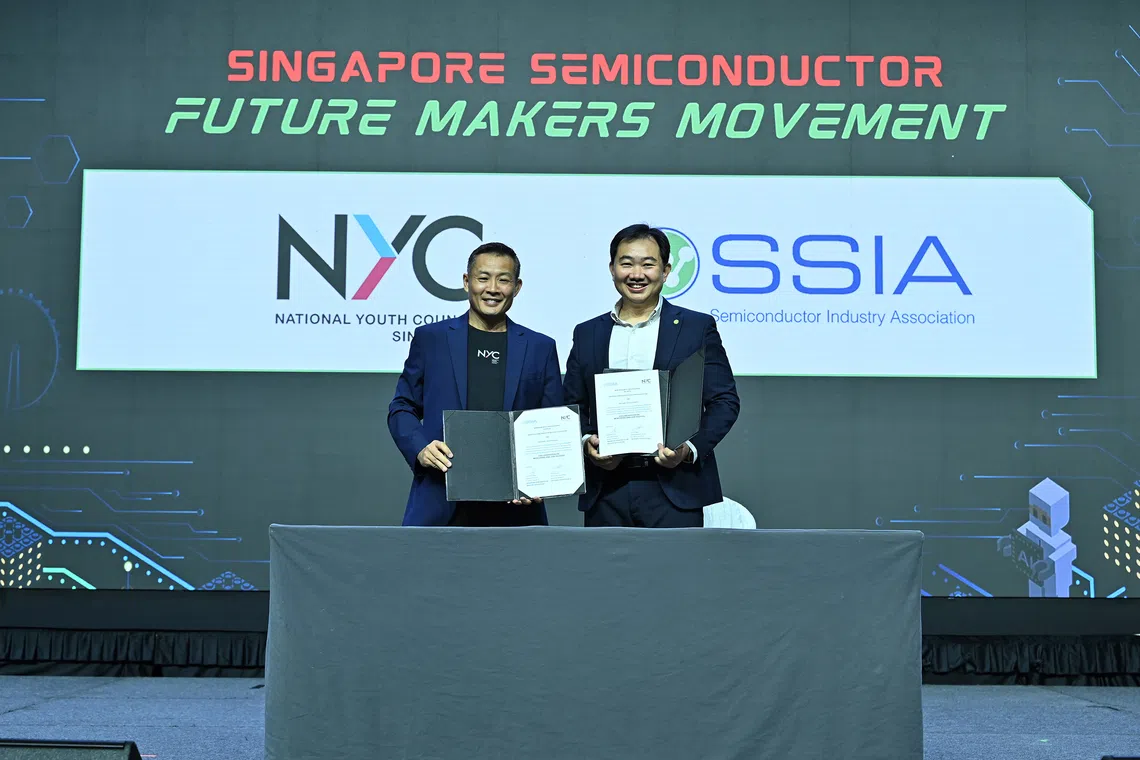
Under a three-year partnership between SSIA and the National Youth Council, the semiconductor industry will support up to 1,000 Job Taster opportunities and 300 industry mentors, alongside broader industry engagement expected to reach more than 4,000 youth.
The partnership will provide opportunities including micro-work experiences, job shadowing, company learning journeys, project challenges and short-term work attachments, alongside mentoring by semiconductor professionals.
SSIA also launched its first Regional Student Talent Exchange, which will connect more than 50 students and educators from India, Indonesia, Malaysia, Vietnam and Singapore with peers, industry leaders and Singapore’s semiconductor ecosystem before they enter the workforce.
Participants span disciplines including IC design, related technologies, electronics engineering and manufacturing, wearable electronics and computer science.
“By bringing students from different markets and technical disciplines together early, we want them to build the relationships and regional perspective they will need in an industry where innovation, manufacturing and supply chains cross borders,” said Ang.

