


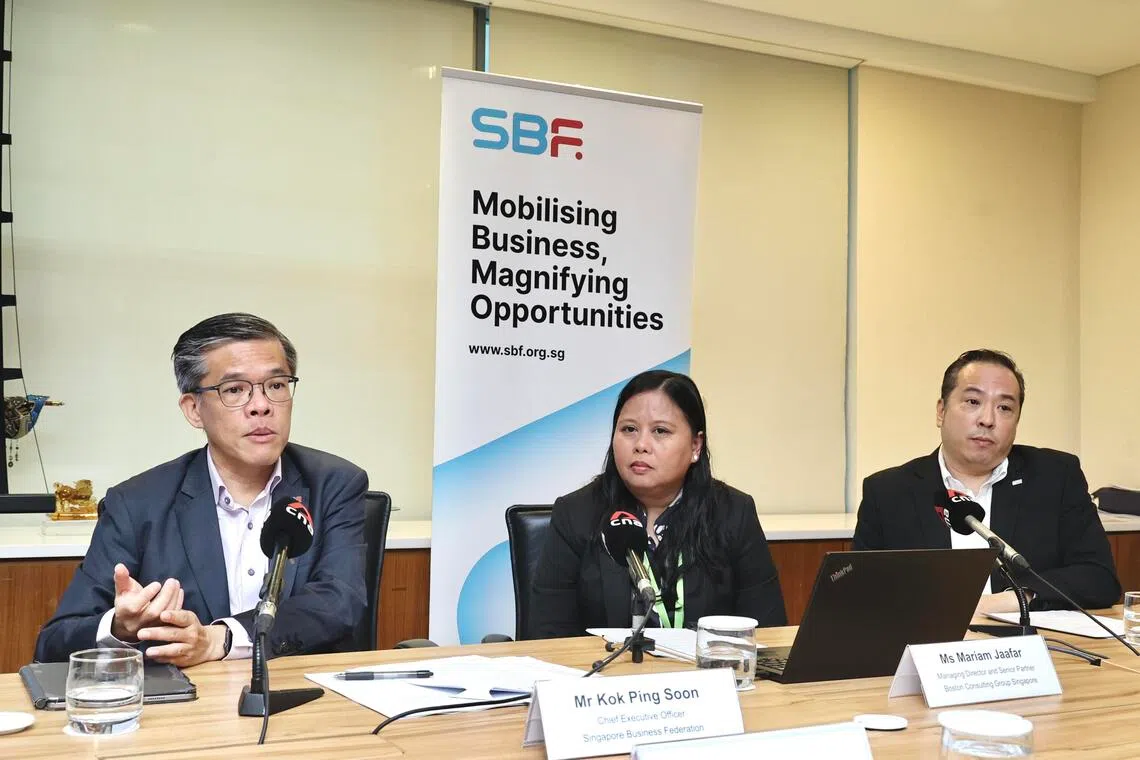
SINGAPORE – The Singapore Business Federation (SBF) on Sept 21 launched a new holistic diagnostic tool to help companies assess their future readiness, identify capability gaps and prioritise transformation efforts.
The launch was officiated by Senior Minister of State for Trade and Industry Low Yen Ling at the inaugural Future Ready Business in Action 2026 event, as part of the wider Future Ready Business platform.
The Future Ready Business Index (FRBI), developed with Boston Consulting Group (BCG) and delivered in partnership with DBS, Enterprise Singapore and RSM Singapore, looks at 11 quantitative measures and 39 qualitative metrics with rubrics with specific descriptors for more objectivity.
It is a “business readiness check” that looks at six key dimensions, said SBF chief executive officer Kok Ping Soon.
The six key dimensions are:
-
Success driven, which looks at their business performance, including strategy and financial strength
-
Scaled globally, which considers their readiness for international growth
-
Smart-enabled, which looks at their use of technology, including their data infrastructure and cybersecurity preparedness
-
Skills empowered, which assesses their workforce planning and development
-
Sustainable centric, which explores measures such as emissions tracking and preparation to seize green opportunities
-
Socially impactful, which looks at businesses’ purpose and governance
Mariam Jaafar, managing director and senior partner at BCG, noted that it uses a T-shaped model, which provides a broad assessment but also helps businesses understand which pillars require the most work.
It is a “first step” that gives the business community something it has not had before at scale, said Kok, highlighting three ways it differs from other diagnostic tools.
First, it gives businesses the full picture, rather than being focused on one aspect such as digitalisation or sustainability.
The six dimensions are interconnected, with capabilities working together as a whole, he said. For example, strong fundamentals are needed to support overseas growth, and sustainability can affect costs.
Second, the FRBI measures maturity, not just activity. It asks not just about adoption, but how well capabilities are embedded and producing results.
Companies will be told whether they are nascent, emerging, progressing, or future ready and how to move forward.
Third, the tool turns diagnosis into action. By identifying the gaps that matter most, it helps businesses “focus their limited time and resources where they have the greatest impact”.
Advisors will direct companies to the relevant programmes, training, financing and specialist support from across the ecosystem.
Work in progress
Kok said: “More than 100 companies have actually completed the FRBI. We aim to double it by end of this year to 200 and then reach collectively 500 companies by the end of next year.”
With more companies using the FBRI, the tool can also be refined over time to stay relevant to business needs and operating conditions, he said.
Jaafar said that based on feedback from the pilot, the tool was tweaked to allow companies to delegate sections to team members with relevant expertise.
The trial also helped to cut the time needed to fill in the survey, as it was optimised to pull data from sources such as the Accounting and Corporate Regulatory Authority.
Of the 102 companies in the pilot programme, 70 were those with revenues of under $10 million.
By maturity level, about 80 per cent of respondents were in the nascent or merging stages, but 77 per cent aspire to be progressing or future ready by 2027.
This shows that companies are aware and willing to transform, but lack capability, Jaafar said.
Kok also noted that this shows that companies are realistic, understanding that they may not reach the “final stage” immediately.
Jaafar also said that according to findings, companies with higher FRBI scores demonstrate better business outcomes. Progressing companies marked median revenue growth that was 5 percentage points higher than nascent ones, for example.
Currently, businesses are most prepared in the success-driven and skills-empowered dimensions, whereas sustainable centric and socially impactful were clear laggards, she shared.
Of the six aspects, the biggest differences between current and target states – the largest ambition gaps for pilot participants – were in smart enabled and skills empowered.
SBF recommends that companies retake the FRBI every two years, providing time for improvements to take effect while establishing a meaningful benchmark for tracking progress.
The Future Ready Business platform includes complementary offerings from closed-room dialogue sessions to behind-the-scenes company visits, with the aim of helping companies move from diagnoses to action. THE BUSINESS TIMES

