


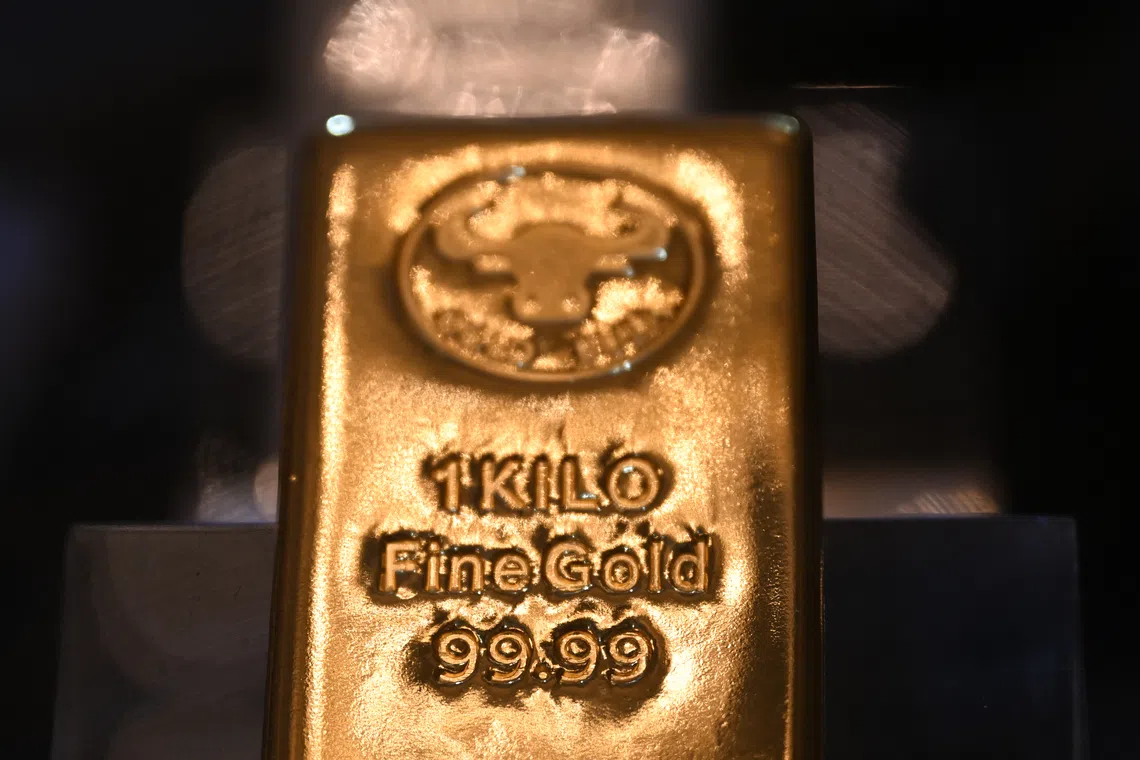
SINGAPORE – Gold prices are expected to rise further into 2027 despite high interest rates and volatile bond yields, as central bank purchases and concerns over US government debt continue to support demand for the precious metal.
Gold has had a mixed year, surging to a record high of US$5,594.82 an ounce on Jan 29 before retreating sharply to around US$3,942 in June. It has since regained some ground despite volatility in the bond market and a recent US interest rate hike, and was trading at around US$4,360 on Sept 21.
Higher interest rates and bond yields typically weigh on gold prices, as they increase the opportunity cost of holding the precious metal, which does not pay interest.
Still, analysts expect gold prices to continue rising into 2027, with forecasts reaching as high as US$5,400 an ounce in the third quarter of next year.
Zavier Wong, market analyst at etoro, said the reason behind the rise in US Treasury yields matters for gold.
If yields rise because the US economy is strong, gold typically comes under pressure as investors can earn higher returns elsewhere, while a stronger US dollar also makes the precious metal more expensive for buyers using other currencies.
But the recent rise in longer-term yields has instead been driven partly by concerns over the amount of debt being issued by the US government to fund its deficit.
US public debt crossed US$40 trillion in August, while the yield on the 30-year US Treasury bond climbed as high as 5.4 per cent in September.
Wong noted that while the higher yields make interest-paying assets more attractive relative to gold, concerns over US government finances are at the same time encouraging investors to turn to gold as an alternative.
“Debt-driven yields only provide the opportunity cost, because the same fiscal doubt pushing yields up is also pushing money into gold as the alternative,” said Wong
“The two effects mostly cancel out… That is the kind of rise we are seeing now, and it explains why gold has held up.”
Wong added that central banks are also buying gold to protect against financial crises and currency risks, and that the US Federal Reserve’s 25-basis-point rate increase on Sept 16 is unlikely to be enough to reverse those purchases.
Central banks globally bought 289 tonnes of gold in the second quarter of 2026, with purchases expected to reach between 700 and 900 tonnes for the full year, nearly double the annual average before 2022.
The People’s Bank of China alone bought more than 20 tonnes of gold in August, its largest monthly purchase since 2023 and its 22nd consecutive month of gold purchases.
Investor demand has also remained strong, with global investors adding US$18 billion to gold exchange-traded funds in August, according to data from the World Gold Council.
Wong said the next key indicator for prices will be central bank purchases in the third quarter of 2026.
“If that number comes in weaker, it means the central bank bid that’s been holding gold prices up is starting to fade,” he said.
Christopher Irwin, head of foreign exchange and precious metals trading for Asia at Julius Baer, said much of the US Fed’s expected tightening had already been priced in before its latest decision.
As a result, the latest rate increase generated little additional selling pressure.
Irwin said that the longer-term case for gold remains intact, supported by concerns over monetary credibility and investors’ willingness to increase their exposure when prices fall.
“Gold’s bull market began in late 2023 under a more restrictive US policy regime, underscoring that the metal’s trajectory is being shaped by forces well beyond interest rates,” he said.
Heidi Sum, global head of product specialists for liquid real assets at German asset management firm DWS, said gold’s near-term direction will depend on the Fed’s next move.
“A one-and-done signal could ease the pressure from higher inflation-adjusted yields and support a recovery, while further rate increases would likely keep gold volatile,” she said, adding that DWS forecasts gold at US$5,000 an ounce by September 2027.
Jeremy Tan, chief executive of Tiger Fund Management, said gold prices continue to be supported by geopolitical risks, particularly escalating tensions in the Middle East.
“We expect gold prices to remain highly resilient between US$4,300 and US$4,400 an ounce,” Tan said, adding that safe-haven demand for gold should help offset any price pressure from elevated short-term interest rates and inflation.
Heng Koon How, head of markets strategy at UOB, noted that gold prices briefly fell below US$4,300 an ounce after the Fed raised rate on Sept 16, before recovering towards US$4,400.
This rebound was an “encouraging sign” that gold was consolidating as investors adjusted to the higher interest rate environment.
UOB forecasts gold at US$4,500 an ounce in the fourth quarter of 2026 and that prices will continue climbing to reach US$5,400 an ounce in the third quarter of 2027.

