


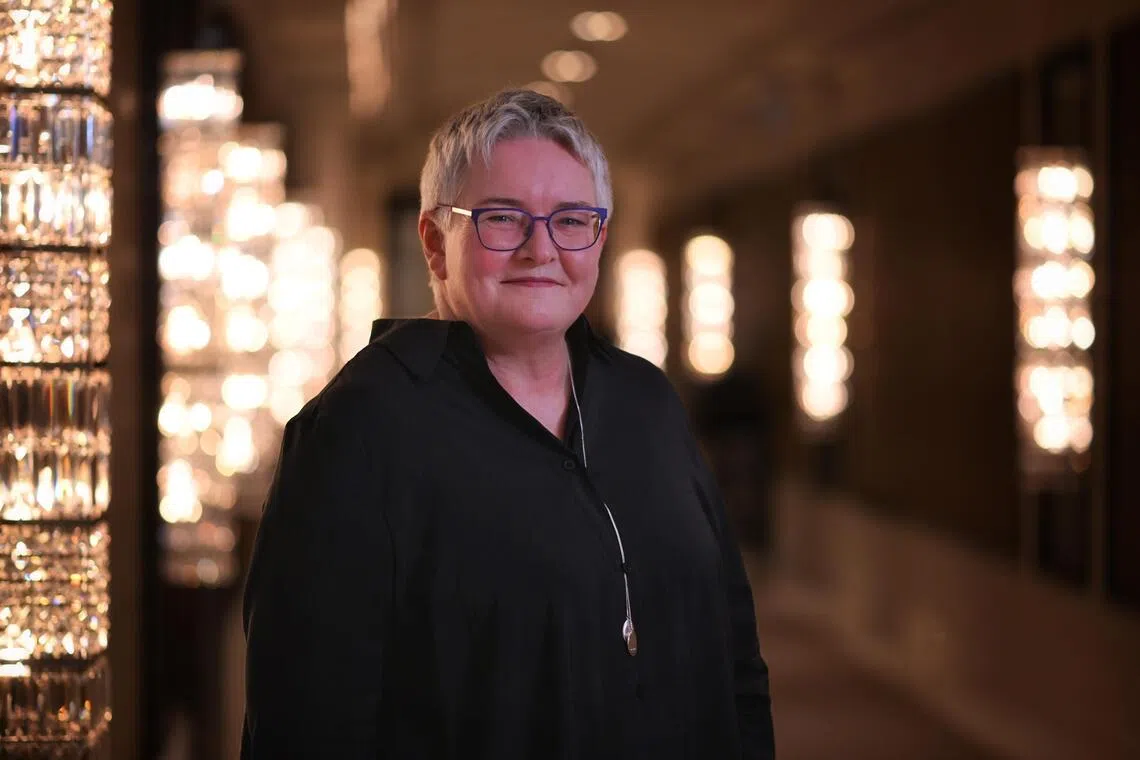
SINGAPORE – In a world of artificial intelligence, the data-crunching, financial report-writing accountant may seem at risk of displacement.
But Helen Brand, chief executive of the Association of Chartered Certified Accountants (ACCA), said that conversely, this makes human financial leadership, in the form of accountants and chief financial officers (CFOs), more vital than ever.
Having headed the global body – which supports more than 257,900 members in 180 countries – since 2008, she has seen the profession go through multiple geopolitical shocks, wars, tariff threats and the proliferation of AI.
Yet, her belief remains unwavering that accountants will have a place in the future workforce, and even grow in numbers.
“What the debate and rhetoric around AI are showing is that the human factor becomes even more important in that environment,” she told The Straits Times.
“The human factor is related to trust and confidence. So, at the heart of the profession is ethical conduct, providing information that the public can trust, that stakeholders can trust, that shareholders can trust.”
While accountants used to rely heavily on traditional training, navigating the ever-changing world demands more. With AI handling the heavy lifting of data collation, the path to becoming a CFO now requires a people-centric, diverse skill set.
Brand said: “There is a lot of routine work that will be removed from roles because the collation of information will be automated. To some extent, even the analysis of information will be automated.”
But she said that how AI is used, and the professional scepticism of an accountant, still needs to be applied by a human.
She noted that AI has issues with biases such as gender, race and nationality, and that is where human judgment still needs to be exercised.
But beyond the human touch, Brand added, the profession’s scope has also expanded, as accountants now need to consider aspects of a business far beyond just its financial reports.
Among these emerging considerations are sustainability as well as risks that businesses have to grapple with, such as tariffs.
“So the scope of the information that needs to be presented and the scope of the considerations of businesses is much wider than it used to be,” she said.
Accountants and financial leaders also have to deal with the increasing speed of change.
“The speed at which things change is accelerating. We didn’t used to talk about tariffs, did we? They existed and everyone had to comply with tariffs. But now it’s become this weaponised and political tool that has a real impact on businesses… very quickly,” Brand said, referring to the US tariffs announced by President Donald Trump in 2025.
While the initial tariffs were overthrown by the US courts, the administration has found alternative ways of imposing new duties.
Brand added: “Things have to be put in place; they need to be reversed.”
In this sense, the skills that are prized in an accountant, as well as those required to reach the CFO office, are now heavily weighted towards adaptability and resilience.
Brand said: “I think sometimes resilience is interpreted as being in a permanent state of misery. That’s not what we mean. It’s that you actually have the tools, and you are prepared and you expect change and speed such that it becomes routine to you.
“You don’t know exactly what the change will be, but you’re very used to going through that cycle.”
Communication skills and networking are also vital, she added.
Brand shared an anecdote about an accounting firm that gives its new recruits roles in hospitality first to hone their people and communication skills.
“I wouldn’t say those are new skills, but the emphasis (is now on) communication, human engagement, adaptability – they become even more critical, which all leads to employability.”
These are not just entry-level requirements. The ability to deal with and communicate complex financial realities to stakeholders is what ultimately defines a successful CFO.
ACCA has announced a redesigned qualification that introduces Essential Employability Modules to assess applied skills such as sustainability, communication, leadership and management. These modules will be available from early 2027.
Brand also highlighted the growing importance of sustainability considerations for accountants.
“It’s a business matter because in your business, you need to be assessing risk, including financial risk, and part of that is the sustainability strategy that your organisation might have.
“The professional accountant should be involved in that as the guardian of the resources of the organisation.”
She added that sustainability reporting, which is mandated for listed companies in Singapore, is just part of it.
Having the sustainability strategies to allow the business to thrive, all driven by financial data, is what matters, she said.
Brand also sees a future where sustainability reporting is integrated with financial reporting as part of a company’s overall story to shareholders, instead of having them as separate reports.
All this is just part of a world that is growing more challenging for everyone, including businesses and young accountant graduates.
“Starting out in that environment is hard. I wouldn’t want to sugarcoat it, but I do feel that people still want a profession with purpose – where they can make a difference – and that has longevity,” she said, adding that ACCA is still growing and sees young people and even mid-career workers entering accountancy.
How to be a CFO
A dream path for some accountants is to rise to the top and become the CFO of a company.
Brand said that for a budding CFO, the main thing is to “keep learning”.
“Your professional qualification is the start, not the end,” she said, adding that taking on other credentials, qualifications and even free courses is vital.
She added that people should not take on a string of similar credentials, but stack different qualifications – such as professional counselling, data science and sustainability strategy – to enhance their overall skill set.
Also, accountants who want to gain experience and a wider perspective should move horizontally across different business aspects, rather than just aiming to climb the career ladder, Brand advised.
Finally, a CFO has to be a good communicator.
“Are you happy making speeches? Are you happy addressing a board meeting? Are you curious? Are you going to demonstrate that you’re going to add value around the table?” Brand said.
But ultimately, CFO or accountant, the job is about maintaining and upholding a high standard and having a purpose in today’s business landscape – and that is what continually attracts people to the profession, she added.

