


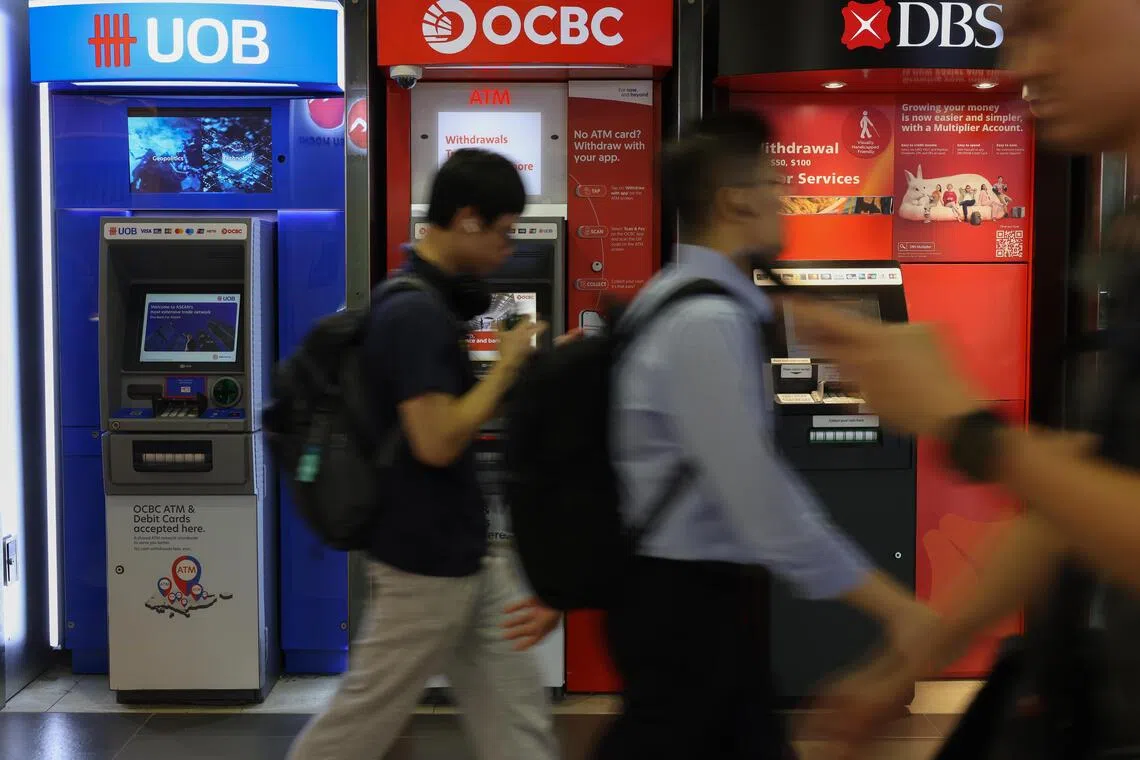
SINGAPORE – The US Federal Reserve’s latest rate hike on Sept 16 offered a potentially more favourable earnings backdrop for Singapore banks by supporting local interest rates and slowing the compression in net interest margins (NIMs), although this did not translate into broad share-price gains over the week.
NIMs measure how much a bank makes from lending after accounting for its funding costs.
UOB rose 1.26 per cent across the week to close Sept 18 at $41.78, while DBS slipped 0.18 per cent to $76.86 and OCBC fell 0.7 per cent to $31.38.
The Fed raised its benchmark interest rate by 25 basis points to a target range of 3.75 to 4 per cent for the first time since 2023, as inflation remained elevated and the US economy stayed resilient.
Most analysts now expect further rate hikes in the months to come, with RHB expecting one more 25-basis-point hike, and UOB anticipating two more hikes in December 2026 and the first quarter of 2027, followed by a pause for the remainder of 2027.
For Singapore banks, a higher-for-longer US rate environment could provide some relief to NIMs, as elevated US rates can feed through to Singapore interest rates as investors demand comparable returns here to keep their money in Singapore-dollar assets.
This would allow banks to reprice loans at higher rates and support net interest income (NII), which had been under pressure as rates declined during the first half of 2026.
Macquarie Equity Research’s Jayden Vantarakis said that while all three local banks stand to benefit from higher Singapore rates, UOB has the most to gain.
About 43 per cent of UOB’s loans are denominated in Singapore dollars, compared with 37 to 38 per cent for DBS and OCBC. UOB also earns more NII in its revenue mix, at 66 per cent, compared to about 58 per cent for its two peers, said Vantarakis.
Yen slumps against Singdollar, US dollar
The Japanese yen weakened against the Singdollar even after the Bank of Japan (BOJ) raised rates by 25 basis points to 1.25 per cent on Sept 18, its highest level since 1995.
The yen was trading at 122.941 against the Sing dollar on Sept 18, from 121.148 on Sept 11.
The yen also slumped against the greenback, trading at 156.880 per US dollar on Sept 18, from 153.571 on Sept 11.
Still, BlackRock head of global fixed income for Asia-Pacific Navin Saigal said that BOJ’s rate hike marked another step in Japan’s gradual but important transition away from the deflationary environment that shaped much of the past three decades.
“The decision should therefore be viewed … more as part of a broader transition toward a more normal economic and interest-rate environment.”
He added that the move could reinforce confidence that the BOJ is serious about gradually raising interest rates from exceptionally low levels, which should strengthen the yen and reduce the need for investors to demand higher yields on longer-term Japanese government bonds.
T. Rowe Price portfolio specialist for Japanese equity strategy Daniel Hurley added that he expects the BOJ to continue tightening its monetary policy as domestic conditions warrant further rate increases and the yen remains “very cheap” on a range of measures.
Gold bounces back
Gold edged up above US$4,300 per ounce on Sept 18, after a temporary slump following the Fed’s decision to raise interest rates.
However, gains were limited by a stronger US dollar, which remained supported after the Fed raised rates and signalled further hikes in the coming months. This means that gold becomes more expensive for non-US buyers.
Higher yields on dollar-denominated assets such as US Treasuries can also make gold relatively less attractive as the yellow metal does not pay interest.
Nevertheless, DWS said that it maintains a positive view on gold, supported by continued central-bank buying, fiscal concerns and diversification away from US Treasuries.
DWS expects gold to reach US$5,000 per ounce by September 2027, but noted that high bond yields are likely to limit the upside potential of gold.
Analyst downgrades SIA as oil prices turn volatile
Oil prices fell about 2 per cent on Sept 18, although they stayed above US$100 a barrel.
Reports indicated that Saudi Arabia was restoring capacity on its damaged East-West pipeline faster than expected and diverting additional crude exports through Oman, easing concerns about supply disruptions.
Still, DBS economists pointed out on Sept 18 that there is no resolution to the Middle East crisis in sight.
High oil prices could still push inflation up, which may pressure some central banks to raise rates, the economists said.
Shares of Singapore Airlines (SIA) fell 2.25 per cent to $6.51 after UOB Kay Hian downgraded the airline to a “sell” after a re-escalation in Middle East tensions sent jet fuel prices rising.
UOB Kay Hian also cut the price target to $6.16, from the previous $6.71, and slashed SIA’s net profit guidance for the second quarter of the 2027 financial year to between $230 million and $370 million, from between $240 million and $460 million.
“Jet fuel prices are likely to remain elevated in the near term, creating continued pressure on SIA’s profitability,” said analyst Roy Chen.
SIA posted a net loss of $76 million for the first quarter, down from a net profit of $186 million a year ago, due partly to rising jet fuel costs.
Other market movers
Metrocon made its debut on the Singapore Exchange’s Catalist board on Sept 15, closing its first trading day at 23.5 cents, or 17.5 per cent above its 20 cents placement price.
The shares closed the week at 23 cents.
This followed the geotechnical foundation engineer completing a $28 million reverse takeover of embattled property developer Hatten Land, which allowed it to be listed without an initial public offering.
The group said it completed more than 40 projects in Singapore and continues to undertake projects across infrastructure and building developments, with capabilities spanning foundation engineering, soil improvement and earth retention works.
It also secured a $750,000 soil improvement subcontract for a public housing development comprising 1,976 units, with the project expected to be completed in 2031.
Shares of UltraGreen.ai closed down 4.84 per cent to 59 US cents.
DBS Group Research analysts cut their target price for UltraGreen.ai further, from 80 US cents to 65 US cents, after the launch of a competing product in the US confirmed that the surgical-dye maker would face pricing pressure.
In August, DBS had already downgraded the company to a “hold” and slashed its price target to 80 US cents from US$1.95 as the competition intensified.
UltraGreen.ai in a Sept 16 filing said it remains focused on maintaining US market share despite a competitive environment. The group is “actively engaging” with distribution partners in the US amid its broader growth strategy.
What to look out for next week
Investors should keep a close eye on DBS, OCBC and UOB shares as markets digest the Fed’s move back towards a higher-rate environment.
A higher rate outlook could be particularly relevant for UOB, given its greater exposure to Singapore-dollar lending and reliance on NII, while DBS and OCBC could also benefit from a more supportive interest-rate backdrop.
US Treasury yields will be another key watchpoint next week, particularly for Singapore REITs.
With the Fed signalling that rates may remain higher for longer, investors should watch the US 10-year Treasury yield, as a sustained rise could weigh on the REITs.
Higher bond yields make safer fixed-income assets more attractive, prompting investors to demand higher yields from local REITs and potentially pushing down their unit prices. Elevated interest rates could also raise their borrowing and refinancing costs.
Another major market event will be the Sept 24 meeting between US President Donald Trump and Chinese President Xi Jinping at the White House, with the market watching for developments on trade and the future of the US-China tariff truce.
For investors, the tone and outcome of the meeting could have implications across Asian equities and currencies.
Signs of a more stable trade relationship could ease concerns around supply chains and regional growth, while renewed tensions could bring volatility back to China and broader Asian markets.
-
To learn more about The Straits Times Index, go to the SPH campaign website.

