


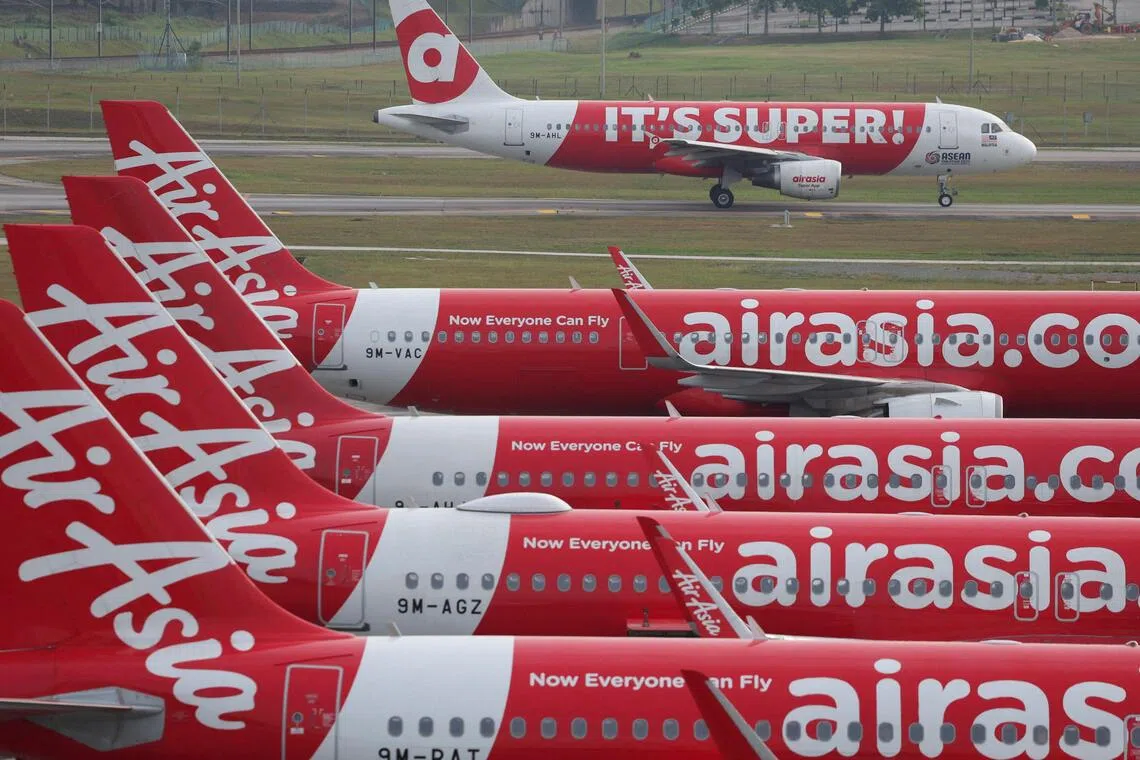
HONG KONG – AirAsia co-founder Tony Fernandes said on Sept 18 that the low-cost carrier’s challenges from soaring jet fuel costs were “far, far” less severe than those it faced during the Covid-19 pandemic, as he sought to reassure investors about the airline’s financial health.
Speaking at a media briefing, Fernandes also said AirAsia had “strong liquidity” and was adept at managing cash, adding the current crisis was largely driven by geopolitical tensions and higher fuel prices, while travel demand remained strong.
The briefing came two days after Reuters reported, citing sources, that Malaysia’s government had asked Malaysia Airlines and Batik Air whether they could absorb AirAsia’s domestic market share.
The sources said it was part of what they described as scenario planning while authorities monitor the financial health of South-east Asia’s largest low-cost carrier.
AirAsia’s current liabilities stood at RM18.4 billion (S$5.73 billion) as of June 30, against cash and bank balances of RM954 million.
Fernandes told reporters the second quarter marked the toughest period for the airline that controls about 60 per cent of Malaysia’s domestic market and he forecast improving conditions as AirAsia adjusts fares to reflect higher fuel costs.
The airline has been hit by soaring jet fuel costs stemming from the US-Israeli war on Iran that surged 66 per cent in the second quarter from the prior quarter to an average of US$183 a barrel.
AirAsia shares closed 21 per cent lower on Sept 17 after the Reuters report. Malaysian financial markets were closed on Sept 16 for a public holiday.
AirAsia shares were trading 2 per cent lower on Sept 18 after falling as much as 5 per cent earlier.
The stock has lost more than 70 per cent of its value so far in 2026.
‘No one can replace’ AirAsia
AirAsia’s large market share in Malaysia has made its financial challenges a significant concern for the government, sources previously told Reuters.
Fernandes said “no one can replace” AirAsia’s 100 planes in the country overnight.
The group’s load factor, which measures how well an airline is filling available seats, stood at 80 per cent in the third quarter and it sees strong bookings for the fourth quarter, Fernandes said, adding he was optimistic about operations in Indonesia, the Philippines and Thailand.
AirAsia reported a net loss of RM831 million for the second quarter ended June 30, hit by rising jet fuel costs and heavy foreign-exchange losses of RM331 million. REUTERS

