


SINGAPORE – Despite the recent global turbulence, South-east Asia’s six largest economies are expected to grow by an average of 4.8 per cent annually over the 10 years ending in 2035, a new report projects.
Vietnam will lead the way with a rate of 6.2 per cent, according to the report released on Sept 16 by DBS Bank and consultancies Bain & Company and Vriens & Partners.
The Philippines, Indonesia and Malaysia follow, with a projected average growth of 5.8 per cent, 5.4 per cent and 4.3 per cent, respectively.
Singapore is expected to record an average annual growth of 2.7 per cent, ahead of Thailand’s 2.2 per cent.
A previous forecast put Singapore’s average annual growth at 2.5 per cent from 2024 to 2034.
Although the Republic’s projection is lower than some of its peers, it notably has the highest income per capita in ASEAN, said DBS Bank’s managing director and chief economist Taimur Baig.
“Growing at 2.5 per cent at the top end of the income frontier is pretty impressive, especially given the demographic headwinds that Singapore is percolating right now and over the next decade,” he added at an event to mark the report’s launch.
Singapore recorded average real GDP growth of 5.2 per cent in 2024 and 2025.
The report also noted a sharp divergence in the region’s growth. Economies like Vietnam, Malaysia and Singapore outperformed the regional average over the two years, supported by drivers including artificial intelligence-linked semiconductor demand, manufacturing exports and investment momentum.
Meanwhile, Indonesia fell short because of institutional and execution constraints, while the Philippines was impeded by weaker investment and execution by the public sector.
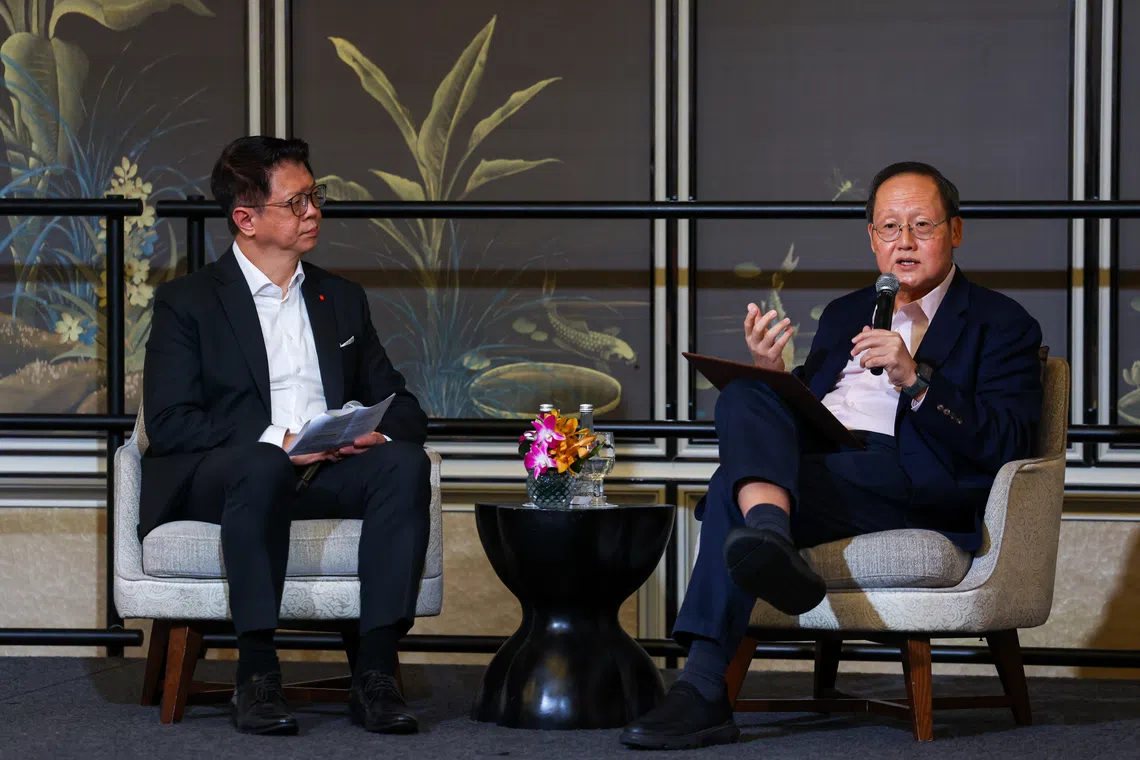
Minister for Trade and Industry (Energy and Industry) Tan See Leng, who spoke at the event’s dialogue session, said Singapore grows when the wider region prospers.
Pointing to an observation in the report that Singapore captured more than 60 per cent of foreign direct investment (FDI) into the region, he noted strong investment interest in the technology space here, including advanced manufacturing and medtech.
However, Tan said these flows are unlikely to remain in Singapore, as companies use it as a base to venture into the rest of South-east Asia.
He added: “My sense is that capturing the lion’s share of the FDI is a phase, and we will eventually see it being redeployed out into the rest of the region.
“This is truly a win-win partnership where the entire region has to win. It’s only when our neighbours prosper and they develop that we will continue to be able to sustain this momentum. It’s a common destiny that we share.”
The ASEAN Power Grid, targeted for realisation by 2045, is a potential area that requires regional architecture, Tan said.
The grid will allow member states to trade surplus electricity. Importing clean electricity is a key strategy for Singapore’s net-zero goal.
The report also stated that Singapore was emerging as ASEAN’s regional capital hub, as it is now the largest source of FDI into Indonesia, Malaysia, Thailand, and Vietnam.
It added that the US remains Singapore’s top FDI source and is expanding its presence in Malaysia through investments in AI, cloud infrastructure and data centres.
This comes as FDI from China has grown in selected regional markets, such as Indonesia’s nickel and electric vehicle battery supply chains.
Tan reiterated Singapore’s plans to strengthen South-east Asia’s centrality and unity when it takes on the ASEAN chairmanship in 2027.
He said: “I think this is really an ASEAN century. Given the geopolitical disruptions, uncertainties and the tensions that are happening all over, we are in a relative oasis of calm, peace and stability.
“We are also a very diverse 11 economies coming together with a very compelling growth and investment proposition. The fundamentals continue to remain strong.”

