


SINGAPORE – Young Singaporeans should start working with artificial intelligence early so they can adapt to a future no one can yet predict, businessman Kwek Leng Beng said, even as he cautioned that relying too heavily on the technology could cause them to neglect the basics.
Speaking to The Straits Times before a fund-raising gala on Sept 15, Kwek, who is also chairman of property developer City Developments (CDL), said young people were eager to learn and should be given room to experiment with AI and find their own way through technological change, including changes to the jobs they may eventually hold.
During the interview at the sidelines of the Star of Hope Gala, organised by the St Joseph’s Institution Philanthropic Fund for the Lasallian Mission (SJIPF) at Capitol Theatre, Kwek, 85, said AI is no longer optional for the next generation.
On a recent debate in the US about the risks and potential ill effects of letting AI develop at its current pace, Kwek said young people should learn to work with AI now, rather than wait until its effects on jobs and society become clear.
“No one knows what will happen in 10 years,” he said. But he believes exposure to new technologies while students are young will help them learn how to be “smarter” and adapt as those technologies change.
Asked about the role education providers play in helping students level up and prepare to enter workplaces already equipped with AI, Kwek said young people are already curious and quick to follow new trends on their own initiative.
He added that “youngsters are smarter than you think”, and should be allowed to explore, make mistakes and work out what is useful for themselves.
“I think they are very keen to learn everything possible and stay up to date. There is nothing wrong with letting them go through this cycle. It is an important experience and they have nothing to lose.”
During the SJIPF event, Kwek also committed $1 million to help young Singaporeans develop the technical skills and independent thinking needed to build AI applications, saying the country cannot afford to fall behind in a rapidly changing world.
The Kwek Leng Beng Innovation Gift will support student-led technology projects at St Joseph’s Institution (SJI), as well as scholarships for SJI students and alumni studying mathematics, computer science or engineering at the University of Cambridge.
The gift is intended to develop students who can independently identify problems and build technological solutions, rather than merely perform well academically.
Half of the money will initially go towards the Kwek Leng Beng Innovation Programme at SJI. The programme will fund student-proposed projects in AI, advanced computing and emerging technologies, including their building costs and competition fees.
It will also pay for mentorship by industry and research practitioners, short courses in areas such as machine learning and robotics, and seed grants awarded directly to student teams. The programme is expected to run for about 10 years.
SJIPF president Leon Yee said students would not have to demonstrate that their ideas fitted within the existing school syllabus to qualify for support.
“A boy with an idea will no longer have to persuade anyone that it fits a syllabus,” he said. “He will be able to apply for a grant, receive a decision and get on with building his project.”
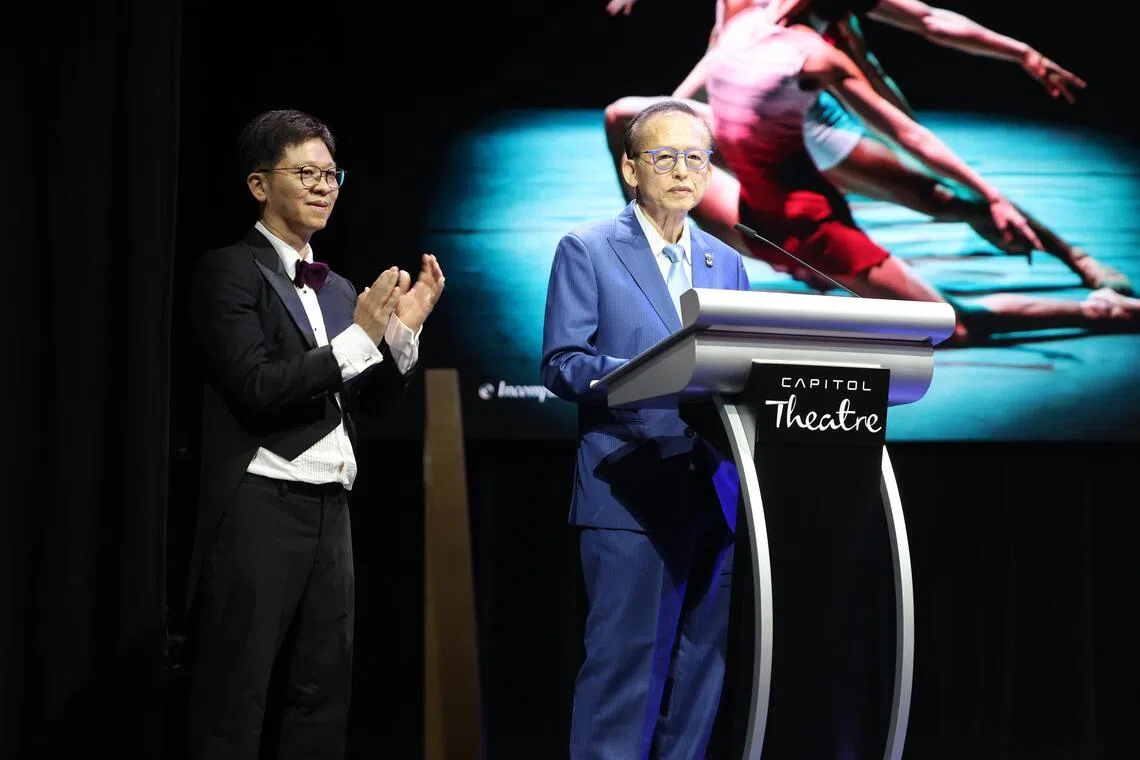
Kwek Leng Beng (right) speaking at the Star of Hope Gala on Sept 15.
PHOTO: LIANHE ZAOBAO
The other half of the gift will initially fund the Kwek Leng Beng SJIPF-Cambridge Scholarship. It will provide as much as $50,000 to each recipient admitted to Christ’s College or St Edmund’s College at Cambridge to study mathematics, computer science or engineering.
The gift is expected to support between 10 and 20 scholars, depending on the amount awarded to each recipient.
Academic results will serve only as an eligibility threshold, as candidates must first secure a place at Cambridge. Scholarship recipients will instead be selected based on their work outside the classroom, including software and systems development, research, previous ventures and other independent initiatives.
The selection panel will also assess whether applicants are willing to pursue difficult or important problems.
The scholarships will carry no bond, repayment requirement or obligation for recipients to return to Singapore.
“A bond tells a young man at the start that we do not trust him to come back on his own,” Kwek said.
“I have been in business a long time, and I have never kept anyone by contract who wanted to leave. Talent is not held by paper. It is held by opportunity.”

