


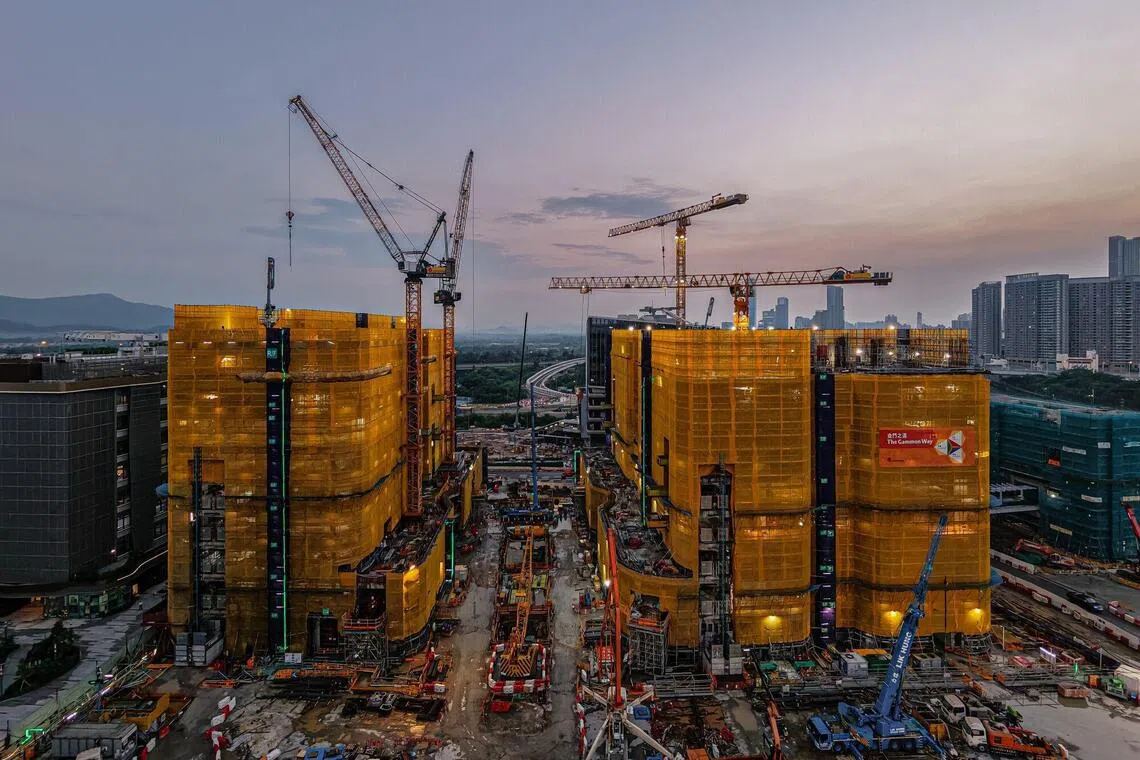
HONG KONG – Hong Kong’s ambitious plan to become a data centre hub got off to a slow start.
When the government put a site in the remote Sandy Ridge up for auction in late 2025, after earmarking it as a high-tech data centre zone, the initial response was silence. Local developers had no interest. Big international data centre operators stayed away.
Eventually, the auction received only a single bid: a HK$24 billion (S$3.9 billion) investment pledge from Range Intelligent Computing Technology Group, a mainland Chinese firm little known outside of its home market.
Bankers in Hong Kong are now weighing up a financing plan for a company few of them had heard of in 2025, in a sector that has become a byword for the spending frenzy around artificial intelligence.
Range Intelligent told bankers earlier in 2026 it wanted to raise around HK$20 billion from the loan, according to people familiar with the matter. That would mark one of the biggest loan financings in the city in 2026, according to Bloomberg-compiled data. But some bankers said they had doubts over how the company will repay the money, or how it will ultimately develop the site.
The financing is a test case for Hong Kong’s ambitions to become a hotspot for data centres, the sprawling physical infrastructure underpinning the AI services being offered by hyperscalers such as Meta Platforms and Alibaba Group Holding. Hyperscalers are technology firms that operate at huge size in cloud computing, storage and network services, among other things.
Range Intelligent is a key player in its domestic market, reaping the benefits of swelling demand by TikTok’s parent ByteDance and giving its founder Zhou Chaonan a fortune of more than US$10 billion (S$12.7 billion) earlier in 2026, according to Bloomberg calculations. But the firm is only just starting to dip its toes into overseas markets.
Hong Kong’s live data centre capacity is expected to roughly double to more than 1,100 megawatts by 2030, requiring at least US$7 billion of investment in data centres and related infrastructure, according to estimates from Structure Research.
But North American investors are pulling back, preferring to back data centres housed by big US hyperscalers like Alphabet and Microsoft, said Brian Groen, principal at BGDC Consulting. The market increasingly relies on demand from mainland China, particularly from the country’s own hyperscalers: Alibaba, Tencent Holdings and ByteDance.
“Hong Kong is positioning itself to be a super hub for Chinese demand,” said Jason Zhou, a senior analyst at Structure Research. The proximity to Shenzhen for the upcoming projects including Sandy Ridge means the new builds can target Chinese hyperscalers, said Zhou.
The shifting demand has put the spotlight on data centre builders that are both willing and able to serve this wall of Chinese demand.
Range Intelligent did not respond to requests for comment. A representative for Hong Kong’s Innovation, Technology and Industry Bureau said it was closely watching the progress of the Sandy Ridge project, but declined to comment on the financing arrangement or development plan.
Loan negotiations
In July, a group of executives from Range Intelligent landed in Hong Kong for meetings with bankers, said a person familiar with the matter. Leading the group was vice-general manager Zhang Xian, daughter-in-law of the company’s founder, Zhou Chaonan, the person added.
It was months after the firm had first reached out to banks to get commitments for the loan, and the two sides remained locked in negotiations. Range Intelligent largely focused on the offshore arms of mainland Chinese banks, leveraging the relationships it had built onshore.
Range Intelligent had talks with some bankers about first raising HK$2 billion from a “phase one” loan before borrowing the remaining HK$18 billion later in 2026, said a person familiar with the matter.
The bigger portion ironically looked like an easier sell to banks, since Range Intelligent made clear it would be willing to provide collateral to boost the appeal of that loan. But in its attempt to save the collateral for the bigger deal, Range Intelligent executives rebuffed attempts to convince them to offer security for the HK$2 billion clip, the person said.
Some bankers said they were concerned about Range Intelligent’s ability to pay back the loan, as well as its wider plan for the project.
Still, several banks have pushed ahead and sent loan proposals to the borrower, in part because Range Intelligent already has a relationship with their banks inside China, said people familiar with the matter.
The company previously told some banks it wanted to sew up the smaller tranche by the end of September, allowing it to launch the bigger HK$18 billion loan before the end of 2026, one of the bankers said. Bankers are now waiting for the loan to move to the next stage, he added.
Range Intelligent, which has a market value of almost US$15 billion after a wild stock market rally, is responsible for around 750 megawatts of computing capacity in mainland China – bigger than the current capacity of all Hong Kong data centres combined.
But the firm has only recently started to expand overseas, with a project in Indonesia’s Batam Island being developed alongside the Hong Kong site.
The company’s established position in China has given it access to cheap funding. Its three-year cost of funding is as low as 1.7 per cent, it recently told investors. In a bond offering document, the company revealed lending relationships with more than a dozen commercial banks, including branches of Bank of China, China Construction Bank and Shanghai Pudong Development Bank.
Government plans
The Sandy Ridge data centre site is part of the Hong Kong’s plan for the Northern Metropolis, a 300 sq km project. The government hopes the data centre project will generate economic output of about HK$4.6 billion in the first three years.
The University of Hong Kong is building a new campus in the area, while railway operator MTR is planning to start digging through a new underground network to reach the sparsely populated area.
The Hong Kong government has also made a clear show of support: the city has dipped into its currency defense fund for the first time in decades, triggering concerns over a dangerous precedent, to help fund development in the area.
These signs of support may help push Range Intelligent’s deal over the finish line.
Sandy Ridge is a key project for the government, which has been pushing artificial intelligence in the city, said Samuel Lai, head of industrial and logistics at CBRE Group. “Whether it is for training AI models or for AI computing power, it actually holds a very important strategic significance,” he said. BLOOMBERG

