


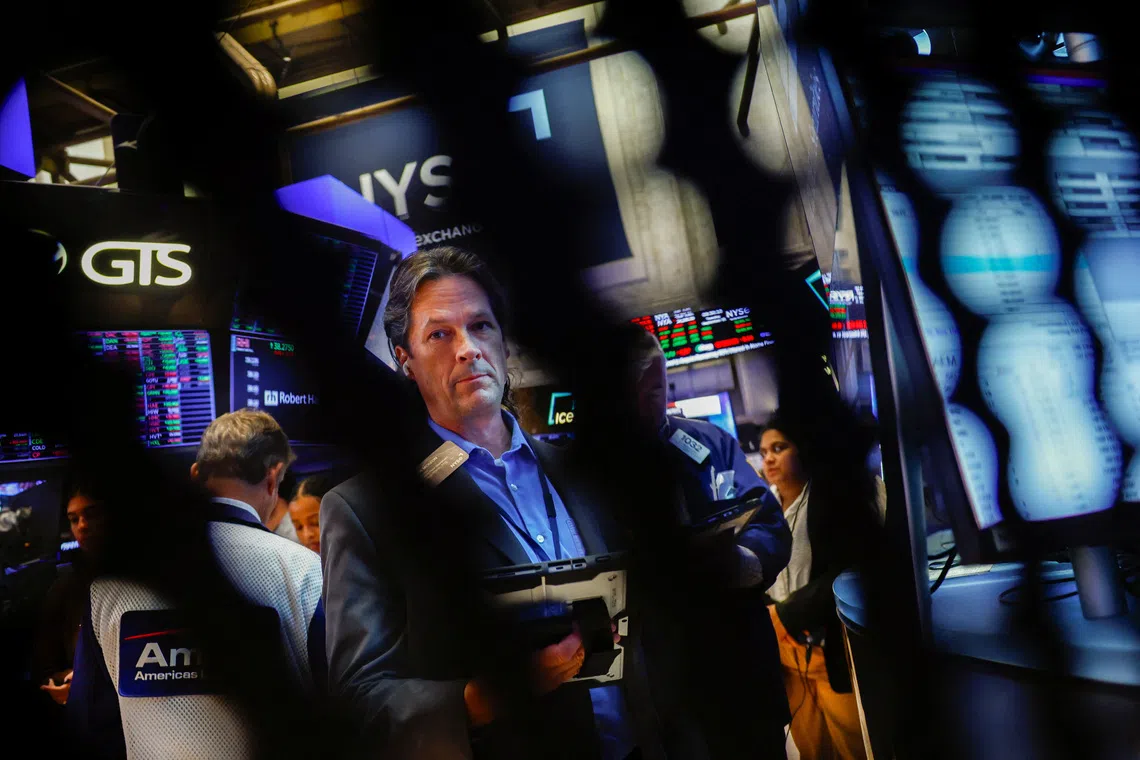
NEW YORK – Wall Street extended its selloff on Sept 15, as rising US Treasury yields, mounting debt concerns and soaring crude prices kept buyers on the sidelines.
All three major US stock indexes extended Sept 14’s losses as broad risk-off sentiment weighed on nearly every sector but energy. That sector benefited from expanding hostilities in the Middle East, which included new attacks on Saudi Arabia’s energy infrastructure.
“Given rising prices for fuel, especially diesel, given the near-certain outlook for rising rates beginning tomorrow, and given the concerns over the potential slowdown in the AI ecosphere, why step into the market aggressively until some of this clears up?” said Peter Tuz, president of Chase Investment Counsel in Charlottesville, Virginia.
The Federal Reserve has convened for its two-day monetary policy meeting, which is due to culminate on Sept 16 with the central bank’s rate decision.
With recent economic data showing the labour market on solid footing, while war-related energy price pressures are morphing into broader, systemic inflation, the central bank is expected to implement a 25-basis-point increase to its Fed funds target rate – its first interest rate hike in over three years.
In the wake of last week’s hot inflation data and the near 25 per cent jump in US crude prices over the last two weeks, financial markets have priced in a 94.5 per cent likelihood of a rate hike on Sept 16, up from 33.1 per cent one month ago, according to CME’s FedWatch tool.
Tuz added that while markets will learn the Fed’s decision tomorrow, “the Middle East conflict is a wild card as to how long it might last.”
Front-month West Texas Intermediate and Brent oil settled up 4.4 per cent and 2.9 per cent respectively, while diesel futures closed at a record high.
“This will probably be not a one-and-done, but a series of rate increases,” said Paul Nolte, senior wealth adviser and market strategist at Murphy & Sylvest in Elmhurst, Illinois. “It will be dependent on oil; that is really the source of inflation and it’s starting to seep into other parts of the market.”
As rate-hike bets increased, global bond yields resumed their upward climb, with benchmark US Treasury yields breaching 5 per cent and reaching the highest level since 2007.
Rising interest rates are increasing the pressure on heavily indebted borrowers, including companies that have placed big bets on AI.
Those worries exacerbated mounting fears over AI’s destructive potential and growing opposition to the construction of data centres, which came to a head on Monday and dragged the Philadelphia SE Semiconductor index down.
The semiconductor index, which has helped drive broader stock market gains this year, did not meaningfully recover from Monday’s rout, eking out a 0.4 per cent gain.
The Dow Jones Industrial Average fell 328.09 points, or 0.63 per cent, to 52,093.11, the S&P 500 lost 34.25 points, or 0.45 per cent, to 7,585.73 and the Nasdaq Composite lost 204.84 points, or 0.78 per cent, to 25,981.57.
Among the 11 major sectors of the S&P 500, consumer discretionary stocks were the biggest percentage losers, while energy, buoyed by rising crude, advanced 2.3 per cent.
Dave & Buster’s tumbled 19 per cent following the company’s second-quarter revenue miss.
Waystar rose 7.1 per cent after Reuters reported the healthcare software firm is exploring options, including a potential sale.
Weakness in bitcoin was compounded by the US Senate not advancing comprehensive cryptocurrency legislation, in a blow to digital asset companies. Crypto firms Coinbase and Strategy dropped 10.1 per cent and 5.4 per cent, respectively.
Declining issues outnumbered advancers by a 2.56-to-1 ratio on the NYSE. There were 113 new highs and 673 new lows on the NYSE.
On the Nasdaq, 1,439 stocks rose and 3,356 fell as declining issues outnumbered advancers by a 2.33-to-1 ratio.
The S&P 500 posted 14 new 52-week highs and 18 new lows while the Nasdaq Composite recorded 52 new highs and 264 new lows.
Volume on US exchanges was 15.85 billion shares, compared with the 15.14 billion average for the full session over the last 20 trading days. REUTERS

