


SINGAPORE – AI was once largely a Big Tech game, requiring billions of dollars to develop powerful models and the computing infrastructure to run them.
But that chapter of the AI transition is more or less done.
The industry’s next challenge is about maximising frontier intelligence’s impact and reach to deliver on the promise of boosting productivity.
The World Economic Forum estimates AI tools could contribute up to 14 per cent of global GDP by 2030, equivalent to about US$15.7 trillion (S$19.90 trillion). Goldman Sachs estimates the technology could lift world productivity growth by 1.5 percentage points over a 10-year period.
Agile start-ups worldwide – and here in Singapore – are slowly taking a leadership role in showing how raw, unpredictable artificial intelligence can be packaged into predictable and valuable workflows that businesses would actually pay for.
“Start-ups are really the canary in the coal mine,” said Juliana Lim, chief startup launchpad officer at JTC, who oversees the agency’s start-up ecosystem initiatives aimed at growing Singapore’s innovation landscape.
She said start-ups are usually quick at sniffing out potential opportunities that even large multinationals would miss.
“JTC’s role in this story is that we provide the space and structures that enable our startups to find a footing…a home,” noted Lim, who is also executive director at technology ecosystem builder and investor SGInnovate, where she oversees the national Deep Tech Central strategy.
JTC’s LaunchPad @ One-North is part of Singapore’s multi-agency effort to scale up the local AI start-up ecosystem. It has grown from one block in 2015 to seven today and has housed more than 2,400 start-ups, including unicorns Carousell, PatSnap and Nium.

JTC’s LaunchPad @ One-North is part of Singapore’s multi-agency effort to scale up the local AI start-up ecosystem.
PHOTO: JTC
Two AI start-ups from One North offer a glimpse of how smaller firms are trying to turn advances in AI into commercial businesses – and the challenges of doing so.
Invigilo AI
Workplace safety start-up Invigilo was co-founded in 2021 by Vishnu Saran and Anand Kumar.
Its AI-powered platform uses computer vision and video analytics on existing webcams or portable cameras the firm provides to identify unsafe acts and high-risk conditions in real time, helping improve safety and productivity across construction and industrial sites.
A web-based dashboard enables safety observations and collaborative case management.
Today, Invigilo’s applications are used across oil and gas facilities, construction sites, industrial plants and large-scale infrastructure projects worldwide that require continuous, camera-based safety enforcement at scale.
A HDB construction project, for instance, saw 60 per cent fewer safety incidents 12 months after Invigilo was deployed on 30 existing cameras.
Saran, Invigilo’s chief executive, said traditional video-based surveillance analytics have been around for decades, but such systems were limited to motion detection and rule-based alerts and could thus identify only what they were programmed to recognise.
AI, on the other hand, is redefining the future of video surveillance.
By applying deep learning, contextual understanding, and self-improving models, AI can transform video from a passive recording tool into an intelligent decision-making system.
But to achieve that, Saran and Kumar had to train their AI model to understand different work environments and unsafe behaviour that increases the risk of accidents and injuries.
A construction site’s safety and compliance requirements, for instance, are quite different from those of an offshore oil and gas exploration platform.
“So you have to install the cameras and train the model accordingly, so that it can actually catch all the scenarios that can possibly happen… and then the AI eventually learns,” said Saran.
Beyond safety and compliance, Invigilo’s AI-powered surveillance can also instruct companies on improving their procedures and processes.
For instance, its Invigilo’s software suite uses AI to break down recorded video sequences of construction site operations into structured, step-by-step procedures such as where a truck should make deliveries, where those deliveries should be stored, and how storage could be optimised. This can help speed up construction and cut costs.
“You must take the companies along with you on the journey of technology. And it’s a journey. Whatever you have made will be constantly improving as the AI technology improves,” Saran said.
Invigilo’s systems are at work at about 200 active sites, according to its website. Its clients include two global petroleum giants: a national oil company in the Middle East and a Western major’s drilling and production operations in Australia.
In June 2026, Invigilo was one of the first three start-ups awarded the Government’s Innovative Procurement Partnership tender. Under the pilot, Invigilo provides JTC with computer-vision technology to track and assess productivity on infrastructure and construction sites.
If successful, Invigilo can scale its technology across other JTC projects without going through traditional re-tendering.
Saran said the startup is making enough to invest back in product development.
From a two-man outfit incubated at BLOCK71, the startup hub run by NUS Enterprise, the firm has grown to 50 staff, with some working remotely from neighbouring countries.
The team is mainly composed of coders, machine learning engineers and computer vision engineers. Kumar is the chief technology officer.
“We are building cutting-edge AI that is not on the market,” Saran said. “So we need somebody to teach the AI what is the ground truth– what exactly is the true and what is false. We need humans to do that.”
dConstruct Robotics
dConstruct Robotics, co-founded by Chinn Lim and Hazel Kuok in 2021, specialises in AI and autonomous robotics solutions.
Located at One-North, dConstruct builds software and hardware that allow autonomous robots, drones, and unmanned vehicles to navigate, map and inspect complex environments safely – even where GPS signals are unavailable or disrupted.
Their proprietary platform combines AI, 3D mapping and robotics to support applications across construction, infrastructure inspection, security and logistics.
But Lim, a veteran tech entrepreneur and former civil servant at GovTech, said the endeavour was very challenging from the beginning.
“It was a very big risk – not because of AI, but because for robotics you need a very deep pocket. And the value proposition was not distinct or clear outside a factory.”

Chinn Lim (pictured) co-founded dConstruct Robotics with Hazel Kuok in 2021.
PHOTO: DCONSTRUCT ROBOTICS
Robots have been used for decades almost exclusively in heavy manufacturing environments where tasks were repetitive, dangerous, or required extreme precision. In the automotive industry, for instance, massive, caged robotic arms are used for spot welding, high-precision painting and heavy lifting.
Now AI is driving a massive paradigm shift in robotics, transitioning machines from rigid, pre-programmed tools into adaptive, autonomous and intelligent entities.
“Autonomy implies that you need to be situationally aware and react to a changing environment,” said Lim, who put together a team of talented engineers from Singapore to achieve this.
“So today, after five years, we have four patents filed. We also found a niche – autonomous navigation in GPS-denied environments. And from there, we obviously got addicted and continued to develop more and more innovations.”
He explained that AI gives robots a perception system. Even without GPS for navigation, robots with a camera or LiDAR (light detection and ranging) sensors can map their surroundings.
In construction, for instance, dConstruct’s robots do not build physical structures like laying bricks or painting. Instead, they provide real-time visibility to ensure a building is being constructed exactly as designed.
The robots can perform centimetre-accurate mapping, spotting costly mistakes early.
dConstruct systems can also build a digital twin of an entire active construction site within hours, allowing engineers to catch structural errors.
The firm’s clients include industrial property developer and manager Boustead Projects; Defence Science and Technology Agency; SBS Transit; and Softbank Robotics Singapore, a global leader in commercial automation.
The start-up is also working on humanoid robotics under a strategic partnership with Texas-based Persona AI to test and scale heavy-duty humanoid platforms alongside standard wheeled and quadruped – or robot dog – models.
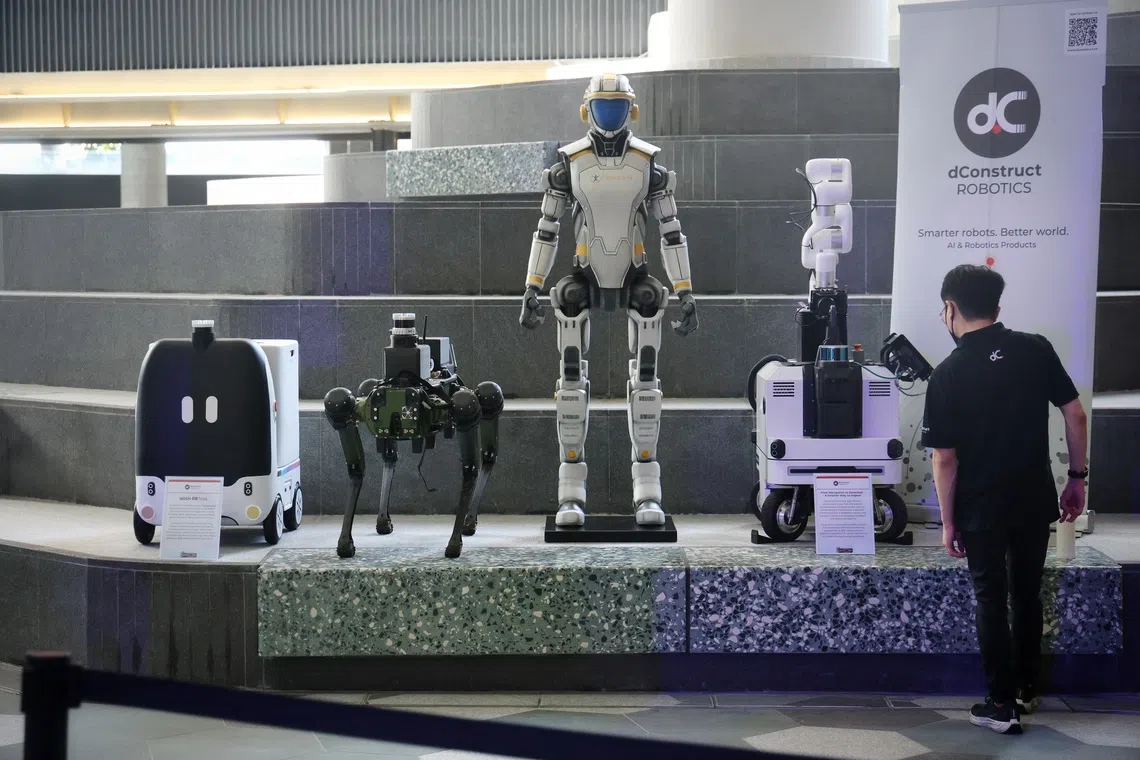
dConstruct is working on humanoid robotics under a strategic partnership with Texas-based Persona AI.
ST PHOTO: JASON QUAH
The challenge the start-up is facing now is how to scale up.
“No matter how advanced Singapore is, there isn’t enough of a local market that can absorb the high research and development costs or pay for it,” said Lim.
Companies in Europe, the US and in China can naturally do better due to the size of their domestic markets.
While Asia, led by China, is the fastest-growing region for the autonomous mobile robots market. Europe holds the largest market share at around 35 per cent. North America represents the largest regional market for last-mile autonomous delivery robots.
Hence, the start-up has a global expansion plan. It has an R&D team in Canada, and is setting up offices in Germany, the US and Japan. It is also growing its workforce, which now stands at 75, in Singapore.
dConstruct recently announced the successful close of its US$125 million Series A funding to scale up commercial deployment of its robots, research and development, and build its massive 42,000 sqm global headquarters, dC Plus, at the Punggol Digital District (PDD).
Its robots will be deployed at PDD, Singapore’s first public-space test site where multiple operators can run robots simultaneously in a mixed-use environment.
To overcome its financial constraints, dConstruct might launch an initial public offering or seek a merger with, or acquisition by, another company.
“We need to be able to have enough financial muscle in the long run… (to have) a share in the global market.”

