


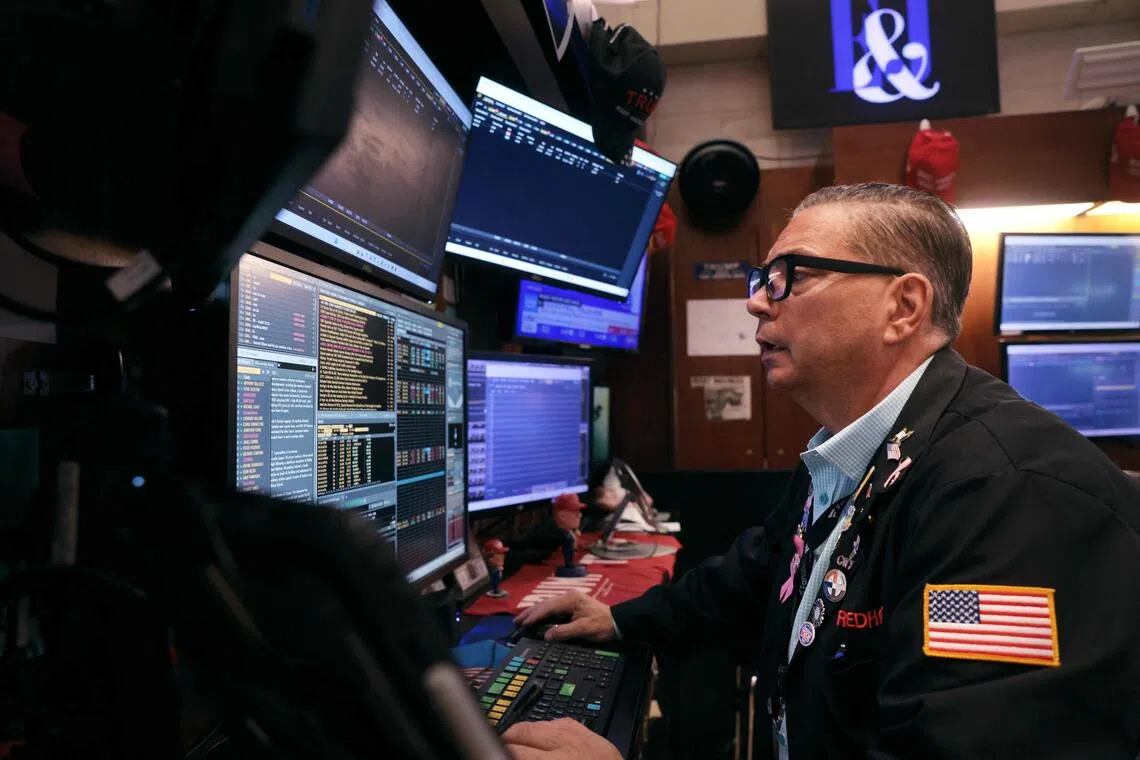
NEW YORK – US stocks ended down on Sept 10 after producer price data for August and surging oil prices stoked worries the Federal Reserve will hike interest rates next week, while climbing Treasury yields made stocks less attractive.
Heavyweight chipmakers lost ground, with Nvidia down 2.3 per cent and Micron Technology losing 4.7 per cent, both weighing on the S&P 500.
Apple rallied 3.6 per cent a day after launching a US$1,999 (S$2,500) iPhone.
With supply routes through both the Strait of Hormuz and the Red Sea disrupted by the US-Israeli war on Iran, Brent crude jumped 6 per cent to US$107 a barrel, adding to inflation worries and fuelling expectations the Fed will raise interest rates at its policy meeting on Sept 16.
Yields on 10-year Treasury notes rose to their highest in nearly three years, while 30-year Treasury yields hit their highest in more than 19 years and two-year Treasury yields reached their highest in more than two years.
“Yields are going up at the short end of the curve because the Fed is probably going to hike in the next couple months. Yields are going up at the long end of the curve because of debt and deficit issues, and sticky inflation,” said Ross Mayfield, an investment strategy analyst at Baird in Louisville, Kentucky.
“Higher yields are a negative for the equity market. They lower valuations and they make it more expensive to operate a business, and more expensive for consumers to exist in the world.”
Data on Sept 10 showed the US producer price index (PPI) increased in line with expectations in August on a monthly basis amid a rebound in the cost of energy products. Investors will pay close attention to August consumer price data on Sept 11.
The S&P 500 declined 0.58 per cent to end the session at 7,591.75 points.
The Nasdaq declined 0.65 per cent to 26,081.73 points, while the Dow Jones Industrial Average declined 0.6 per cent to 52,064.10 points.
The S&P 500 has lost 2 per cent in the past four sessions, its deepest four-day loss since June.
Nine of the 11 S&P 500 sector indexes declined, led lower by materials, down 1.45 per cent, followed by a 0.91 per cent loss in information technology.
Volume on US exchanges was relatively heavy, with 15.1 billion shares traded, compared to an average of 14.9 billion shares over the previous 20 sessions.
Traders now see a 70 per cent chance the Federal Reserve will raise interest rates by at least 25 basis points next week, up from about 64 per cent before the Sept 10 report, the CME FedWatch tool showed.
Following recent declines, the S&P 500 is down nearly 3 per cent from its record high close on Aug 13, and it remains up 11 per cent in 2026.
The S&P 500’s recent decline, coupled with a strong earnings outlook, has the benchmark trading at 19 times expected earnings, its cheapest since April 2025, when US President Donald Trump’s “Liberation Day” tariff announcements threw global markets into a tailspin.
In Sept 10 trading, Macy’s fell 4.7 per cent. The struggling department-store operator raised its annual forecasts, but not by enough to impress investors.
American Eagle Outfitters dropped 14 per cent to its lowest since October as the apparel maker reiterated its annual comparable sales forecast amid choppy discretionary spending.
Declining stocks outnumbered rising ones within the S&P 500 by a 2.0-to-one ratio.
The S&P 500 posted eight new highs and 28 new lows; the Nasdaq recorded 44 new highs and 215 new lows. REUTERS

