


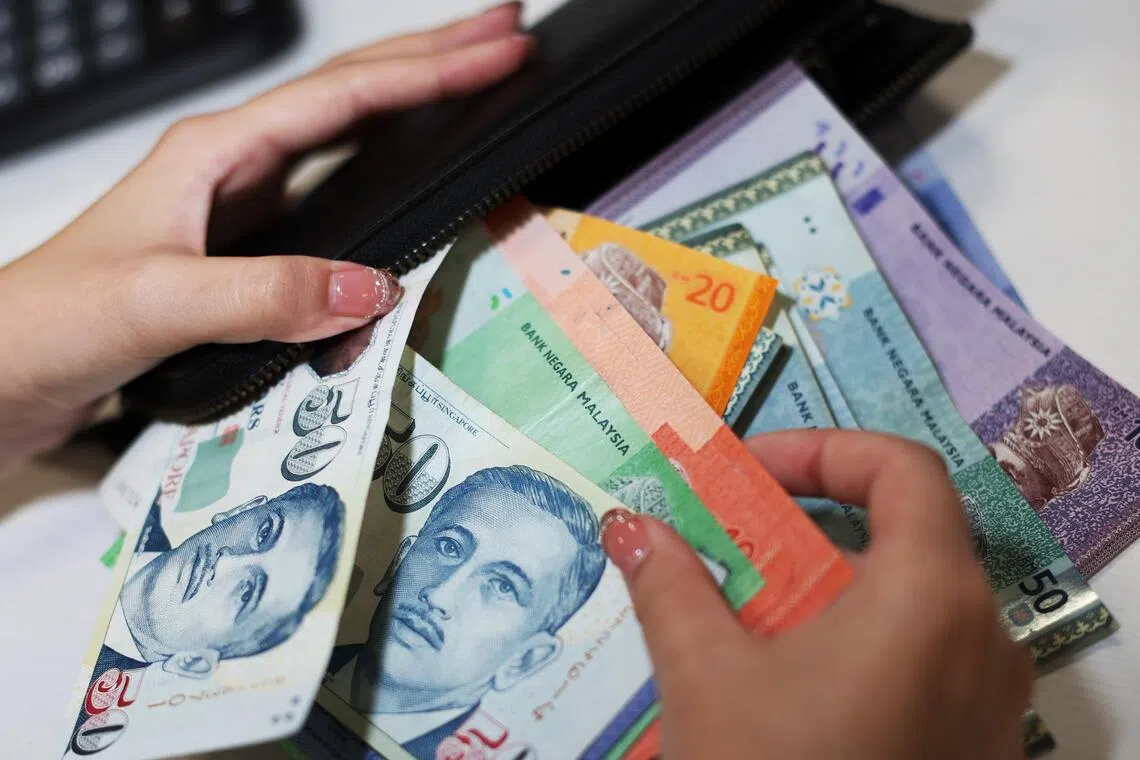
SINGAPORE – The ringgit’s recent decline – falling to a 10-month low versus the Singapore dollar on Sept 9 – is welcome news for some Singaporeans, who say they may spend more across the Causeway as their dollar stretches further.
Retiree Christine Lee-Chan, 81, said the favourable exchange rate could see her travelling more frequently to Penang, where she plans to enjoy the local cuisine and buy more souvenirs and snacks to bring home.
She added that she does not typically carry ringgit in cash, preferring to pay with a multi-currency card when she is there.
But while consumers are eager to capitalise on the favourable exchange rate, the ringgit could remain under pressure against the Singdollar in the coming weeks amid uncertainty over Malaysia’s fuel subsidy bill as well as higher global yields.
The ringgit weakened to 3.22 against the Singdollar on Sept 9, driven by foreign fund outflows from Malaysian assets and broader risk-off sentiment.
It gained 3.77 per cent against the Singdollar in 2025, but has weakened 1.86 per cent so far in 2026.
Analysts said the recent weakness reflects broader risk-off sentiment, foreign fund outflows and uncertainty over the government’s fuel subsidy plans, rather than a deterioration in Malaysia’s economic fundamentals.
At the same time, the Singdollar has its own sources of support, with the Monetary Authority of Singapore (MAS) having tightened monetary policy twice in a row in 2026.
The Republic’s strong domestic growth has also enabled MAS to maintain a policy of allowing the Singdollar to appreciate against its trade partners’ currencies.
OCBC foreign exchange strategist Chris Wong said the ringgit’s recent weakness looked “more like a near-term market adjustment”.
Higher oil prices, firmer US Treasury yields and broader risk-off sentiment have weighed on regional currencies, while a recent sell-off in Malaysian government securities has hurt sentiment towards the ringgit, he said.
Higher US Treasury yields can weigh on emerging-market currencies like the ringgit by making US assets relatively more attractive.
“Domestic fundamentals remain relatively supportive, with growth, investment and the external sector still holding up,” Wong added.
Zavier Wong, market analyst at trading platform etoro, said uncertainty over how the Malaysian government will fund its fuel subsidy plans has contributed to foreign outflows from the country’s assets.
“The subsidy bill is what’s pulling money out of Malaysian equities right now because there’s an element of uncertainty there,” he said.
He noted that the Malaysian government is restoring the monthly quota under its targeted fuel subsidy scheme at a time when oil prices remain elevated, raising questions among investors over the eventual cost and how it will be funded.
“What we’re seeing play out here is simply investors pricing in the uncertainty until the government tells them where that money’s coming from,” Wong added.
Hence, the ringgit is expected to remain under pressure until Malaysia unveils its Budget on Oct 9, when the government is expected to provide greater clarity on how the subsidies will be funded.
“Once that number’s public, the market can then move beyond a guess,” Wong said.
He noted that some of the funding could come from additional bond issuance, adding that investors would be watching the impact on Malaysia’s debt burden.
Malaysia has a statutory debt ceiling of 65 per cent of gross domestic product, which limits the amount of certain federal government debt that can be outstanding.
“It will be especially important to watch how far this pushes the statutory debt load towards its 65 per cent ceiling,” added Wong. “A credible funding plan should draw some foreign funds back to Malaysian assets.”
Trading platform Saxo’s sales trader Sean Teo said the ringgit’s weakness against the Singdollar also reflects strength in Singapore’s currency, which has benefited from safe-haven flows and the MAS’ tighter monetary policy stance.
“In the current environment of heightened global uncertainty, Singdollar and Singapore-based assets have become relatively more attractive given Singapore’s political stability and strong fiscal position,” he said.
Teo added that MAS remains relatively hawkish as it seeks to guard against inflationary pressures from higher oil prices, while Malaysia’s monetary policy stance remains more geared towards supporting growth.
Concerns over the longer-term outlook for the greenback could also benefit the Singdollar, as investors look for alternatives to US dollar-denominated assets, he said.
“I think the Singdollar would still strengthen in the long term, given its strong regional presence and pro-business policies,” Teo added.
“However, global uncertainties and high oil prices could create some volatility along the way, as Malaysia stands to benefit from higher energy prices as an oil producer.”
For Malaysians working in Singapore, however, the weaker ringgit may not affect how much they send home for now.
Asrul Basri Azmi, 40, a business development manager based here, said: “It hasn’t come to a point where I have to make huge adjustments to my expenses here to make up the difference.”
He sends money to Malaysia about twice a month to meet financial commitments there.
“I will still remit the same amount in Singapore dollars as planned, as long as the exchange rate does not fall below RM3 to S$1, since my commitments in Malaysia are fixed in ringgit,” he added.

