


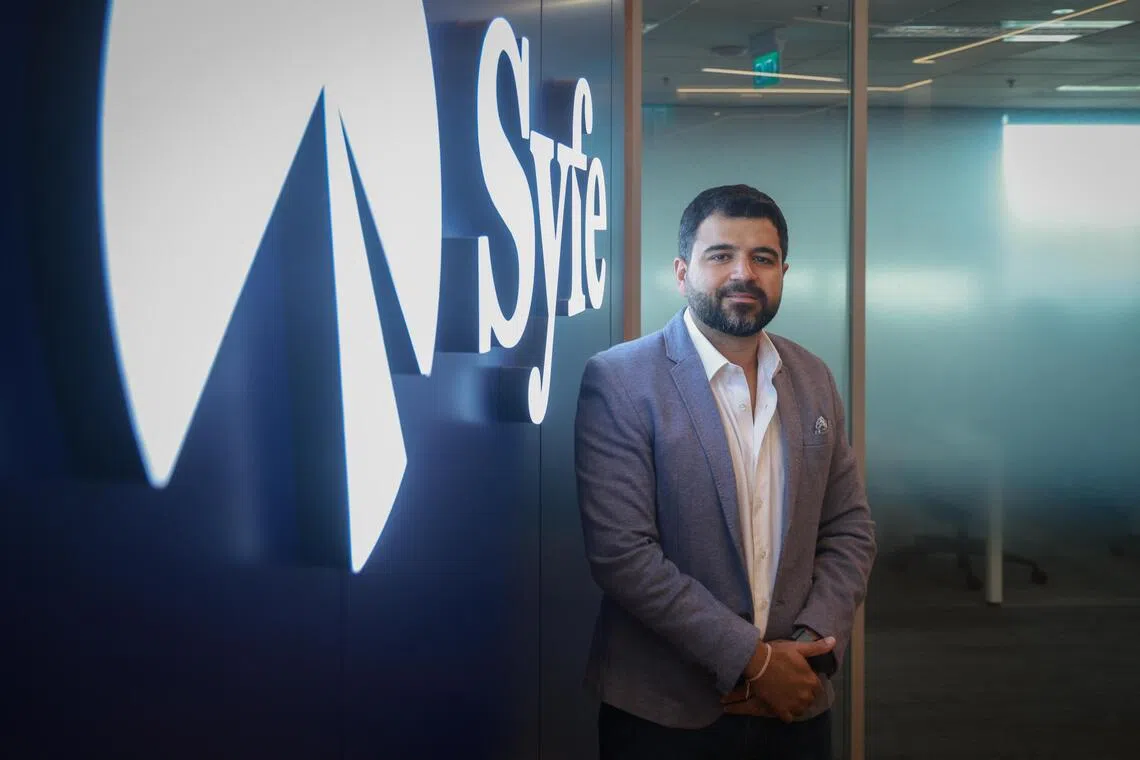
SINGAPORE – Investing carries risks, but not investing at all is a guaranteed way to lose money, warns Dhruv Arora, chief executive of digital wealth management platform Syfe, who points to the steady erosion inflation inflicts on the real value of savings.
For example, he said, $100 today could be worth just $98 a year from now. While 2 per cent may not seem significant, the impact compounds over 10 or 20 years, potentially reducing nearly half of the money’s purchasing power. In two decades, $100 left untouched could effectively be worth only $45 to $50.
“What hasn’t changed is that inflation is going to be there, the cost of living is going to increase – and not investing is a bigger risk than investing,” Arora told The Straits Times at Syfe’s office at Manulife Tower in Cross Street.
His view is that Singapore sits atop a vast pool of low-yield, idle cash, and the next major productivity gain in finance will come from putting more of this wealth to work.
About $339 billion was held in savings deposits across the Singapore banking system in May, according to the Monetary Authority of Singapore, much of which earns minimal base rates, he said.
But historically, across parts of the industry, accessing higher yields has often meant navigating complex terms, lock-ups or unfamiliar financial mechanics. Many consumers equate “savings” with safety and “investing” with volatility, making them reluctant to bridge the gap on their own.
Achieving the next leap depends on building enough trust in the underlying infrastructure of digital finance for people to feel comfortable keeping their liquidity continuously productive, Arora said.
It is also key that they trust that the product is right for them, not just what someone is incentivised to sell, he noted, adding that Syfe’s wealth advisers operate on a non-commission structure. This means their guidance focuses on client goals rather than sales targets or product pushing.
Syfe’s numbers suggest growing customer confidence. Across its three markets – Singapore, Hong Kong and Australia – the platform serves more than 400,000 investors. In Singapore alone, roughly 8 per cent of adults use the platform to manage and grow their money, according to Syfe.
The Singapore-founded firm’s assets under management (AUM) increased to more than US$10 billion (S$12.75 billion) in 2025, with Singapore AUM growing 50 per cent year on year. Syfe does not share user or AUM figures by market.
Launched in 2019, the company turned group-level EBITDA – which stands for earnings before interest, taxes, depreciation and amortisation – positive across its operating markets for the first time in the fourth quarter of 2025.
Bridging the gap between savings and investing
Arora sees an opportunity to close the gap between savings and investing by making invested cash instantly accessible.
According to a July survey of more than 400 Syfe users, when asked about cash management products, nearly half said that having access to their money at any time mattered most.
Arora said the firm is working to further shrink the time gap between customers selling assets and receiving the proceeds.
Syfe customers currently receive cash proceeds from the sale of US market securities within one business day, while transactions in the Singapore, Hong Kong and British markets are settled within two business days.
“Fast forward five years from now, money should be moving instantly,” Arora said.
Potential downsides
Still, all investments come with risks, and investors should weigh their risk appetite and horizon accordingly.
Moving savings from an eligible bank deposit into an investment product means the invested money will generally no longer be covered by the Singapore Deposit Insurance Corporation deposit insurance of up to $100,000.
Syfe said it is transparent about the underlying assets in any investment product and the risks involved.
“We don’t call any investment solution a zero-risk product. We call it a very low-risk product. There is clearly risk involved,” Arora said.
Customers who are low-risk or risk-averse would typically go for money market funds – mutual funds or unit trusts that pool cash from investors to buy short-term, high-quality debt such as government T-bills and corporate paper – or cash products.
Syfe’s user base spans ages 18 to over 90, demonstrating steady engagement across its products regardless of age.
Younger and mid-career investors up to age 54 largely focus on long-term wealth building through equities via managed portfolios and brokerage services.
From age 55, users gradually pivot towards cash products – a shift that becomes much more pronounced among those aged 60 and older.
Keep dollar-cost averaging
When asked how investors should balance higher returns with capital preservation, Arora said most diversified portfolios tend to recover and grow over the long term for investors who stay invested through volatility and continue dollar-cost averaging.
Dollar-cost averaging is the practice of investing a fixed sum regularly regardless of market conditions. The strategy automatically buys more shares or units when prices are low and fewer when prices are high, lowering the average cost per unit over time.
Arora cited the ongoing Iran war as an example of the importance of staying invested. The S&P 500 fell less than 8 per cent during the initial market turmoil but recovered rapidly. Within about six weeks, the benchmark US index had returned to pre-war levels and then gained nearly 20 per cent from its low, reaching record highs.
Staying on the sidelines during a market recovery could be painful. Data from JPMorgan showed that missing out on the S&P 500’s 10 best days over the past 20 years could wipe out about half of an investor’s total returns compared with staying fully invested.
Building a diversified, balanced portfolio remains key to weathering volatility, Arora said.
An example of such a portfolio would consist of a 60 per cent allocation in global equities via diversified exchange-traded funds, balanced with 25 per cent fixed income, 10 per cent in real estate investment trusts and 5 per cent in gold.
“If people are diversified and they hold for the long term, they will be better off than not investing at all,” Arora said.

