


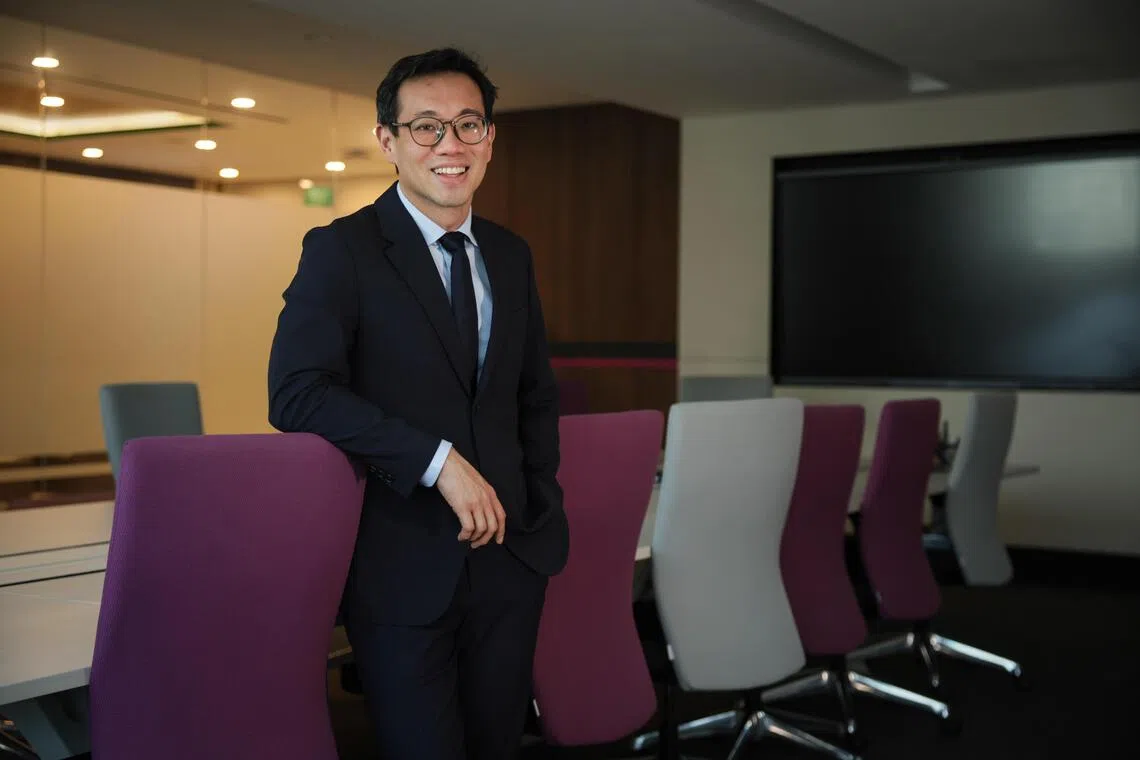
SINGAPORE – Thomson Medical Group (TMG) will increase its focus on building out its specialties beyond obstetrics and gynaecology (O&G) as birth rates here continue to fall, putting a dent in its Singapore business.
Group chief executive Melvin Heng told The Straits Times that although the business was driven by higher revenue intensity and reduced discounts to corporate customers, profitability was hit by higher costs of drugs and consumables, and increased headcount. Depreciation and amortisation were also higher as the group continues to invest in capabilities to support its transformation.
Over the past few years, TMG has been expanding its services beyond O&G, a specialisation that it has historically been known for, to include different specialties catering to the needs of families across different life stages.
These include general surgery, gastroenterology, ENT and orthopaedics, which Heng said complement the group’s existing strengths “rather than simply adding services.”
This comes as its core business faces challenges due to Singapore’s falling birth rates over the years, with the total fertility rate sinking to a record low of 0.87 in 2025.
“Singapore’s declining birth rate is clearly part of the longer-term environment for a business with Thomson’s heritage in maternity,” said Heng.
“We remain committed to women’s and children’s health, but our growth is increasingly coming from following patients and families through a much broader range of healthcare needs over their lifetime.”
He added that bringing together the right doctors, clinical capabilities and supporting infrastructure takes time, but the ecosystem has become more established, while the broadened specialty mix has also improved utilisation of its operating theatres.
He added that the transformation has allowed the group to become “a top partner of choice for all major insurers and payors in Singapore”.
Heng also acknowledged that business has been somewhat impacted by the ongoing construction surrounding Thomson Medical Centre for the upcoming North-South Corridor, which has caused some inconvenience for patients and visitors.
He also noted that the incentives for families announced by Prime Minister Lawrence Wong at the recent National Day Rally could positively impact business.
“We welcome the Government’s stronger support for families announced at the National Day Rally. These measures address some of the financial and practical pressures associated with raising children, which is positive for Singapore families.”
But any demographic response will still take time, and therefore TMG’s strategy in Singapore will continue to remain broader than maternity alone, he said.
At the group level, total revenue rose 6.4 per cent year on year to $420.1 million, while its net loss after tax narrowed 40.8 per cent to $27.8 million, down from $47 million a year ago.
Heng said the group has been making investments to upgrade and expand its Singapore and Malaysia businesses, while a portion of its losses is also attributed to the costs of acquiring Vietnam’s FV Hospital in 2024.
“We went into these investments knowing that there would be an impact on earnings before the benefits were fully realised,” Heng said. “There is still more work to do, but the direction of travel is consistent with what we expected as these investments mature and contribute more meaningfully to the group.”
Its Malaysia business was a strong contributor, with revenue from the market rising 19 per cent to $125.3 million and profit increasing almost fivefold to $5.3 million.
While it did not disclose its profitability by individual specialty, TMG said it saw the strongest growth momentum in oncology and other specialist services. This was in part driven by the full-year earnings contribution from its oncology centre, which opened at its Kota Damansara hospital in Selangor state in November 2024.
The group intends to build on the market’s growing position as a medical tourism destination by expanding its hospital’s ability to serve overseas patients through a broader range of specialist services and stronger clinical capabilities.
“This is an area where Malaysia has been building momentum over time, and we see further opportunity to grow that international patient base as our specialist offering deepens,” Heng said.
The group is also developing a massive $5.5 billion mega project in the Johor Bay area, which will include a multidisciplinary hospital and facilities for aged care and assisted living, alongside luxury residences and hospitality offerings.
The ringgit’s appreciation against the Singapore Dollar since the fourth quarter of 2025 also led to a positive translation impact on its Ringgit-denominated assets, he added.
Meanwhile, revenue in Vietnam rose 2.9 per cent to $101.3 million on higher patient volumes, although the weaker Vietnamese dong weighed on growth by reducing its revenue contribution. Segment profit also rose 10.3 per cent to $3 million.
Heng said TMG’s FY2026 financial performance gives the group a stronger operating base with operating cash generation strengthened and financing costs declined.
“The focus ahead is to keep building on that momentum, deepen the capabilities we have established, and continue translating the strategy into stronger performance over time.”
Shares of TMG closed flat on Aug 28 at 5.4 cents.

